
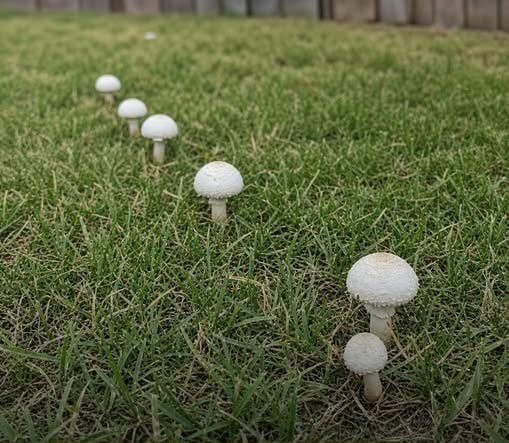
White Mushrooms Suddenly Appearing in Your Lawn? Here’s What They May Be Telling You
Those Mushrooms Are Usually a Sign of Something Happening Below the Surface
You walk outside one morning and notice several white mushrooms scattered across the lawn.
By the following day, there may be even more.
They can seem to appear overnight, sometimes forming clusters in places where the grass looked completely normal only hours earlier.
For many homeowners, the first reaction is concern.
Are the mushrooms damaging the lawn?
Do they mean the soil is unhealthy?
Or are they warning that something larger is happening underground?
Mushrooms Are Only the Visible Part of a Larger Fungal Network
The mushroom visible above the grass is only one part of the organism.
Much of the fungal activity exists below the soil or inside decaying organic material.
When environmental conditions become favorable, the fungus can produce mushrooms above ground.
That is why they sometimes seem to appear so suddenly.
The fungus may have already been present long before the first mushroom became visible.
Moisture Is One of the Biggest Triggers
White mushrooms often appear after periods of rain or frequent watering.
Fungi generally thrive where moisture remains available long enough for them to grow.
A lawn that stays consistently damp can therefore create favorable conditions.
This does not automatically mean there is a serious problem.
Sometimes the weather alone is enough to explain the sudden appearance.
Overwatering Can Encourage Repeated Growth
If mushrooms keep returning even when rainfall has been limited, irrigation habits may be worth examining.
Watering too frequently can keep the upper soil layers damp for extended periods.
That creates conditions fungi often favor.
Reducing unnecessary watering may make the lawn less hospitable to repeated mushroom growth.
Poor Drainage Can Create the Same Environment
Some areas of a lawn naturally hold more water than others.
Low spots may remain wet long after the rest of the yard has dried.
Heavy or compacted soil can also slow drainage.
If mushrooms repeatedly appear in exactly the same damp section, excess moisture below the surface may be part of the explanation.
The Real Food Source May Be Underground
Mushrooms do not simply appear because grass is present.
Many fungi feed on decomposing organic material.
That material may be completely hidden beneath the lawn.
Old tree roots, buried wood, dead plant material and other organic debris can all become food sources.
Old Tree Roots Can Keep Feeding Fungi for Years
A tree may have been removed long before mushrooms begin appearing nearby.
The stump may even be gone.
But an extensive root system can remain underground.
As those roots gradually decay, fungi help break them down.
Mushrooms above the lawn can therefore reveal where buried roots are decomposing beneath the grass.
Buried Wood Can Have the Same Effect
Construction debris, pieces of lumber or old landscaping material can sometimes remain beneath a yard.
As the wood breaks down, fungi may colonize it.
The homeowner sees mushrooms.
The actual food source may be several inches or more below the surface.
Mulch Can Encourage Mushroom Growth Too
Mulch is organic material designed to decompose gradually.
That process naturally involves fungi.
When mulch is close to a lawn, fungal activity can sometimes extend into surrounding areas.
This is generally part of normal decomposition rather than evidence that something is wrong.
In Many Cases, Mushrooms Mean the Soil Is Biologically Active
Fungi play an important role in soil ecosystems.
They help break down dead organic material and recycle nutrients.
That means mushrooms are not automatically a sign of unhealthy soil.
Quite often, they simply indicate that decomposition is taking place.
The Mushrooms Usually Are Not Attacking the Grass
When mushrooms appear among otherwise healthy green grass, the fungus may simply be feeding on buried organic material.
The mushrooms themselves are often temporary.
They may disappear when the soil dries or weather conditions change.
Removing the visible mushrooms does not necessarily eliminate the underground fungal network.
Repeated Mushrooms Can Still Offer Useful Information
A single short-lived cluster after heavy rainfall may not reveal much.
But mushrooms that repeatedly appear in the same location can tell you something about that particular area of the yard.
There may be persistent moisture.
There may be buried organic matter.
There may be drainage issues.
Or there may be an old root system decomposing underground.
Compacted Soil Is Worth Considering
Soil becomes compacted when its particles are pressed tightly together.
This can happen from repeated foot traffic, vehicles, heavy equipment or naturally dense soil conditions.
Compaction reduces the spaces through which air and water normally move.
As a result, water may remain near the surface longer.
That damp environment can contribute to mushroom growth.
Look at the Grass Around the Mushrooms
The condition of the surrounding lawn can provide useful clues.
If the grass is green, healthy and growing normally, the mushrooms may simply be part of ordinary fungal activity.
If the surrounding grass is yellowing, thinning or dying, however, it may be worth taking a closer look.
Dying Grass Changes the Picture
Mushrooms appearing alongside declining turf may indicate that more than ordinary decomposition is occurring.
The underlying problem could involve excessive moisture, damaged roots or another soil issue.
The mushrooms themselves may not be causing the decline.
They may simply be appearing because the same conditions affecting the grass also favor fungi.
A Declining Tree Nearby Deserves Attention
If mushrooms suddenly appear around the base of a tree that is also losing branches, thinning or showing other signs of decline, the situation deserves closer inspection.
Fungi can grow on dead or decaying roots.
That does not automatically identify the cause of the tree’s decline.
But the combination of fungal growth and a weakening tree can be important information.
Location Matters
Where the mushrooms appear can help narrow the possibilities.
A cluster around an old stump may suggest decaying wood.
Mushrooms in a constantly wet depression may point toward drainage problems.
Growth beside a mulch bed could be connected to decomposing landscape material.
A line of mushrooms across the lawn may even follow an underground root.
Sudden Appearance After Rain Is Common
Warm temperatures combined with wet soil can cause mushrooms to emerge quickly.
That is why homeowners often notice them after several rainy days.
They may appear overnight and disappear almost as quickly when the weather becomes dry.
This temporary cycle is common.
Removing the Mushroom Does Not Remove the Fungus
Picking or mowing down the visible mushroom may improve the appearance of the lawn.
But it usually removes only the fruiting structure above ground.
The fungal network beneath the soil can remain.
If moisture and organic material are still available, mushrooms may return later.
The Better Approach Is to Look at the Conditions
Instead of focusing entirely on killing mushrooms, it can be more useful to ask why they are appearing.
Is the lawn staying wet too long?
Are sprinklers running more frequently than necessary?
Is there an old stump nearby?
Was a tree removed from that location years ago?
Could buried wood or mulch be decomposing?
Watering Habits Are Easy to Check
Watch how quickly the lawn dries after irrigation.
If the soil remains soggy for long periods, watering may be excessive.
Repeated shallow watering can also keep the surface continually damp.
Adjusting irrigation may reduce conditions that encourage mushroom production.
Drainage Problems May Need More Attention
If water consistently pools in one area after rain, changing the watering schedule may not solve the problem.
The shape of the yard or condition of the soil may be causing water to collect.
Persistent wetness can affect grass roots as well as encourage fungi.
In that situation, improving drainage may benefit the lawn more broadly.
Organic Matter Is Not Necessarily Bad
Homeowners sometimes become alarmed when they hear that mushrooms are feeding on decaying material.
But decomposition is a normal part of healthy soil.
Dead roots, leaves and plant material have to break down somehow.
Fungi are among the organisms that perform that work.
Mushrooms Can Actually Be Evidence of Nutrient Recycling
As fungi break down organic material, nutrients are gradually returned to the soil ecosystem.
That process supports other organisms and plants.
So the presence of fungi alone should not automatically be treated as a lawn disease.
Not Every White Mushroom Is the Same
Many mushroom species can appear in lawns, and identifying them accurately from color alone is difficult.
Two mushrooms that both look white may belong to completely different species.
That is one reason appearance alone should not be used to decide whether a mushroom is harmless or safe to eat.
Do Not Assume Lawn Mushrooms Are Edible
Wild mushrooms can be difficult to identify correctly.
Some toxic species can resemble edible ones.
For that reason, mushrooms growing spontaneously in a lawn should not be eaten unless they have been reliably identified by someone qualified to do so.
Children and Pets Are Another Reason to Remove Them
Even when mushrooms are not harming the grass, homeowners may choose to pick them if young children or pets use the yard.
The goal is not necessarily to cure the lawn.
It is simply to reduce the chance that someone or an animal might ingest an unidentified mushroom.
Use Gloves and Dispose of Them
If you decide to remove visible mushrooms, they can usually be picked or raked from the lawn.
Wearing gloves is a reasonable precaution, especially when the species is unknown.
Removing them before they release additional spores may also reduce some visible spread, although fungal spores are naturally widespread outdoors.
Mowing May Make Them Disappear Temporarily
A mower can easily knock down lawn mushrooms.
But again, this addresses appearance rather than the underlying cause.
If the soil remains moist and the food source remains underground, another flush of mushrooms can appear later.
Fungicides Are Often Not the First Answer
Because many lawn mushrooms are simply decomposers, treating the entire lawn with chemicals may not address what is actually encouraging them.
Changing moisture conditions and removing obvious sources of buried decaying material may be more useful when repeated growth becomes annoying.
Sometimes the Best Response Is Simply to Wait
If the grass looks healthy and the mushrooms appeared after rain, they may disappear naturally as conditions dry.
No major intervention may be necessary.
A few days of sunshine can sometimes change the appearance of the lawn completely.
But Persistent Growth Is Worth Observing
Take note of where the mushrooms return.
Look for patterns.
Do they follow the former location of a tree?
Do they appear only after irrigation?
Is the soil constantly wet?
Are they growing around unhealthy plants?
The Pattern Often Tells More Than the Mushroom
The mushroom itself is only a clue.
The surrounding environment tells the larger story.
Healthy grass, recent rain and a few temporary mushrooms usually present a very different situation from recurring mushrooms beside a declining tree in saturated soil.
Check for Old Landscaping History
Sometimes the explanation lies years in the past.
A previous homeowner may have removed a tree.
A garden bed may once have occupied the area.
Wood may have been buried during construction.
Those forgotten materials can remain underground long enough to support fungal growth years later.
Mushrooms Can Reveal Hidden Decomposition
This is one of the most interesting things about seeing them in a lawn.
The surface may look clean and uniform.
Below it, roots and other organic material may be slowly breaking down.
The mushrooms are sometimes the only visible indication that the process is happening.
They Can Also Reveal Where Water Collects
If one patch of lawn repeatedly produces mushrooms while the rest remains clear, compare the soil moisture in that area.
The spot may receive runoff from a roof, sprinkler or slope.
It may simply drain more slowly than the surrounding ground.
Correcting that moisture imbalance can improve both the appearance and health of the lawn.
Healthy Soil Contains Fungi
A perfectly fungus-free lawn is not necessarily a realistic or desirable goal.
Soil naturally contains fungi, bacteria and countless other organisms.
They interact with plant roots and decomposing material continuously.
Mushrooms are simply one of the few parts of that underground ecosystem that homeowners occasionally get to see.
When Should You Be More Concerned?
Repeated mushrooms alone do not necessarily indicate danger.
But pay closer attention if they appear alongside other warning signs.
These can include persistent waterlogging, rapidly declining grass, weakened trees, obvious root decay or repeated fungal growth around damaged woody plants.
In those circumstances, investigating the underlying cause can be worthwhile.
A Tree Professional May Be Helpful in Some Cases
If mushrooms are growing around a mature tree that appears unstable or unhealthy, a qualified tree professional can assess the tree and its root system.
The concern is not simply the mushrooms.
It is whether significant root or wood decay may also be present.
For Ordinary Lawn Mushrooms, Start Simple
Check the watering schedule.
Allow overly wet areas to dry when possible.
Improve airflow and drainage where practical.
Remove visible mushrooms if children or pets may reach them.
And observe whether the grass itself remains healthy.
The Mushrooms May Be Telling You More Than You Think
White mushrooms scattered across a lawn can certainly be annoying.
But they can also provide useful information.
They may reveal excess moisture.
They may mark the location of buried wood or old roots.
They may show where drainage is poor.
Or they may simply demonstrate that fungi are doing their normal work in healthy soil.
Look Below the Surface Before Assuming the Worst
The sudden appearance of mushrooms does not automatically mean your lawn is diseased.
Often, the explanation is far less alarming.
Moisture and decomposing organic matter have created the conditions fungi need to produce mushrooms.
Once those conditions change, the visible growth may disappear.
But Do Not Ignore the Rest of the Yard
If the mushrooms are accompanied by dying grass, unusually wet soil or a tree that appears to be declining, take the combination seriously enough to investigate.
The mushrooms may not be causing the problem.
They may simply be the most visible clue that something beneath the lawn has changed.
Sometimes the Lawn Is Showing You Its Hidden Ecosystem
What looks like a strange overnight invasion can actually be part of a completely natural process.
Below the grass, fungi are constantly interacting with moisture, roots, wood and soil.
Most of that activity remains invisible.
Then one morning, white mushrooms appear.
Instead of seeing them only as an eyesore, consider them a message from beneath the surface.
The question is not simply how to remove them.
The more useful question is what conditions allowed them to appear in the first place.