
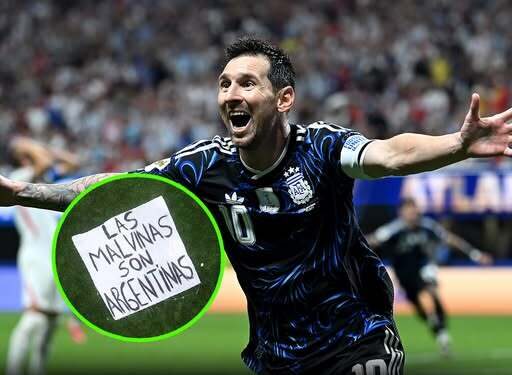
Argentina Could Face FIFA Action After Falkland Islands Banner Appears Following England Victory
Post-Match Celebration Raises Questions Over Possible Sanctions
Argentina could face disciplinary action from FIFA after several players displayed a banner supporting the country’s claim to the Falkland Islands following their World Cup semi-final victory over England.
The banner appeared during celebrations after Argentina secured a place in Sunday’s final with a dramatic comeback against the English side. It carried the message “Las Malvinas son Argentinas”, which translates as “The Falklands are Argentine”.
The display may attract scrutiny because FIFA regulations prohibit players and teams from using football matches to promote political messages. Although no official response had been issued at the time of writing, the incident has already created uncertainty over whether Argentina or individual players could be sanctioned.
The moment followed an emotionally intense match shaped not only by the importance of reaching a World Cup final but also by the difficult political history shared by the two countries.
Argentina Complete a Late Comeback Against England
England moved ahead midway through the second half through Anthony Gordon, putting Argentina under pressure at a critical stage of the semi-final.
The reigning world champions responded immediately. After conceding, Argentina began to control possession, increase the tempo of their attacks and create repeated opportunities around the England goal.
The pressure continued as the match entered its final stages. Argentina eventually scored twice late in the game, overturning England’s advantage and securing a place in the final.
The comeback sparked major celebrations among the Argentine players and supporters. During those scenes, several members of the team raised the large banner carrying the Falkland Islands message.
The display quickly became one of the most discussed moments after the final whistle, shifting some attention away from the sporting result and toward the possibility of FIFA intervention.
Historical Tension Formed Part of the Match’s Backdrop
The political sensitivity surrounding the Falkland Islands had already formed part of the build-up to the semi-final. The dispute remains deeply significant in Argentina and continues to influence the relationship between the two nations.
The Falkland Islands are a British overseas territory located approximately 8,000 miles from the United Kingdom. Argentina refers to the islands as the Malvinas and continues to maintain its claim over them.
On April 2, 1982, Argentine forces seized the islands. Britain responded by sending a major naval task force to recover the territory.
The conflict continued for 74 days and resulted in substantial loss of life. A total of 255 British military personnel were killed, along with 649 Argentine troops and three civilians.
British ground forces later advanced across East Falkland. The Argentine garrison in Port Stanley ultimately surrendered, bringing the military confrontation to an end.
Although more than four decades have passed since the war, the issue remains emotionally and politically important, particularly in Argentina. That history added another layer of meaning to a World Cup semi-final already carrying enormous sporting significance.
Banner Brings Political Messaging Rules Into Focus
The message shown by the Argentina players may place the national team at risk of punishment because FIFA maintains strict rules concerning political expressions during matches and official competition activities.
Football’s governing body generally seeks to prevent players and teams from using the sport as a platform for political statements. Disciplinary measures can be imposed when messages displayed on clothing, equipment, banners or other materials are considered political.
FIFA’s official regulations state: “For any offence the player and/or the team will be sanctioned by the competition organiser, national football association or by FIFA.”
The wording leaves open several possible forms of action. Any punishment could potentially be directed at the players involved, the national team, the Argentine Football Association or a combination of those parties.
However, no decision had been announced at the time of writing. FIFA had not publicly confirmed whether it would open disciplinary proceedings, issue a fine or take any other action connected to the banner.
The absence of an immediate response means Argentina’s position remains uncertain as preparations begin for the World Cup final.
Argentina Were Previously Fined Over the Same Message
The latest incident is not the first time Argentina’s national team has displayed a banner containing the same statement.
In 2014, the Argentine Football Association was fined $27,000 after players presented a banner carrying the same wording before a friendly match against Slovenia.
That earlier punishment may increase expectations that FIFA will examine the semi-final celebration closely. The repetition of an identical message creates a clear comparison between the two incidents, even though the circumstances and competitions were different.
The 2014 case demonstrated that political messaging related to the Falkland Islands can result in financial penalties. It also established that FIFA was willing to act when the issue was brought into a football setting.
Whether the latest display produces a similar outcome will depend on FIFA’s assessment of the incident and the application of its competition rules.
The timing may also be significant, as the banner appeared immediately after one of the tournament’s most important matches and only days before Argentina are due to compete for the title.
Argentina’s Vice-President Responds After the Match
Argentina’s vice-president, Victoria Villarruel, publicly addressed the semi-final and the Falkland Islands dispute after the victory.
She wrote on X: “It wasn’t just another match. The Falklands are Argentine. They banned bringing them to the stadium and forgot that we carry them in our blood and our hearts.”
Her comments reinforced the political meaning attached to the encounter by some figures in Argentina. They also indicated that the dispute had remained prominent throughout the build-up and the match itself.
Before the game, Villarruel had described the contest as being ‘about putting the invaders in their place’.
Those remarks contributed to the intense atmosphere surrounding the semi-final and highlighted how the historical conflict continued to influence public discussion around the sporting event.
The banner raised by the players after the final whistle echoed that wider sentiment and ensured the political issue remained central to the post-match conversation.
A Major Sporting Victory Overshadowed by Disciplinary Concerns
Argentina’s performance against England represented another significant achievement for the reigning world champions. After falling behind in the second half, the team showed composure and attacking determination to reverse the score.
The late goals secured a dramatic victory and placed Argentina within one match of another World Cup title.
However, the post-match banner has complicated the celebrations. Instead of focusing entirely on the comeback and the upcoming final, Argentina must now wait to learn whether football’s governing body will respond.
A disciplinary process could place additional attention on the team during its final preparations. Even a financial penalty would keep the controversy active in the days leading up to the tournament’s decisive match.
Any more serious sanction would create further uncertainty, although no indication had been given that FIFA was considering a specific punishment.
Until an official announcement is made, the possibility of action remains unresolved.
Final Against Spain Scheduled for Sunday
Argentina will now face Spain in the World Cup final in New Jersey on Sunday, July 19.
The match offers Argentina the opportunity to retain its status as world champion after surviving a difficult semi-final against England.
Spain will stand between Argentina and another major international trophy, while the South American side enters the final carrying both the momentum of a late comeback and the distraction created by the banner controversy.
The Argentine players will need to turn their attention quickly toward the challenge ahead. A World Cup final requires intense preparation, and the limited time between matches leaves little room for outside issues.
At the same time, officials from the Argentine Football Association may be required to address questions about the display if FIFA decides to investigate.
The central issue will be whether the banner is formally judged to have violated the competition’s prohibition on political messaging and, if so, what sanction is considered appropriate.
FIFA Decision Still Awaited
For now, no official disciplinary outcome has been confirmed. FIFA has yet to publicly respond to the banner or announce whether a formal case will be opened.
The previous $27,000 fine from 2014 provides a relevant precedent, but it does not guarantee that the same punishment will be applied in this instance.
The governing body may consider the setting, the timing, the players involved and the visibility of the display before reaching a decision.
Whatever the eventual outcome, the incident has shown that the Falkland Islands dispute remains capable of entering the sporting arena decades after the 1982 conflict ended.
Argentina’s victory over England ensured the team would compete in Sunday’s final, but the celebrations also created a new issue that may follow the squad into the tournament’s closing days.
As Argentina prepare to meet Spain in New Jersey, attention will remain divided between the pursuit of the World Cup trophy and the possibility of disciplinary action over the politically charged banner.