
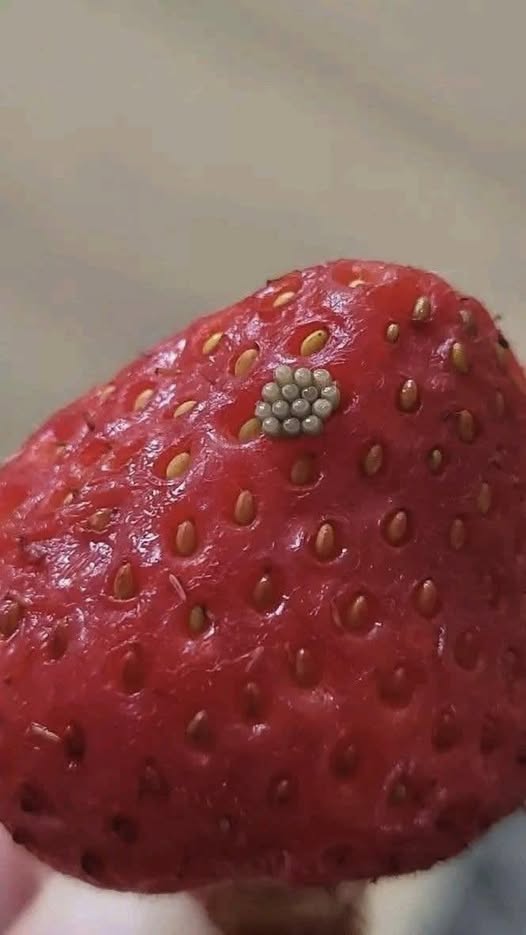
What the Tiny White Larvae Found in Strawberries Really Mean
Why These Tiny Creatures Appear and Whether Strawberries Are Still Safe to Eat
Viral social media videos have changed the way some people look at strawberries. In many of these clips, fresh berries are placed in a bowl of salt water, and tiny white creatures begin moving out of the fruit shortly afterward.
The sight can be surprising, especially for anyone who assumed the inside of a strawberry was completely free of insects. Some viewers have reacted by throwing away their berries, avoiding strawberries at the grocery store, or deciding that the fruit is no longer safe to eat.
Although the videos may appear alarming, the explanation is much less frightening than the images suggest. The small creatures are larvae from a type of fruit fly known as the spotted wing drosophila.
These larvae can develop naturally inside soft fruit. Their presence may be unpleasant to discover, but it does not mean the strawberry contains a mysterious parasite or a dangerous organism that specifically targets humans.
Why Tiny Larvae Can Be Present Inside Strawberries
The spotted wing drosophila is a fruit fly that lays its eggs inside fruit. Strawberries provide a suitable environment because they are soft, moist, and naturally rich in the material the developing larvae need.
After the eggs are deposited, the larvae begin developing within the fruit. Because they remain inside the strawberry, they may not be visible when the berries are purchased, washed, sliced, or served.
Their pale color and extremely small size can also make them difficult to notice. In many cases, a strawberry may look completely normal from the outside even when a larva is present beneath the surface.
This is one reason the saltwater videos attract so much attention. The larvae are usually hidden, so seeing them emerge creates the impression that something unusual or previously unknown has suddenly been discovered.
In reality, small insects and larvae have long existed around fruit. Strawberries grow in natural environments where insects are present, and some fruit flies have developed ways to place their eggs directly inside soft produce.
What Happens During a Saltwater Soak
When strawberries are soaked in salt water, the solution can encourage larvae inside the fruit to move outward. Once they leave the berry, their white bodies become much easier to see against the surface of the water or the red skin of the strawberry.
This process does not create the larvae. The salt does not cause worms to grow inside the fruit, nor does it transform part of the strawberry into a living organism.
The soak simply makes organisms that may already be present more noticeable. Without that step, many people would never see them at all.
That distinction is important because viral clips often focus only on the dramatic moment when the creatures appear. They may not provide enough explanation about what the organisms are or why the solution causes them to emerge.
As a result, viewers can be left with the impression that every strawberry is heavily infested. The videos do not establish that every berry contains larvae, and the appearance of larvae in one batch does not prove that all strawberries will produce the same result.
Why the Discovery Feels So Disturbing
People generally expect fresh fruit to appear clean, familiar, and visually appealing. Finding a moving organism inside something that was about to be eaten can create an immediate feeling of disgust.
That reaction is understandable. Food is closely connected to trust, and anything unexpected can make a familiar item suddenly seem unsafe.
The emotional response can become even stronger when the discovery is shown in a close-up video. A tiny larva that would be difficult to see in normal circumstances can appear much larger and more dramatic when filmed with a camera positioned only inches away.
Repeated viewing can also make the issue seem more common than it may be in an individual person’s kitchen. When similar videos are shared thousands of times, viewers may begin to assume that every package of strawberries contains the same visible activity.
However, an unsettling appearance is not the same as evidence of a health danger. The visual shock of the larvae does not automatically mean that the fruit is harmful to consume.
Are Strawberries Containing These Larvae Dangerous?
Consuming the larvae of the spotted wing drosophila is not known to be harmful to human health. Although many people would prefer not to eat them, their presence is not presented as a sign that the strawberry poses a known danger.
People may have consumed small larvae in fruit without realizing it. Because the organisms can remain hidden inside the berry, they may be swallowed without being seen or noticed.
Most individuals who have eaten strawberries over the years have probably never soaked every berry in salt water or examined each piece under close lighting. The absence of a visible discovery does not necessarily mean that naturally occurring organisms were never present.
The important point is that accidental consumption has not been identified as a harmful event in the information surrounding these larvae. The concern is primarily based on appearance and personal comfort rather than a demonstrated threat to health.
This does not mean people are required to ignore the issue. Anyone who feels uncomfortable can take additional steps to inspect or clean the fruit before eating it.
How Washing Can Help Before Eating
Thorough washing is a practical step for preparing strawberries. Rinsing the berries helps remove material from the surface and gives the person preparing them an opportunity to inspect each piece.
Damaged, overly soft, or visibly spoiled berries can be separated from the rest of the package. The remaining strawberries can then be cleaned before they are eaten or used in a recipe.
Some people may choose to soak strawberries in a saltwater solution because they want to encourage any hidden larvae to leave the fruit. This method can provide reassurance for individuals who have become concerned after watching the viral demonstrations.
After a soak, the fruit should still be handled carefully and washed thoroughly. Salt water can affect the taste if residue remains on the berries.
A person who does not wish to use salt water can still wash the strawberries carefully. The main purpose is to clean the fruit and make it more comfortable to eat.
A Natural Occurrence Rather Than a Sinister Discovery
The word “worms” is often used in descriptions of the viral videos because the larvae have long, pale bodies and move in a wriggling manner. That label can make the discovery sound more dangerous than it is.
These organisms are the immature form of a fruit fly. They are not presented as human parasites, and their development is connected to the fruit rather than the body of the person who eats it.
Understanding this difference can reduce unnecessary fear. The larvae may be unappetizing, but they are part of a natural insect life cycle.
Fresh produce does not develop in a completely sealed environment. Fruit grows where insects, soil, moisture, and other natural elements are present.
Modern food preparation can make produce look perfectly controlled by the time it reaches the table. A discovery like this reminds consumers that fruit is still a natural product, even when it is neatly arranged inside a clean package.
Why Avoiding Strawberries May Be an Overreaction
Some viewers have responded to the videos by saying they will never eat strawberries again. That decision is often driven by the immediate discomfort of seeing the larvae rather than by evidence that the fruit is unsafe.
A more measured response is to understand what was found and decide how to prepare the berries in a way that feels acceptable. Washing, inspecting, or soaking them can address much of the concern without requiring someone to permanently remove strawberries from their diet.
The same discovery can also be viewed differently once the organisms are correctly identified. What initially appears to be a frightening unknown becomes a small fruit fly larva with a clear explanation for how it entered the berry.
Knowledge does not necessarily make the sight appealing. It does, however, help separate a natural occurrence from a genuine danger.
People who remain uncomfortable are free to check their fruit more carefully. The goal is not to dismiss the emotional reaction, but to place it within the correct context.
Keeping Viral Food Videos in Perspective
Social media content is often designed to create a strong reaction within seconds. A bowl of strawberries releasing tiny white larvae is visually powerful and likely to be shared by viewers who feel shocked, disgusted, or curious.
That format can leave little room for a calm explanation. The dramatic discovery may receive far more attention than the basic facts about the spotted wing drosophila and the lack of a known health risk from consuming its larvae.
When food-related videos spread rapidly, it is useful to separate what is visible from what it actually means. Seeing an organism inside fruit does not automatically prove that the food is poisonous, contaminated in a dangerous way, or unsuitable for everyone.
In this case, the larvae developed inside the strawberry because a fruit fly placed eggs there. A saltwater soak made them emerge and become visible.
The event may look disturbing, but it has a straightforward natural explanation. The appearance of the larvae is more alarming than the known risk associated with accidentally consuming them.
Enjoying Strawberries With Greater Confidence
Strawberries can still be enjoyed after the discovery shown in viral videos. Consumers who are concerned can rinse them carefully, inspect them, or use a saltwater soak before eating.
These simple preparation choices allow individuals to respond to the issue without assuming that every berry is dangerous. They also give people more control over what they are comfortable serving or consuming.
The small white creatures are larvae of the spotted wing drosophila, not evidence of a sinister threat. They can remain hidden because they develop inside the fruit and may only become visible when a solution encourages them to move outward.
Accidentally eating them is not known to cause harm. The discovery is mainly unpleasant because it reveals a natural process that usually remains unseen.
By understanding what the larvae are, why they appear, and how strawberries can be cleaned, consumers can make informed choices instead of reacting only to the shock of a viral clip.
The presence of tiny natural inhabitants may change how some people inspect their berries, but it does not need to end their enjoyment of strawberries altogether.