
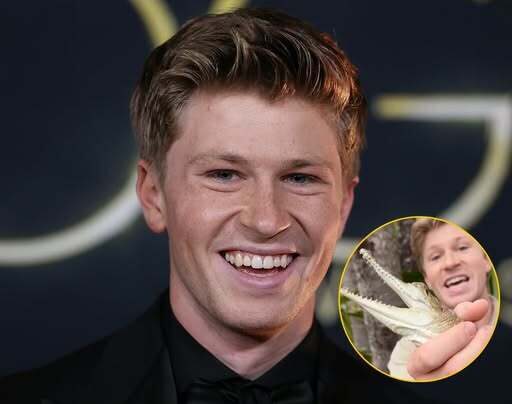
Robert Irwin’s Crocodile Encounter Sparks Fierce Debate Over Risk, Conservation, and His Father’s Legacy
A Routine Feeding Turns Into a Frightening Moment
The roar inside the crocodile enclosure was unmistakable, and the fear surrounding the moment appeared just as real.
What began as a routine crocodile feeding at Australia Zoo suddenly became a tense retreat when the powerful animal lunged forward. Robert Irwin immediately shouted “Bail!” as the keepers moved away from the danger.
The encounter lasted only seconds, but those seconds were enough to ignite a major online reaction. Viewers watched the scene, replayed the crocodile’s movement, and quickly formed sharply divided opinions about what had happened.
Some people viewed the incident as an alarming example of humans taking unnecessary risks around a wild animal. Others saw it as proof that Robert understood the crocodile’s behavior and knew exactly when to end the interaction.
No keeper was harmed during the encounter. However, the frightening footage continued to spread, turning a brief moment inside the enclosure into a much larger debate about animal care, television, public entertainment, and the Irwin family’s approach to conservation.
Viewers Quickly Divide Into Two Camps
The online response was immediate and emotional.
Critics argued that the crocodile should never have been placed in a situation that could be presented as entertainment. They questioned whether dangerous feeding demonstrations encourage audiences to view wild animals as performers rather than powerful creatures that must be respected.
For those viewers, the lunge represented more than a close call. It appeared to symbolize a style of wildlife presentation that they believe depends too heavily on suspense, risk, and dramatic television moments.
Some demanded that Robert face consequences, while others questioned whether the Irwin family’s methods remain appropriate in a world where people increasingly examine how animals are handled in public settings.
Supporters reached a very different conclusion.
They focused on Robert’s immediate response when the crocodile’s behavior changed. He did not remain in place or attempt to extend the encounter. He called for the keepers to leave, and the team retreated without injury.
To his defenders, that reaction demonstrated experience rather than recklessness. They argued that working safely with powerful animals does not mean every interaction will look calm. It means recognizing danger quickly and responding before the situation becomes worse.
The Meaning of Robert’s Warning
The single word Robert shouted became the center of the discussion.
“Bail!” was not a dramatic speech or an attempt to entertain the crowd. It was a direct warning that the feeding needed to stop and that everyone in the enclosure needed to move away.
Supporters interpreted the command as evidence that Robert remained alert throughout the demonstration. He noticed the threat, understood that the circumstances had changed, and acted before anyone was injured.
Critics, however, argued that the need for such an urgent retreat showed how quickly the event could have become dangerous. In their view, a successful escape does not automatically prove that the situation should have occurred.
The disagreement reflects two different ways of interpreting the same footage.
One side sees a risky event that came too close to disaster. The other sees trained wildlife keepers responding correctly when an unpredictable animal behaved with sudden force.
Both reactions are rooted in the intensity of the moment. A large crocodile lunging toward people naturally creates fear, even when those people have years of experience and established safety procedures.
Questions About Conservation and Entertainment
The encounter has also revived a broader question about the boundary between conservation work and public entertainment.
Critics believe wild animals should not be involved in demonstrations that appear designed to create excitement. They worry that dramatic scenes can shift attention away from the animals themselves and toward the danger faced by the humans working beside them.
From that perspective, the crocodile becomes part of a performance built around suspense. The audience waits for movement, watches the keepers react, and experiences the fear created by the animal’s strength.
Supporters reject the idea that the demonstration was simply a performance.
They believe encounters with powerful animals can help audiences understand why those animals deserve protection. Seeing a crocodile’s speed, size, and natural behavior can create respect that may not develop through distant or carefully controlled images alone.
They also point to the Irwin family’s lifelong commitment to wildlife. In their view, one frightening moment should not erase years of work centered on protecting animals and encouraging the public to value them.
The debate therefore extends beyond whether the feeding was safe. It raises questions about how conservation should be communicated and whether dramatic public encounters help or harm that mission.
A Powerful Animal Cannot Be Fully Controlled
The footage also reminded viewers that crocodiles remain wild animals, regardless of how experienced their keepers may be.
Training and preparation can reduce risk, but they cannot transform a powerful predator into a predictable performer. Every movement must be watched, and every change in behavior can require an immediate response.
That reality is central to the supporters’ defense of Robert.
They argue that recognizing unpredictability is part of responsible wildlife work. The decision to retreat showed that the keepers were not pretending the crocodile could be controlled under every circumstance.
Critics see the same unpredictability as the strongest reason to avoid such close encounters. They question why people should enter a situation where one unexpected movement can create an emergency.
The crocodile’s lunge became frightening precisely because it exposed the limits of human control. The animal acted with its own instincts, and the people nearby had to respond within seconds.
The Weight of the Irwin Family Name
Robert Irwin’s actions are rarely viewed as those of an ordinary 21-year-old wildlife presenter.
Every major moment in his public life is connected to the memory of his father, Steve Irwin. That connection shaped much of the reaction to the crocodile encounter.
Some critics described the footage as Robert repeating the most controversial parts of his father’s legacy. They believe the same approach that made Steve famous also encouraged dangerous interactions that can appear more focused on excitement than education.
Supporters see Robert’s work as a continuation of a deeply personal mission.
They believe he is honoring his father by remaining committed to wildlife and by helping new audiences care about animals that are often feared or misunderstood.
This makes every public incident more complicated. Robert is judged not only for what happens in the present but also for how closely his choices resemble those of his father.
The comparison can be both supportive and unforgiving. Admirers celebrate the connection, while critics use it to question whether old methods should continue.
A Son Carrying a Public Legacy
Behind the public debate is a young man who lost his father when he was still very young.
Robert barely knew Steve in the way an adult child knows a parent, yet he has grown up surrounded by his father’s image, mission, and worldwide reputation.
That history gives his work an emotional significance that extends beyond his role at Australia Zoo.
For many supporters, Robert’s involvement with wildlife represents loyalty to a family purpose. They see him carrying forward the work that defined his father’s life while developing his own experience and judgment.
For critics, the emotional weight of that legacy should not prevent questions about safety. They argue that honoring a parent does not require preserving every part of the approach associated with that parent.
Robert therefore occupies a difficult position. He is expected to respect the past, protect the family mission, satisfy audiences, care for animals, and meet modern expectations about safety and ethical wildlife presentation.
Why the Footage Became So Controversial
The clip spread because it contained all the elements that create an immediate emotional response.
There was a powerful animal, a sudden movement, a shouted warning, and a narrow escape from possible harm. Viewers could understand the danger without needing a long explanation.
Social media then reduced the event into competing judgments.
One interpretation presented Robert as irresponsible and willing to risk lives for dramatic footage. Another presented him as a trained professional who protected his team by reacting at exactly the right moment.
The limited length of the clip made those arguments even stronger. People judged the entire situation through a few intense seconds rather than through the countless uneventful feeds mentioned by his supporters.
A frightening moment naturally receives more attention than a routine one. The lunge became the defining image, while the preparation, experience, and ordinary work surrounding such feeds remained less visible.
At the same time, critics argued that the dramatic moment deserved attention because it revealed the danger involved. They believed viewers should not dismiss what they saw simply because previous feeds had ended without incident.
Safety Versus the Appearance of Safety
Another important part of the debate concerns the difference between an event being managed safely and an event looking safe to the public.
Supporters believe the outcome demonstrated that the keepers had a working response for sudden danger. Robert gave the command, the team moved, and everyone left the enclosure unharmed.
Critics focused on the appearance of the scene. To them, the speed of the crocodile and the urgency of the retreat made the demonstration look uncontrolled.
These two judgments are not identical.
A wildlife team may understand its procedures, distances, and escape routes, while viewers watching from outside see only a predator moving toward people. The audience may not know what preparations were in place before the feeding began.
However, the absence of visible context also does not automatically invalidate public concern. When a wildlife demonstration is shared with a broad audience, viewers will naturally evaluate what they can see.
The result is a conflict between professional experience inside the enclosure and public interpretation outside it.
A Debate With No Simple Conclusion
The crocodile encounter did not end with injuries, but it did leave behind difficult questions.
Should dangerous animals be presented through close feeding demonstrations? Does the public gain valuable respect for wildlife by seeing its power directly, or does the drama turn conservation into entertainment?
Was Robert’s retreat proof of responsible judgment, or evidence that the situation had already gone too far?
The footage alone has not settled those questions. Instead, it has become a symbol for opposing views about the Irwin family, wildlife education, and the risks accepted by people who work closely with powerful animals.
Supporters continue to emphasize Robert’s training, his quick decision, and the fact that every keeper emerged unharmed. They believe his actions showed awareness and respect for the crocodile’s strength.
Critics continue to argue that no conservation message should depend on an encounter that can place people or animals in a highly stressful situation. They believe the incident should encourage a serious reconsideration of how wildlife is presented.
Beyond the Call to Cancel or Celebrate
The most intense online reactions have attempted to place Robert into one of two categories.
Some want him condemned for taking part in the feeding. Others want him praised as a hero for recognizing the danger and protecting the people around him.
The reality shown in the enclosure is more complicated than either label.
Robert entered the feeding as an experienced wildlife figure carrying the expectations attached to his family name. When the crocodile lunged, he made a rapid decision and ordered the retreat.
The moment demonstrated both the danger of working near a massive crocodile and the importance of responding immediately when an animal’s behavior changes.
It also showed how quickly a short video can become a public trial. Within moments, people far beyond Australia Zoo were deciding what the encounter meant and what it revealed about Robert’s character.
Between the demands for cancellation and the declarations of heroism stands a 21-year-old continuing a mission closely tied to the father he barely had the chance to know.
Whether viewers consider the encounter reckless or responsible, the footage has forced renewed attention on the difficult balance between conservation, education, entertainment, and safety.
The crocodile’s roar may have lasted only a moment, but the argument surrounding it is likely to remain much louder.