
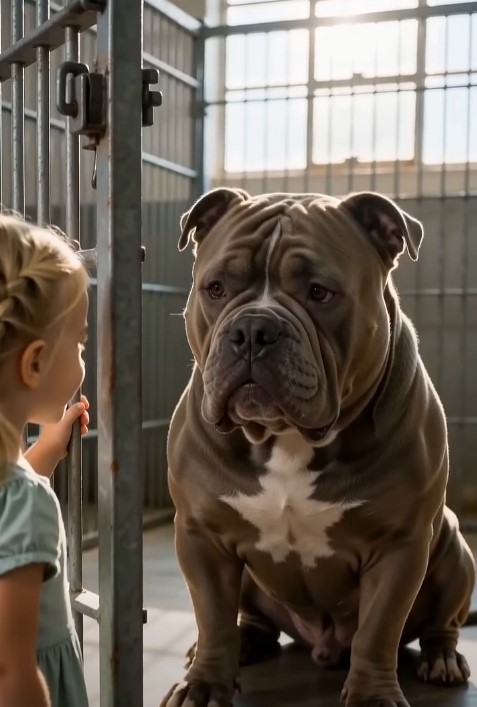
Condemned Shelter Dog Stuns Everyone After Showing Complete Trust in a Three-Year-Old Girl
The Warning Surrounding Cage Number Seventeen
At the Green Valley Municipal Shelter, employees repeated the same warning whenever visitors reached the darkest end of the building.
—Do not approach cage number seventeen.
The instruction was not printed on the walls or included in adoption brochures. Even so, anyone who walked far enough down the corridor quickly understood why staff members treated that area differently.
A large dog named Bob lived behind the reinforced door.
He had a broad, muscular body marked by numerous scars. One crossed his snout, another stretched along part of his back, and one of his ears had been torn.
A pale line circled his neck, suggesting that a tight chain had once remained there for a long period of time.
No one knew Bob’s exact age. The shelter veterinarian estimated that he was between five and six years old.
His breed was also uncertain. He appeared to be a mix of pitbull, American Bully, and another large breed, but his history offered no clear answers.
What the staff did know was that Bob trusted no one.
A Dog That Reacted to Every Stranger
Whenever a person approached the cage, Bob immediately rose to his feet.
His body became rigid, the hair along his back stood up, and his teeth appeared as a deep growl came from his chest.
If someone moved closer, he threw his body against the bars with enough force to shake the entire door.
Visitors often shouted in alarm. Children hid behind their parents, while employees directed everyone to keep moving.
—Don’t look directly at the dog. Keep walking.
Bob had lived at the shelter for two years, but the fear surrounding him had not faded.
To most visitors, he appeared aggressive, unpredictable, and impossible to approach safely.
To the small number of employees who understood his history, his behavior looked less like uncontrolled anger and more like a desperate attempt to prevent anyone from coming close.
The Abandoned Property Where Bob Was Found
An animal control officer discovered Bob on an abandoned property approximately forty kilometers from the city.
The location was surrounded by a metal fence. Inside were broken chains, empty cages, old stains on the floor, and containers that held no water.
When officers entered the property, Bob remained hidden beneath a wooden structure.
He was severely dehydrated and had several infected wounds. Every attempt to approach him caused an immediate violent reaction.
The officers eventually had to calm him before they could move him from the property.
Records did not identify who had left him there or explain what had happened before the rescue.
His injuries, however, revealed signs of prolonged mistreatment.
Dr. Helen Parker, the shelter veterinarian, suspected that Bob had been used in illegal fights.
Her concern was not based simply on the dog’s behavior. It came from the placement and condition of the wounds across his body.
There were marks around his neck, cuts on the front legs, scars across the face, and evidence of older rib injuries.
The pattern suggested that Bob had been forced to defend himself repeatedly, possibly against other dogs, people, or both.
The Incident That Changed Bob’s Classification
During his first weeks at the shelter, no employee could touch him safely.
Food had to be pushed through a special opening, while cleaning was performed behind a metal divider that kept Bob separated from staff.
Even with those precautions, he barked, struck the walls, and tried to reach the tools being used inside the cage.
A volunteer named Eric once entered the area before the protective separation had been fully secured.
Bob saw the opening and ran toward it.
Eric attempted to control him with a leash, but the frightened dog bit his arm and knocked him to the floor.
The injury required surgery.
After that event, Bob was officially classified as a high-risk animal.
Only three people were authorized to work close to him: Helen, head caregiver Marcus Hill, and an experienced trainer named Laura Bennett.
Laura’s Slow Attempt to Earn His Trust
Laura had spent more than fifteen years rehabilitating dogs that had suffered abuse.
She did not promise dramatic transformations, and she refused to describe any animal as permanently beyond help.
At the same time, she never ignored the danger Bob could present.
For months, she sat several meters away from his cage without attempting to touch him.
She avoided direct eye contact and read aloud in a soft voice.
At first, Bob barked for long periods whenever she appeared.
Eventually, he began to tire and settle down. Over time, he seemed to understand that Laura could remain nearby without entering his space or causing him pain.
One day, he accepted a small piece of food through the bars.
The gesture was limited, but Laura considered it an important sign of progress.
“He doesn’t want to attack us,” he explained to the director. “He wants to prevent us from getting close.”
The shelter director, Martin Shaw, remained concerned.
“The result is the same if someone ends up hurt,” he replied.
A Shelter Running Out of Time and Resources
Martin did not hate Bob, but he was responsible for the safety of the employees, visitors, and other animals.
He also had to manage the shelter’s limited budget.
Maintaining a reinforced cage required additional money. Expert training sessions also created expenses, and every dangerous incident increased the possibility of a legal claim.
“We can’t keep him here forever,” he kept repeating.
Laura and Helen understood the reality of the situation, but neither wanted to accept what could happen if Bob was declared impossible to place.
As the months passed, other animals came and went.
Puppies were adopted quickly. Smaller dogs attracted families with young children, and even several older animals found homes through special campaigns.
Bob remained in cage number seventeen.
Some visitors asked why he was isolated. Others wanted to know whether he had killed anyone or whether he was considered dangerous.
Rumors spread until people began referring to him as “the beast of Green Valley”.
The Photograph That Defined Him as a Threat
A local newspaper published an article after the attack on Eric.
The photograph showed Bob throwing himself against the door of his cage.
It did not explain that he had reacted after becoming trapped near several people.
It also did not describe the evidence of long-term abuse found on his body.
The headline focused only on the danger.
“Aggressive dog remains locked up despite the risks.”
After the article appeared, inquiries about adopting Bob stopped almost completely.
He was no longer seen as an injured animal shaped by fear.
He became known only as a threat.
At night, after the shelter had closed, Marcus often walked through the corridor to inspect the cages.
The other dogs barked, moved toward the doors, or wagged their tails.
Bob usually sat silently in the far corner.
He did not charge the bars or growl during those quiet hours. He simply watched the entrance with exhausted eyes.
“I don’t know what they did to you,” he said from outside. “But nobody here is going to force you to fight.”
Bob did not move closer, but he also did not turn away.
A Final Evaluation Is Ordered
Eventually, the organization that funded the shelter requested a final assessment.
If Bob failed to demonstrate sufficient improvement, he would be classified as unadoptable.
No one needed to explain what that decision could mean.
Laura received thirty days to present a realistic rehabilitation plan.
She worked with Bob each morning using barriers, positive associations, calm voices, and carefully controlled introductions.
Bob tolerated Laura and occasionally allowed Marcus to remain nearby.
The moment an unfamiliar adult appeared, however, his behavior changed.
He growled, barked, and struck the bars as though every new face carried a memory of past violence.
“He’s stuck in the past,” Laura said during a meeting. “He doesn’t respond to what we do. He responds to what he thinks we’re going to do.”
Martin closed the folder in front of him.
—But we can’t explain that to a family after someone gets hurt.
—It needs time.
—We already gave him two years.
—For an animal that lived for years under abuse, two years may not be enough.
—And how much are you proposing? Five? Ten?
Laura had no definite answer.
The final decision was scheduled for the following Monday.
A Family Arrives Looking for a Small Dog
Two days before the meeting, Thomas and Rachel Wilson visited the shelter with their three-year-old daughter, Emily.
They wanted to adopt a calm, small dog that could live comfortably in their house and garden.
Neither parent had experience with large animals.
Emily wore a light green jacket, yellow boots, and two small pigtails in her blonde hair.
From the moment she entered the building, she greeted every dog she passed.
-Hello.
—Hello, little dog.
—You’re handsome too.
Rachel laughed and reminded her daughter that they could not adopt every animal in the shelter.
Emily responded seriously.
—We can try.
An employee named Natalie introduced the family to several suitable dogs.
A small white mixed-breed animal wagged its tail, while a brown dog eagerly licked Thomas’s hand.
Emily appeared pleased with each one but could not decide which dog she liked most.
Emily Walks Toward the Forbidden Cage
While the adults discussed vaccines, food, and basic care, Emily began moving quietly down the corridor.
No one noticed her leaving the group.
She did not run or make noise. She simply stopped in front of each cage and whispered reassuring words to the animals.
—Don’t be afraid.
—They’re going to find you a house.
—You’re good.
Eventually, she reached the red warning sign near cage number seventeen.
Bob was lying in the corner when she approached.
He raised his head and watched her.
Normally, the presence of an unfamiliar person caused an immediate defensive reaction.
This time, Bob did not growl or expose his teeth.
Emily placed one hand against the bars.
-Hello.
The dog remained motionless.
She tilted her head and studied him.
—Why are you alone?
Bob inhaled deeply, and his ears moved slightly.
Emily stepped closer.
—You don’t seem bad.
An Unsecured Latch Opens the Door
The cage had been cleaned earlier that morning, but the latch had not been fully secured.
The door appeared closed, even though the locking mechanism was not properly engaged.
Emily placed her fingers on the metal piece.
The latch shifted, and the door opened several centimeters.
Bob stood up.
From the opposite end of the corridor, Natalie noticed the opening.
Then she saw Emily standing directly in front of the cage.
Her face lost all color.
-My God!
Natalie ran toward the child.
Thomas and Rachel turned when they heard the alarm in her voice.
Rachel saw her daughter beside Bob.
—Emily!
The scream echoed through the building.
Emily looked over her shoulder.
The movement caused the cage door to swing fully open.
Bob stepped into the corridor.
The Dog Everyone Feared Stands Before a Child
The large dog stopped directly in front of Emily.
His head reached almost to the height of her chest.
Employees rushed from nearby rooms. Marcus grabbed a control rod, while Laura entered from the outside area.
“Nobody get too close!” he shouted.
Everyone understood that moving too quickly could make the situation worse.
Bob took one step toward Emily.
Rachel attempted to run to her daughter, but Thomas tried to hold her back.
—Don’t scare him!
—She’s our daughter!
Bob lowered his head.
Emily did not step away.
She either failed to understand the danger or saw something in the animal that the adults could not recognize.
“Hi, Bob,” he said.
The dog stopped.
No one knew how Emily had learned his name. She may have read the plaque beside the cage or heard an employee mention it earlier.
Bob brought his scarred snout close to her yellow boots.
He sniffed her shoes and then her small hands.
Emily smiled.
—You have many wounds.
A Choice Between Fear and Trust
Laura held her breath while Marcus remained several meters away, prepared to intervene.
Rachel was crying as she watched the dog study her daughter.
For one long moment, Bob’s entire past appeared to be present in the corridor.
He could have reacted with the fear that had controlled him for years.
He could have attacked, escaped, or thrown himself against the people surrounding him.
Instead, Bob slowly bent his front legs.
He lowered his body onto the floor in front of Emily.
Then he rolled onto his side and exposed his belly.
The corridor became completely silent.
Laura lowered the control equipment slightly.
Marcus stared in disbelief.
Rachel stopped moving.
No employee had ever seen Bob place himself in such a defenseless position before an unfamiliar person.
He had not even shown that level of trust with Laura.
The First Gentle Touch
Emily knelt beside him.
—You want me to caress you.
She slowly extended her hand.
Her fingers touched the scarred top of Bob’s head.
The dog released a long breath and closed his eyes.
The tension disappeared from his body.
Emily stroked the torn ear that had once helped convince visitors that Bob was dangerous.
—You’re gentle.
Rachel finally reached her daughter and lifted her into her arms.
—Never walk away again!
Emily appeared confused by her mother’s tears.
—Bob is sad.
The dog sat upright.
He did not bark, chase Rachel, or resist when the child was taken away.
He simply watched Emily closely.
Bob Allows the Employees to Approach
Laura moved forward with extreme caution.
Bob looked at her but did not growl when she entered the open area around the cage.
“Everyone back up,” he ordered.
She picked up a leash and carefully moved it toward him.
Bob allowed her to attach it.
The employees guided him back into cage number seventeen without resistance.
Once the door was secured, Bob sat beside the bars.
Emily leaned from her mother’s arms and reached toward him.
The dog rested his head against the metal.
The little girl placed her palm on the opposite side.
The shelter staff watched in silence.
A Beautiful Moment That Did Not Remove the Risk
The dog who had bitten an adult and prevented nearly everyone from touching him had shown complete trust in a three-year-old child.
The animal described publicly as “the beast of Green Valley” had chosen vulnerability instead of aggression.
The moment was powerful, but it did not erase the seriousness of what had happened.
Rachel and Thomas had seen a gentle side of Bob that no one expected.
They had also watched their daughter stand only seconds away from a potentially tragic outcome.
One peaceful interaction could not guarantee that Bob would behave safely in every home, around every person, or under every stressful condition.
Laura understood that the event revealed something important about him, but it did not provide a complete rehabilitation plan.
Bob had not suddenly forgotten his past. His fear of adults and strangers remained a serious concern.
Emily Makes an Unexpected Request
As the family prepared to leave the corridor, Emily looked at her parents and asked whether they could take Bob home.
The request stunned everyone who heard it.
Thomas and Rachel had entered the shelter seeking a small, quiet companion.
Bob was large, powerful, deeply traumatized, and officially classified as high risk.
He required experienced handling, careful supervision, and a rehabilitation process that could not be rushed.
At the same time, he had responded to Emily in a way no one had seen before.
Her presence appeared to reach beyond the fear that controlled him whenever adults approached.
For the first time, the shelter staff had witnessed clear evidence that Bob was still capable of trust.
That discovery changed the discussion surrounding his future.
The Real Test Begins
Until that Saturday, the shelter’s decision had appeared to involve only two possibilities.
Bob could improve enough to be considered adoptable, or he could remain classified as too dangerous to place.
Emily’s encounter introduced a third and far more complicated possibility.
The dog might not be incapable of affection. He might simply require a level of patience, understanding, and specialized care that no ordinary adoption process could provide.
Laura saw hope in the way Bob had lowered himself before the child.
Martin still had to consider the risks, the previous attack, and the responsibility of protecting the public.
Rachel and Thomas had to decide whether a moving moment could ever justify bringing such a powerful animal close to their young daughter.
Emily saw only a lonely dog with scars who had chosen not to hurt her.
Bob remained behind the bars, watching the child who had approached him without fear.
The encounter had not solved the shelter’s problem.
It had made the decision more difficult, more emotional, and more urgent.
The final evaluation was still scheduled for Monday.
For the first time in two years, however, cage number seventeen no longer contained only the dog everyone had condemned.
It also contained the possibility that Bob had never been a monster at all.