
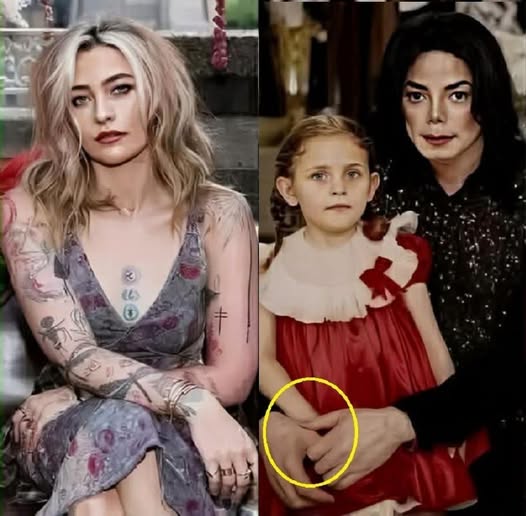
Paris Jackson Built a Life Beyond Her Father’s Shadow Without Denying Where She Came From
She Refused to Become a Copy of Michael Jackson and Chose Her Own Identity
From the moment Paris Jackson entered public life, the world seemed ready to decide who she should become.
As the daughter of Michael Jackson, she inherited a level of attention few people could ever understand. Her father was not simply famous. He was one of the most recognizable performers in modern entertainment, and his influence reached nearly every corner of the world.
Many expected Paris to follow the path already built for her. They imagined the same polished image, the same musical direction, and the same kind of carefully controlled public presence.
Instead, she quietly refused to become a replica.
Her adulthood unfolded through choices that often looked nothing like the legacy surrounding her. She stepped into modeling with visible tattoos and scars, pursued unconventional acting roles, and developed a musical sound far removed from her father’s catalog.
That difference was not a rejection of Michael Jackson. It became one of the clearest ways she protected his uniqueness while creating space for her own life.
Paris did not try to reproduce what could never truly be repeated. She allowed her father to remain singular while insisting that she also deserved to be seen as an individual.
Growing Up Beneath an Unavoidable Name
Being the child of a global icon created expectations long before Paris could define herself.
Her surname carried history, admiration, controversy, and impossible comparisons. Every appearance invited questions about whether she looked like her father, sounded like him, or intended to continue his work.
For many celebrity children, family recognition can open doors. It can also become a permanent frame through which every personal decision is judged.
Paris faced the challenge of building a public identity while millions of people believed they already knew her story.
She could not enter music without being compared to one of the most successful recording artists in history. She could not appear in front of a camera without viewers searching her face for traces of Michael Jackson.
Even her most personal choices were interpreted as statements about the family legacy.
Rather than spend her life attempting to satisfy those expectations, Paris moved in another direction. She accepted that she came from an extraordinary family while refusing to let that fact become the only meaningful thing about her.
Her Style Became a Declaration of Independence
Paris’s public image has never depended on appearing flawless.
She has modeled with visible tattoos, scars, and features that tell the story of a life lived beyond carefully edited celebrity presentation.
In an industry that often rewards perfection, her willingness to appear without hiding every mark became an act of independence.
The tattoos across her body are not merely decorative. Many reflect memories, beliefs, relationships, and experiences that she chose to carry visibly.
Some honor her father, creating a permanent connection between grief and remembrance. Others represent parts of her identity that exist entirely outside the Jackson name.
Her scars have also remained visible rather than being erased from public view. That choice challenges the expectation that pain must be hidden before someone is considered beautiful or successful.
Paris’s appearance communicates something simple but powerful: survival does not always look polished.
She has allowed the public to see that a person can carry evidence of difficult years and still step confidently into fashion, music, and performance.
Music That Refuses to Recreate Her Father’s Sound
Music may have been the most obvious place for Paris to imitate Michael Jackson, but it became one of the strongest examples of her refusal to do so.
Her sound leans toward folk-rock, emotional songwriting, and a raw vocal style that does not attempt to recreate the rhythm, production, or performance energy associated with her father.
Her voice carries texture rather than perfection. It can sound cracked, vulnerable, and close to the emotions behind the lyrics.
That approach separates her work from the enormous musical world Michael Jackson built.
She does not perform as though she is competing with him. She writes and sings as though she is trying to understand herself.
In that sense, the distance between their styles becomes meaningful. Paris appears to recognize that imitation would reduce both of them.
Michael Jackson’s music remains unmistakably his. Paris protects that distinction by choosing a sound shaped by her own experiences, influences, and emotional language.
Her refusal to imitate him can therefore be understood as a form of respect. She does not treat his artistry as a family formula to be copied.
She allows it to stand alone while making something separate beside it.
Acting Offered Another Path Away From Expectations
Paris also explored acting, but her choices did not suggest an attempt to become a conventional Hollywood star.
She appeared in offbeat projects and roles that allowed her to experiment rather than remain inside a safe, predictable image.
Acting gave her another way to step outside the public assumptions attached to her identity.
For someone whose real life had been observed from childhood, playing fictional characters created a different kind of freedom.
She could enter stories that did not begin with her father, her family, or the expectations of people who had watched her grow up.
Her projects also reflected a willingness to accept uncertainty. Instead of selecting only the most polished or commercially obvious roles, she explored work that matched her personal interests.
That pattern remained consistent across her career. Whether modeling, acting, or making music, Paris repeatedly chose expression over imitation.
A Life Shaped by Pain and Recovery
Paris’s independence was not formed only through artistic ambition. It was also shaped by difficult experiences and a complicated journey through grief.
Her father’s death placed an enormous emotional burden on her at a young age. The loss was deeply personal, yet it unfolded under worldwide attention.
She was not given the privacy most children receive while grieving a parent. Her sadness became part of a public story that strangers analyzed, debated, and sometimes misunderstood.
As she grew older, Paris spoke openly about trauma, mental health struggles, and suicide.
Those disclosures challenged the glossy version of celebrity life that many people prefer to believe.
She did not present survival as a clean transformation in which pain simply disappeared. Instead, she described healing as an ongoing process.
Treatment became part of that journey, but leaving treatment did not mean returning to an ordinary or uncomplicated life.
It meant entering adulthood with the responsibility of deciding what came next.
Paris chose to build that next chapter herself.
Vulnerability Became Part of Her Advocacy
Rather than conceal the most difficult parts of her life, Paris used them to speak about issues that are often hidden behind celebrity images.
She has discussed suicide, trauma, queerness, recovery, and emotional healing with a directness that makes her public voice different from the polished language commonly associated with fame.
Her openness carries risk. Personal disclosures can be simplified, sensationalized, or used to define someone permanently.
Paris continued speaking despite that danger.
By acknowledging pain, she gave others permission to recognize their own struggles without shame.
She also challenged the idea that people with famous families are protected from loneliness, grief, or self-destructive thoughts.
Wealth and recognition did not remove emotional suffering from her life. In some ways, public attention made that suffering more difficult to process.
Her advocacy grew from lived experience rather than distant observation. She spoke as someone who understood what it meant to survive a period when continuing forward did not feel guaranteed.
Honoring Michael Jackson Without Becoming Him
Paris has never denied the importance of her father.
She has honored him through tattoos, personal memories, and the photograph she keeps beside her.
These gestures reveal that independence does not require emotional distance.
She can love Michael Jackson deeply while refusing to build her entire identity around his career.
That balance may be one of the most difficult parts of her public life.
Some people expect celebrity children either to continue the family legacy or reject it completely. Paris chose neither extreme.
She carries her father with her while building a life that does not resemble his.
She protects the bond without turning it into a performance designed for public approval.
Her tattoos make the connection visible, but her music makes the difference equally clear.
She honors where she came from without surrendering ownership of where she is going.
Challenging the Stories Told About Her Father
Paris has also pushed back against narratives that reduced Michael Jackson to public controversy rather than recognizing his full humanity.
Growing up as his daughter gave her a personal understanding that outsiders could never completely share.
She knew him not only as a global performer, but as a parent, a presence in the home, and the person whose loss changed the course of her life.
That perspective shaped her response to the way he has been discussed since his death.
She has defended his humanity while refusing to turn herself into a permanent spokesperson for every argument surrounding his legacy.
This distinction is important. Paris can challenge dehumanizing portrayals without allowing the public debate around her father to consume her own adulthood.
She inherited the emotional consequences of those narratives, but she did not choose to let them become the only subject she was permitted to address.
Her Refusal to Change May Be the Most Powerful Part
The greatest surprise in Paris Jackson’s story is not that she looks or sounds different from her father.
It is that she has continued refusing to erase the visible evidence of who she has become.
She does not hide every tattoo to fit a more conventional image. She does not disguise the roughness in her voice to sound more polished.
She does not pretend that grief, treatment, and trauma belong entirely in the past.
Instead, she allows those experiences to remain part of her story without permitting them to control every chapter.
That refusal is not rebellion for its own sake. It reflects a determination to exist without constantly adjusting herself to satisfy public expectations.
The world may still compare her to Michael Jackson, but Paris does not appear interested in winning that comparison.
She seems more interested in making it irrelevant.
A Different Kind of Inheritance
Paris inherited fame, scrutiny, and a name recognized around the world.
She also inherited grief and the pressure of carrying a legacy that belonged to millions of fans as well as to her own family.
Yet the most meaningful inheritance may be the one she created for herself.
She demonstrates that loving a famous parent does not require becoming a continuation of that person.
She shows that survival can be followed by creation, advocacy, and identity rather than permanent retreat.
Her life suggests that healing is not the process of becoming untouched by the past.
It is the process of deciding what the past will mean without allowing it to own the future.
Paris’s scars, tattoos, songs, and public honesty all carry parts of that message.
They show a person who did not emerge from pain perfectly restored. She emerged changed, visible, and determined to keep becoming.
Choosing Vulnerability Over Myth
Michael Jackson became surrounded by myth because his fame grew beyond the scale of ordinary life.
Paris chose a different path.
Rather than protect herself through mystery, she often moved toward vulnerability.
She spoke about experiences that could have remained hidden and allowed the public to see uncertainty alongside strength.
That openness may make her less untouchable, but it also makes her more human.
She does not present herself as the flawless heir to an entertainment dynasty. She appears as an artist still learning, healing, and changing in public.
Her greatest rebellion may be the decision to remain complicated.
She can be the daughter of Michael Jackson and a musician whose work sounds nothing like his.
She can honor him and still question the public stories surrounding the family.
She can carry pain visibly while continuing to build a career.
She can love where she came from without allowing that origin to become a prison.
Paris Jackson Continues Writing Her Own Story
The world once expected Paris Jackson to become a reflection of her father.
Instead, she became evidence that identity does not have to be inherited in full.
She entered modeling without hiding her scars, pursued acting without choosing only predictable projects, and created music that followed a completely different emotional and artistic direction.
She transformed personal grief into advocacy and used her voice to discuss subjects that celebrity culture often prefers to smooth over.
Through it all, she continued honoring Michael Jackson privately and publicly without surrendering her independence.
Her story is not about escaping her father’s shadow by pretending it does not exist.
It is about learning how to walk beside it without disappearing inside it.
Paris Jackson did not reject her inheritance. She redefined what inheritance could mean.
Instead of copying a legend, she chose honesty.
Instead of protecting a perfect image, she allowed the scars to remain visible.
Instead of becoming the person the world expected, she continued becoming the person she chose.
That may be the most meaningful way she could ever honor where she came from.