
Alfie Patten Was Branded Britain’s Youngest Dad at 13 — Then a DNA Test Changed Everything
The 2009 Story Became a Worldwide Sensation Before a Stunning Paternity Result Revealed the Truth
When 13-year-old Alfie Patten was introduced to the world as Britain’s youngest father, the teenager from East Sussex became internationally famous almost overnight.
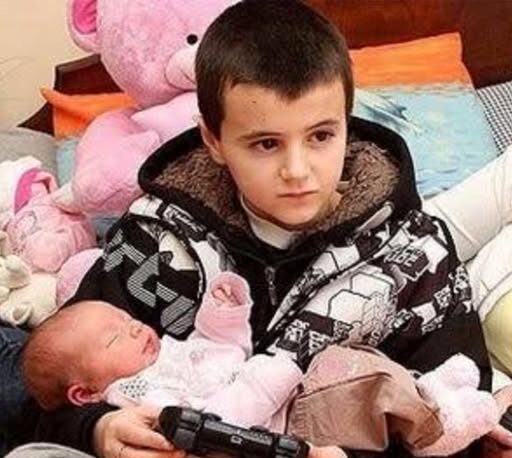
His youthful appearance made the story particularly striking. Photographs showed a baby-faced schoolboy standing beside newborn Maisie Roxanne, creating an image that quickly spread across newspapers, television programs, and the internet.
But only weeks after Alfie had been presented as the child’s father, a DNA test dramatically changed the story.
Alfie was not Maisie’s biological father.
Who Was Alfie Patten?
Alfie was a schoolboy living in East Sussex when his name suddenly became known around the world in 2009.
He had been identified as the father of a baby born to family friend Chantelle Steadman.
Chantelle was 15 when Maisie Roxanne was born at Eastbourne Hospital in East Sussex.
Because Alfie was only 13 at the time of the birth, reports quickly described him as one of the youngest fathers in Britain.
The claim generated enormous public attention and transformed what had been a private family situation into a national controversy.
The Story Spread Around the World
The Sun was among the newspapers that prominently reported the story.
Interest became enormous, partly because Alfie looked considerably younger than what many readers associated with parenthood.
His boyish appearance and unbroken voice contrasted sharply with photographs and headlines presenting him as responsible for a newborn child.
The story produced such intense curiosity that it became one of the most widely discussed British news stories of the period.
Alfie and his family suddenly found themselves recognized in public and discussed by people who knew almost nothing about their lives beyond the headlines.

His Family Faced Intense Criticism
The attention did not stop with Alfie.
His parents also became targets of public criticism.
The family was portrayed by some as evidence of wider social problems surrounding teenage pregnancy, parenting, education, and young people’s relationships.
For Alfie’s mother, Nicola, the attention became overwhelming.
What had begun as an intensely personal situation had become something discussed nationally, with strangers forming strong opinions about the family.
Alfie and Chantelle Had Met the Previous Year
Alfie reportedly met Chantelle in 2008 while they were living in the East Sussex area.
His mother initially regarded the friendship as harmless and did not expect it to become the center of an international news story.
After Chantelle became pregnant, the situation remained private for a period before her family became aware of it.
According to the account at the time, Chantelle did not initially realize she was pregnant and later kept the pregnancy secret for several additional weeks.
The Case Became Part of a National Debate
The story quickly moved beyond questions about one family.
Commentators began using Alfie’s case to discuss teenage pregnancy, sex education, relationships, and the pressures facing young people.
Politicians also became involved in the debate.
Nigel Waterson, then Member of Parliament for Eastbourne, said, ”This is a very sad story… which raises huge questions about sex education rather than relationship education in schools, and also about the sexualisation of our society.”
Suddenly, a 13-year-old schoolboy had become part of a much larger political and cultural conversation.
View this post on Instagram
One Interview Showed Just How Young Alfie Was
The enormous responsibility associated with parenthood seemed especially striking when Alfie was interviewed about his ability to support a family.
Asked about finances, he responded: “What’s financially?”
The answer became one of the most widely remembered moments surrounding the story.
It emphasized something that could easily become lost beneath the sensational headlines: Alfie was still a child himself.
Alfie Initially Believed the Baby Was His
As the pregnancy progressed, Alfie apparently accepted that he was going to become a father.
He said, ”I thought it would be good to have a baby,” while also admitting that he had been frightened to tell his parents about the situation.
His father later described Alfie as determined to participate rather than disappear after the baby’s birth.
”He could’ve just shrugged it off and stayed home playing on his PlayStation. But he’s been at the hospital every day,” he said.
Those comments helped build the public image of a very young boy attempting to take on responsibilities far beyond his age.
Maisie Roxanne Was Born in February 2009
Maisie was born weighing 7 pounds 3 ounces.
Photographs of Alfie beside the newborn quickly became central to coverage of the story.
Because of his age and appearance, viewers sometimes remarked that the photographs looked more like those of an older brother holding a younger sibling than a father with his daughter.
For Alfie, however, the emotional experience felt real.
”It was a crazy time. Holding Maisie for the first time was amazing. I was too young to understand the consequences of being a dad but I liked holding her and immediately loved her,” Alfie said.
Questions About Paternity Soon Emerged
Despite the certainty suggested by the early headlines, doubts began developing within Alfie’s own family.
His mother Nicola questioned whether her son could actually be Maisie’s biological father.
The extraordinary story had already traveled around the world by the time those doubts led to a DNA test.
Then came the result that changed everything.
The DNA Test Revealed Alfie Was Not the Father
Approximately six weeks after Maisie’s birth, testing established that Alfie Patten was not her biological father.
The baby’s father was identified as another teenager, 14-year-old Tyler Barker, who was described as one of Alfie’s friends.
With that single result, the central claim behind weeks of international headlines collapsed.
Alfie was no longer the exceptionally young father newspapers had presented him as being.
But the effects of the publicity did not disappear with the DNA result.
The Revelation Was Emotionally Difficult for Alfie
Although he was not Maisie’s biological father, Alfie had spent weeks believing that he was.
He had visited the hospital, held the baby, and formed an emotional attachment during a period when the entire world was telling him he had become a parent.
After receiving the paternity result, Alfie reportedly cried for several days.
The situation became even more painful when Chantelle and her family moved away and Alfie was no longer able to see Maisie.
For a child already overwhelmed by international attention, the sudden reversal added another layer of confusion and loss.

The Headlines Did Not Disappear When the Story Changed
Alfie’s family hoped the DNA result would allow them to return to ordinary life.
That proved difficult.
His name had already become nationally recognizable.
He had been discussed in Parliament, analyzed in newspapers, and used as an example in arguments about Britain’s younger generation.
The correction that he was not Maisie’s father could not undo the weeks during which the original story had dominated public attention.
The Media Coverage Became a Controversy of Its Own
The way newspapers handled the case eventually attracted scrutiny from the Press Complaints Commission, which at the time acted as a voluntary regulatory body for British newspapers and magazines.
Questions were raised about how the story had been obtained and whether Alfie’s parents had received payments connected with media coverage.
A spokesperson for The Sun responded: “We will be happy to fully cooperate with PCC’s inquiry into this story, which we absolutely believe to be in the public interest.”
The controversy raised a larger question about how aggressively newspapers should pursue stories involving children, even when those stories generate enormous public interest.
The Investigation Could Not Be Fully Completed
The Press Complaints Commission’s examination of the case eventually encountered legal restrictions.
Those restrictions limited further contact with the Patten family and prevented the inquiry from continuing as originally planned.
The PCC nevertheless issued a warning to newspapers.
The dispute became another chapter in a story that was already as much about media behavior as it was about Alfie himself.
Newspapers Defended the Public Interest
Those defending the intense coverage argued that the case highlighted an important national issue.
Teenage pregnancy and the challenges facing young people were legitimate topics for public discussion.
By focusing on an individual case, newspapers argued that they were making a broader social problem easier for readers to understand.
Critics, however, could point to the enormous personal consequences of turning a young teenager and his family into public symbols before crucial facts had been firmly established.
Alfie’s Mother Said the Family Struggled to Recover
Two years after the original controversy, Nicola described how difficult the experience had been for the family.
“Suddenly Alfie’s name was being thrown about in Parliament and on the 10 o’clock news. We were portrayed as a bad family from the wrong side of town,” she said.
The unwanted attention affected her personally as well.
“Alfie’s a good boy and I was too scared to go out.”
The DNA test had corrected the central factual claim, but public recognition and the emotional effects of the coverage remained.
Later Years Brought New Difficulties
Alfie continued to attract occasional newspaper attention as he grew older.
In 2019, reports said he was convicted of criminal damage following an incident involving vehicles and property while intoxicated.
According to the account presented in court, police became involved after damage was caused to a van, another vehicle, and a fence.
His circumstances at the time were described as troubled, with unemployment and frequent alcohol use also discussed.
His Defense Said He Wanted to Change
During the 2019 proceedings, Alfie’s defense presented him as someone hoping to move away from destructive behavior.
His defense said: “He wants to improve to become normal and seek peace rather than continue the destructive, chaotic behavior that is deeply dangerous to his health.”
The comment offered a very different picture from the 13-year-old boy who had appeared in photographs with a newborn a decade earlier.
By then, the child at the center of one of Britain’s biggest tabloid stories had become an adult dealing with his own difficulties.
Alfie and His Mother Returned to the Headlines in 2021
Further reports appeared in 2021 concerning the home where Alfie and Nicola were living in Hailsham, East Sussex.
The property became connected with allegations of drug dealing and anti-social behavior.
District Judge Teresa Szagun stated, ”The premises were being used for drug dealing, and there was anti-social behavior spilling out onto the street, affecting the neighborhood.”
The family was subsequently reported to have been evicted from the property.
Alfie’s Life Had Become Very Different From the Story That Made Him Famous
Years after the DNA revelation, Alfie was no longer the schoolboy presented to the world as Britain’s youngest father.
He had grown into adulthood while carrying a name that many people still associated with events from when he was only 13.
Reports described periods of unemployment and struggles with alcohol, while also indicating that he had sought help with some of those problems.
His later life attracted far less continuous attention than the extraordinary media frenzy of 2009.
The Original Story Raises Difficult Questions About Childhood and Fame
Looking back, perhaps the most striking element of Alfie Patten’s story is how quickly a young teenager became the subject of worldwide judgment.
Before the DNA test, politicians, commentators, newspaper readers, and television viewers discussed what Alfie supposedly represented about British society.
His parents were criticized.
His future was debated.
His apparent fatherhood became evidence in arguments about education, parenting, and teenage behavior.
Then scientific testing demonstrated that the foundation of that worldwide narrative was wrong.
A DNA Result Could Correct the Record but Not Erase the Experience
Once the test showed that Tyler Barker, rather than Alfie, was Maisie’s biological father, newspapers could publish the new information.
What they could not do was return Alfie and his family to the anonymity they had before the original story appeared.
The photographs had already circulated.
The interviews had already been watched.
The family’s name had already entered public debate.
Millions of people had formed opinions about a 13-year-old boy before one of the most important facts in the story had been established.
The Case Became a Lesson in the Power of Sensational Headlines
Alfie’s youthful appearance helped make the story irresistible to the tabloid press.
The contrast between his age and the responsibilities associated with fatherhood generated enormous curiosity.
But that same sensational appeal also demonstrated the risks of allowing a dramatic narrative to race ahead of certainty.
The correction was significant, yet it could never attract exactly the same kind of attention or undo the emotional experience of being labeled across the world.
Today, Alfie Appears to Prefer a Quieter Life
Years have passed since the photographs of Alfie and baby Maisie became international news.
More recent glimpses of his life suggest he has remained connected with the Hailsham area while living much more privately than he did during the intense publicity of his teenage years.
His name still periodically resurfaces because the original story remains memorable.
But the extraordinary claim that made him famous was ultimately proven wrong.
The Most Lasting Question May Be How the Story Was Handled
Alfie Patten entered the public imagination as a symbol before he was old enough to fully understand the consequences of that attention.
He was presented as an exceptionally young father, scrutinized by the press, discussed by politicians, and surrounded by strangers’ judgments.
Then, only weeks later, a DNA test established that he was not the baby’s father at all.
For Alfie and his family, that revelation did not immediately restore normal life.
The fame, criticism, and emotional upheaval had already happened.
His story therefore remains about more than mistaken paternity.
It is also a striking example of how quickly a sensational story involving a child can become a worldwide phenomenon, and how difficult it can be to reverse the consequences once the headlines have already been written.