
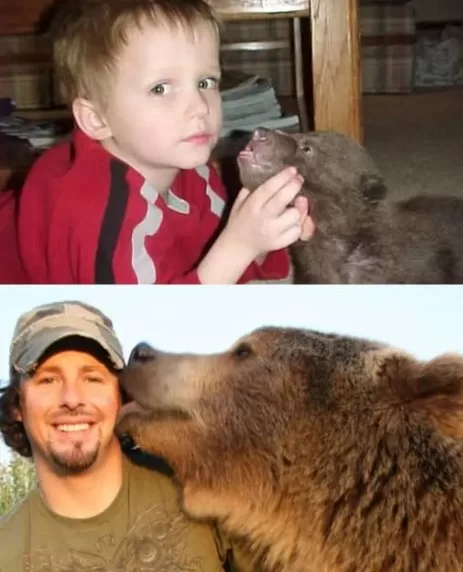
The Unusual Friendship Between Casey Anderson and a Rescued Grizzly Bear
Friendships often begin with small moments of familiarity. A shared interest, a simple conversation, or a brief encounter can become the starting point for a lasting connection.
For naturalist Casey Anderson, however, that moment began in an unexpected way. His companion was not another person but a rescued grizzly bear weighing around 360 kilograms.
The bear’s name was Brutus.
A Cub Facing an Uncertain Future
Brutus entered the world under difficult circumstances. As an orphaned cub, his chances of surviving in the wild were extremely limited.
Young bears depend heavily on their mothers during the early stages of life. Without that protection and guidance, it becomes almost impossible for them to learn essential survival skills.
In situations like this, wildlife authorities often face complicated decisions. Orphaned cubs may struggle to find food, avoid danger, and adapt to the harsh conditions of the wilderness.
Many such cases end tragically because the animals cannot be safely released back into their natural habitat.
Brutus was moving toward that same uncertain outcome until Casey Anderson stepped in.
Instead of allowing the bear’s story to end prematurely, Anderson offered an alternative path. What followed was a relationship that would eventually draw international attention.
The Beginning of an Extraordinary Bond
From the earliest days, Anderson approached the situation with patience and respect. Rather than treating Brutus as a spectacle, he focused on understanding the bear as a living creature with instincts, behaviors, and emotional responses.
The connection between them developed gradually through daily interaction and consistent care.
Over time, the two formed a routine that strengthened their trust. They spent long hours together outdoors, exploring nature and sharing moments that helped build familiarity.
They walked through forest trails, spent time near lakes, and experienced the outdoors side by side.
Observers who witnessed these moments often found the sight difficult to believe. A man calmly walking alongside a fully grown grizzly bear seemed almost impossible.
Yet the relationship between Anderson and Brutus was not built on control or performance. It grew from observation, patience, and a deep understanding of animal behavior.
Anderson devoted years to learning Brutus’s habits, moods, and natural boundaries.
In return, Brutus displayed a level of comfort and trust that few people have ever witnessed between a human and a wild animal.
International Attention Through Film
The remarkable friendship eventually reached audiences around the world when it became the focus of the documentary Expedition Grizzly.
The film presented a rare look into the daily life shared by Anderson and Brutus.
Rather than focusing on danger or sensationalism, the documentary highlighted the emotional and behavioral complexity of grizzly bears.
Viewers were able to see moments of playfulness, calm interaction, and mutual trust between the two.
These scenes offered a perspective that many people had never considered before.
Grizzly bears are often portrayed as dangerous predators in headlines and dramatic stories. Because of that reputation, their intelligence and emotional capacity are rarely discussed.
The documentary shifted that perception by presenting Brutus as a thinking, feeling animal capable of forming a connection with a human caretaker.
For many viewers, it was the first time they had seen a grizzly bear in such a context.
The narrative moved away from fear and toward understanding.
A Memorable Moment During a Wedding
One of the most talked-about moments in the story of Anderson and Brutus occurred during an important personal milestone.
When Casey Anderson married actress Missi Pyle, Brutus was present during the ceremony and symbolically included in the celebration.
The image of a towering grizzly bear calmly standing beside the couple created a powerful visual moment.
It reflected how deeply the animal had become part of Anderson’s life.
The presence of Brutus during the event was not meant as a spectacle. Instead, it represented years of shared experiences and the strong bond that had developed between them.
For Anderson, Brutus was never just a rescued animal.
He once described their relationship with simple but powerful words.
“Er ist mein bester Freund. Er liebt mich bedingungslos.”
The statement captured the depth of the connection they shared. Unconditional love is often associated with family members or lifelong companions.
Hearing those words used to describe a grizzly bear challenged many people’s assumptions about wildlife.
Changing the Way People See Bears
The story of Casey Anderson and Brutus sparked widespread discussion about how humans perceive large predators.
In many parts of the world, bears are commonly associated with danger and conflict.
News coverage frequently focuses on encounters that result in fear or harm.
As a result, the public often sees these animals only as threats rather than as complex creatures with their own behaviors and social patterns.
The relationship between Anderson and Brutus encouraged people to reconsider those assumptions.
Through public appearances and educational outreach, Anderson emphasized that bears possess intelligence and emotional awareness.
However, he also made it clear that wild animals should always be respected and approached with caution.
The friendship he shared with Brutus developed through years of experience and careful understanding.
It was never presented as something that should be imitated casually.
Instead, it served as an example of how knowledge and responsibility can shape the way humans interact with wildlife.
The Creation of Montana Grizzly Encounter
The unique bond between Anderson and Brutus eventually inspired a larger mission.
Anderson established Montana Grizzly Encounter, a sanctuary dedicated to the care of rescued bears.
The sanctuary provides a safe home for animals that cannot survive independently in the wild.
Many of these bears come from difficult backgrounds and require long-term care.
At the refuge, they receive proper food, shelter, and a controlled environment that prioritizes their well-being.
But the sanctuary’s purpose extends beyond providing a home for rescued animals.
It also functions as an educational center designed to teach visitors about bear behavior, habitat preservation, and wildlife conservation.
Guests who visit the sanctuary learn how bears live, how they interact with their environment, and why protecting natural ecosystems is so important.
The goal is to replace fear with knowledge.
Through guided learning experiences, people gain a deeper appreciation for animals that are often misunderstood.
Brutus as the Symbol of a Mission
Brutus eventually became the central figure representing the sanctuary’s message.
His life story demonstrated how compassion and understanding could transform a difficult situation into something meaningful.
As visitors learned about Brutus and his relationship with Anderson, they also learned about the broader challenges facing wildlife.
Habitat loss, human expansion, and environmental changes continue to affect many animal species around the world.
Educational programs at the sanctuary aim to encourage responsible coexistence between humans and wildlife.
By sharing Brutus’s story, Anderson helped people see bears from a new perspective.
The focus shifted away from fear and toward respect.
A Story That Changed Perspectives
Over time, Brutus grew into far more than a rescued cub.
He became a symbol of how humans and animals can exist alongside one another when mutual respect guides their interactions.
The story of Anderson and Brutus illustrates an important lesson about the relationship between people and nature.
True connection with the natural world does not come from trying to dominate it.
It comes from learning, observing, and respecting the boundaries that define wild environments.
Through patience and dedication, Anderson developed a rare bond that inspired people around the world.
His experience encouraged many to reconsider how wildlife is perceived and treated.
Rather than viewing nature as something to control, the story invites a different perspective.
It suggests that understanding and respect can create meaningful connections that once seemed impossible.
Sometimes the most powerful relationships are not formed by changing nature, but by changing the way people see it.
And through that shift in perspective, extraordinary stories like the one shared by Casey Anderson and Brutus can emerge.