
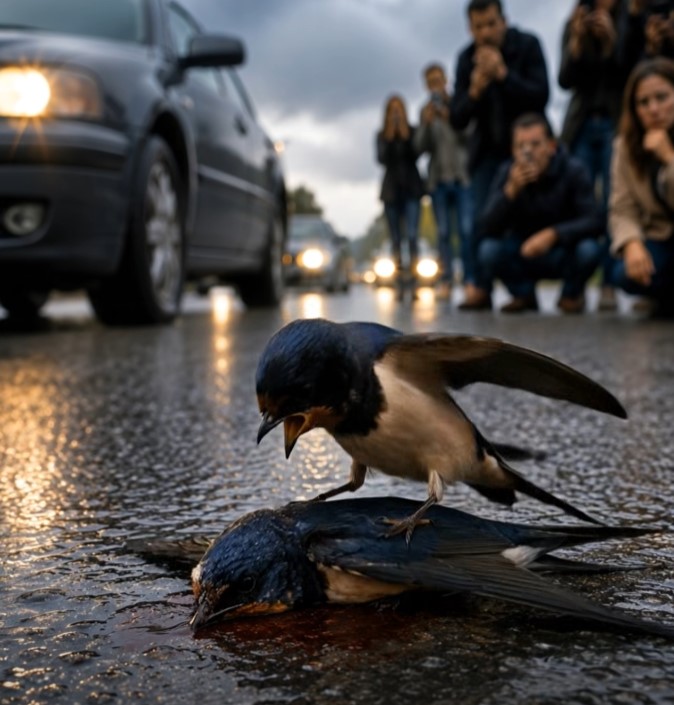
Male Swallow Refused to Leave His Injured Companion After She Was Struck on the Road
A Photographer Captured a Series of Moments That Appeared to Show the Bird Staying Beside His Fallen Partner
Animals often surprise people with behaviors that seem deeply familiar.
Sometimes those moments involve protection.
Sometimes they involve loyalty.
And sometimes, as in the case of two swallows photographed after a roadside accident, the behavior appears remarkably similar to grief.
The scene began when a female swallow flew dangerously low across a road and was struck by a passing vehicle.
She fell onto the pavement.
What happened afterward became the part of the story that people found difficult to forget.
Another swallow, described as her companion, immediately returned to the area and remained close to her.
The Male Bird Came Back to Her Side
Instead of flying away from the road, the male swallow approached the injured bird.
He appeared agitated as he moved around her.
The female was still showing signs of life, but she was unable to fly away.
The male remained nearby.
For anyone who has watched small birds dart rapidly through the sky, seeing one remain exposed on a roadway was already unusual.
Yet he continued returning to the fallen swallow.
The danger of the road did not appear to drive him away.
He Brought Food While She Was Still Moving
One of the most striking moments came when the male swallow appeared to bring food to his injured companion.
The gesture suggested that he was responding to her as he might have under normal circumstances.
But the food could not change what had happened.
The female remained on the road.
The male continued hovering around her and returning to her position.
Photographs of the encounter captured the contrast clearly: one bird lying motionless or barely moving, and the other refusing to leave.
He Appeared to Try to Move Her
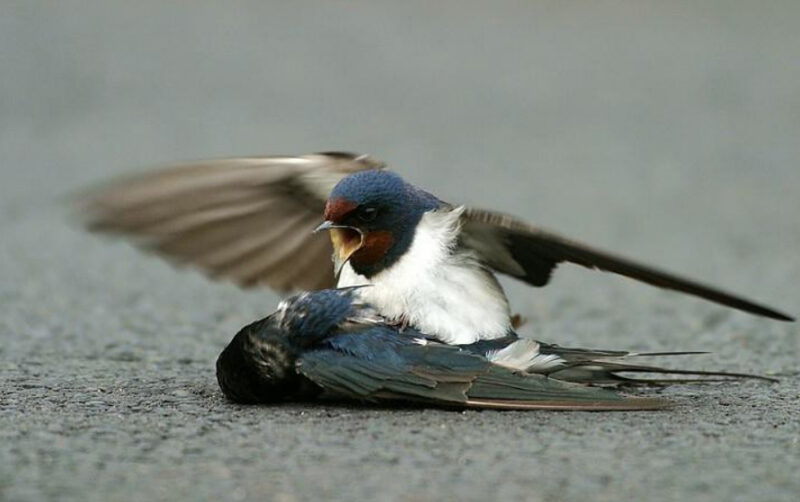
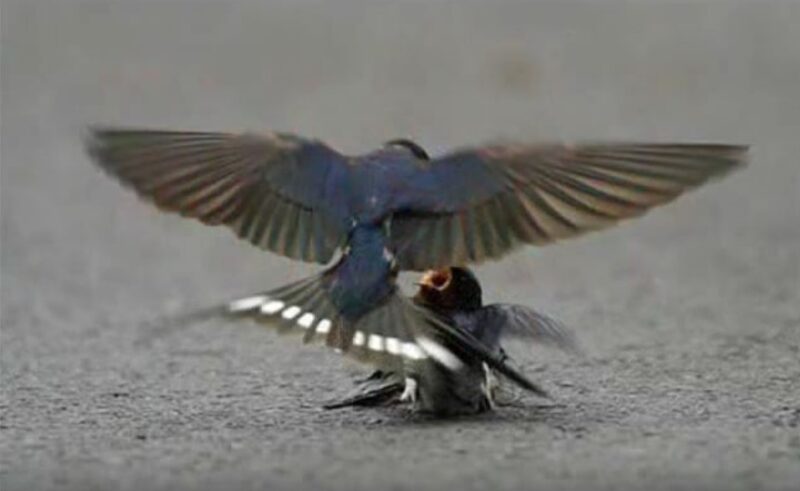
The male swallow then seemed to make another attempt to help.
He positioned himself close to the female and appeared to try to lift or move her.
For such a small bird, shifting another bird across the pavement would have been extremely difficult.
He tried more than once.
His efforts did not succeed.
The female remained where she had fallen.
The scene became increasingly emotional for the people who later viewed the images.
Then His Behavior Became More Distressed
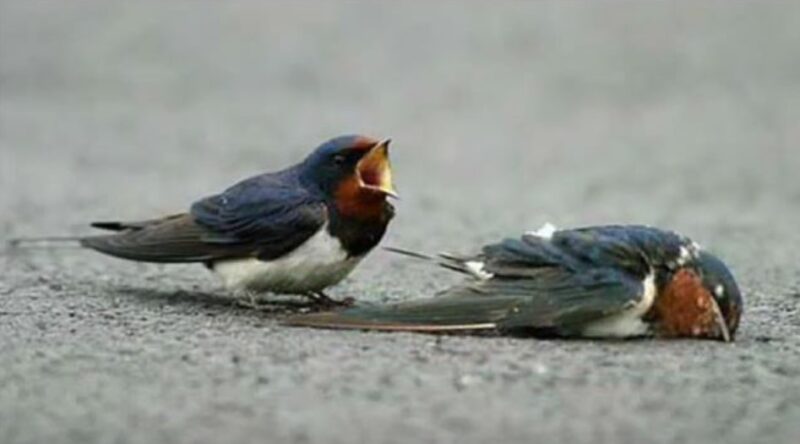
As the injured swallow weakened, the male’s movements reportedly became more frantic.
He flapped his wings and called loudly.
To human observers, the behavior looked like distress.
There was no way for the bird to understand the accident in the way a person might.
He could not move the car that caused the injury.
He could not summon medical help.
He could only remain beside his companion and continue responding to her.
The Photographs Turned a Brief Accident Into a Lasting Story
Without the photographer, the moment might have passed unnoticed.
A small bird struck on a road could easily have become just another unfortunate event in nature.
Instead, the images preserved what happened afterward.
They showed the surviving swallow returning repeatedly.
They showed him bringing food.
They showed him staying close when the female could no longer respond normally.
Those photographs gave viewers a reason to think about what animals may experience when a bonded companion suddenly disappears.
People Often Underestimate Animal Bonds
Humans tend to describe love, loyalty, and grief using words.
Animals obviously do not explain their feelings in that way.
Instead, people interpret behavior.
A dog waiting beside an owner.
An elephant lingering near a dead herd member.
A bird repeatedly returning to a fallen companion.
Such scenes can feel powerful because they resemble emotional responses that people recognize in themselves.
The Swallow’s Actions Were Impossible to Ignore
What made this particular story so affecting was persistence.
The male did not simply land beside the female once and then disappear.
He remained involved.
He appeared to check her condition repeatedly.
He brought food while she was still alive.
He attempted to move her.
And when those efforts failed, he continued calling and flapping nearby.
To observers, the sequence looked less like curiosity and more like attachment.
Swallows Are Highly Social Birds
Swallows are commonly seen traveling quickly through open spaces in search of food.
Their movements can make them appear constantly busy and independent.
But they also form social bonds and often spend significant time around other members of their species.
That context makes the roadside encounter easier to understand as part of an existing relationship between the two birds.
The male was not reacting to a completely unfamiliar animal.
He was described as the injured swallow’s companion.
The Road Became a Dangerous Place for Both Birds
Once the female fell, the male faced danger simply by returning to her.
Roadways offer little protection for small animals.
Vehicles move quickly, and drivers may have very little time to react when birds suddenly fly close to the pavement.
Yet the male continued approaching the same area.
That made the scene more striking.
Whatever motivated him appeared stronger than the instinct to immediately leave the dangerous location.
His Attempts Could Not Change the Outcome
The most painful part of the sequence was its helplessness.
The male swallow appeared to keep trying different responses.
Food did not help.
Remaining close did not help.
Attempting to move the female did not help.
Eventually, there was nothing more he could do.
For human observers, that progression closely resembled something painfully familiar: trying to help someone when the situation is already beyond your control.
The Female Swallow Eventually Stopped Responding
As time passed, the injured bird’s movements became weaker.
The male continued staying near her.
The story describes him calling loudly and beating his wings when he appeared to realize that she was no longer responding.
The image of one small bird beside another on an empty stretch of road became the defining moment of the encounter.
There was no dramatic rescue.
There was no sudden recovery.
There was simply one bird remaining close to another until the end.
Why the Scene Affected So Many People
The story circulated because viewers saw something emotionally recognizable in it.
Most people understand the fear of losing someone they love.
The specific circumstances may differ, but helplessness in the face of loss is universal to human experience.
Watching an animal behave in a way that appears to echo that experience can be deeply moving.
It also challenges the idea that animals move through life without meaningful relationships.
Behavior Can Say What Words Cannot
The swallow could not explain why he stayed.
He could not tell the photographer what the female meant to him.
There was no spoken goodbye.
All that remained was behavior.
He returned.
He brought food.
He attempted to move her.
He remained close when she weakened.
Those actions were enough for viewers to interpret the scene as one of remarkable loyalty.
The Story Also Shows the Fragility of Wildlife Near Roads
Behind the emotional reaction is another simple reality.
Birds and other small animals frequently cross areas built for vehicles.
A momentary flight too close to traffic can have immediate consequences.
The female swallow’s accident happened quickly.
There was no opportunity for the male bird to understand why his companion had suddenly fallen.
One moment they were together.
The next, everything had changed.
Nature Can Be Beautiful and Unforgiving at the Same Time
Stories involving animals often focus on survival, rescue, and happy endings.
This one is different.
There is tenderness in the male swallow’s actions, but there is also loss.
Nature does not always offer recovery simply because another animal refuses to give up.
Sometimes the most meaningful part of a story is not that someone was saved.
It is that they were not left alone.
The Male Swallow Stayed When He Could Have Flown Away
Perhaps that is why the photographs remain so powerful.
The male had wings.
He could have left the road at any moment.
Instead, he remained near the female.
He repeatedly returned to the place where she had fallen.
To viewers, that simple decision became the emotional heart of the story.
We Cannot Know Exactly What the Bird Felt
It is important not to assume that an animal experiences emotion in precisely the same way a person does.
The male swallow could not explain his internal state.
What observers could see was his behavior.
He appeared distressed.
He remained near his companion.
He attempted actions that looked like efforts to help.
Whether people describe that response as grief, attachment, instinct, or something else, the bond between the birds appeared significant.
The Images Became a Reminder to Look More Closely at Animals
Small creatures often move through human environments without attracting much attention.
A swallow may cross the sky in seconds and disappear before anyone thinks twice.
This encounter forced people to slow down.
The photographs showed that even a brief moment in the life of a small bird can contain behavior that feels complex and deeply moving.
They also reminded viewers that animals have relationships that matter within their own lives, even when humans rarely stop long enough to notice them.
A Heartbreaking Ending Left a Lasting Impression
The female swallow did not recover from the collision.
Her companion could not lift her from the road or undo what had happened.
But he stayed.
He brought food when she still moved.
He tried to help when she could not rise.
And when his efforts failed, the surviving bird remained nearby, calling and flapping his wings beside her.
For the photographer and everyone who later saw the images, those final moments became more than a wildlife encounter.
They became a quiet reminder that attachment does not always need words to be visible.
Sometimes the Smallest Lives Leave the Strongest Message
The entire scene involved two tiny birds on an ordinary road.
There were no crowds, no dramatic rescue equipment, and no way to change the outcome.
Still, the male swallow’s refusal to immediately abandon his companion transformed the incident into something people remembered.
His actions seemed to express care in the only ways available to him.
He stayed close.
He tried to provide food.
He tried to move her.
And when there was nothing left to do, he remained nearby.
For anyone who has ever wondered whether animals form bonds deeper than simple instinct, the photographs offer a scene that is difficult to dismiss.
Sometimes love is not measured by what can be saved.
Sometimes it is visible in who refuses to leave.