
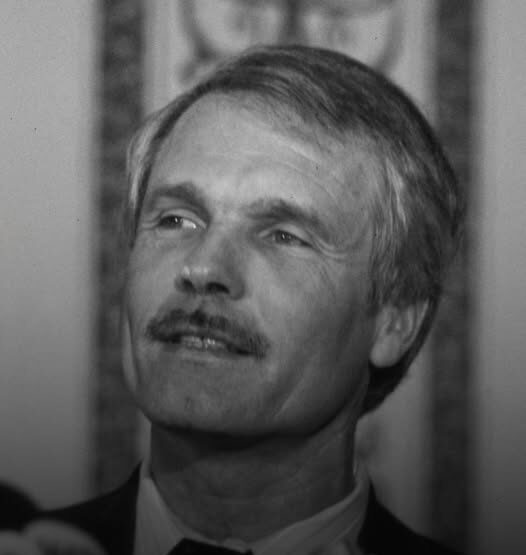
Ted Turner, CNN Founder Who Transformed Global Television, Dies at 87
A pioneering media figure leaves behind an extraordinary legacy
Ted Turner, the pioneering media entrepreneur who changed television by creating CNN and later became one of the world’s most prominent philanthropists, died on May 6, 2026, at the age of 87. Turner Enterprises announced his death, bringing to a close the life of one of the most influential figures in modern broadcasting. :contentReference[oaicite:0]{index=0}
Turner’s career was defined by enormous risks and ideas that initially seemed almost impossible. His most consequential gamble came in 1980, when he launched CNN as the first television news network built around continuous, 24-hour coverage. :contentReference[oaicite:1]{index=1}
The idea fundamentally altered the relationship between television and breaking news. Audiences no longer had to wait for scheduled evening broadcasts to learn what was happening around the world.
News could now unfold continuously, creating a model that would eventually become standard across the global television industry.
From a family billboard business to a broadcasting empire
Turner’s rise began far from the international television operation he would eventually control.
Born in Cincinnati in 1938 and raised in Georgia, Turner entered the family billboard business while still a young man. After taking control of that operation, he expanded his ambitions beyond outdoor advertising and moved aggressively into broadcasting. :contentReference[oaicite:2]{index=2}
His willingness to take risks became one of the defining characteristics of his professional life.
Turner acquired struggling television properties and began looking for ways to reach audiences beyond the geographical limits imposed on traditional local stations.
Satellite distribution gave him that opportunity.
His Atlanta television station became a nationally distributed “superstation,” helping demonstrate how cable and satellite technology could transform a regional broadcaster into something much larger. :contentReference[oaicite:3]{index=3}
That experience helped prepare Turner for the idea that would define his career.
CNN challenged the traditional television news model
When Turner launched CNN in 1980, the established television networks dominated American news.
His concept challenged the assumption that television news needed to exist primarily inside scheduled programs.
CNN would broadcast news around the clock.
At any hour, viewers could turn on their televisions and find journalists covering events, interviews, politics, international developments and breaking stories.
The concept helped create what eventually became known as the 24-hour news cycle.
Turner’s gamble proved influential far beyond his own company. Continuous television news eventually became a fundamental part of the global media landscape, with broadcasters around the world adopting variations of the model he pioneered.
Breaking news became something viewers could watch unfold
The power of Turner’s idea became increasingly apparent during major international events.
CNN offered viewers the ability to follow important developments as they happened rather than relying exclusively on summaries presented later.
The network’s expanding international profile eventually demonstrated that a cable news service could compete for attention with much older broadcasting institutions.
Its coverage of major events during the 1980s and early 1990s helped establish CNN as a global news brand. :contentReference[oaicite:4]{index=4}
Turner had bet that viewers would want access to news whenever events occurred.
The modern media environment ultimately proved how powerful that assumption was.
Turner continued expanding beyond CNN
CNN was only one part of Turner’s larger broadcasting ambitions.
His media holdings expanded to include networks and properties associated with news, entertainment, movies and sports.
The Turner empire eventually included TBS, TNT, Cartoon Network and Turner Classic Movies, giving his company a presence across several major areas of cable television. :contentReference[oaicite:5]{index=5}
Each expansion demonstrated Turner’s willingness to build specialized channels around particular audiences.
Long before hundreds of narrowly focused channels became normal, Turner recognized that cable television could support programming strategies very different from those of traditional broadcast networks.
Sports became another important part of his media strategy
Turner also understood the value of sports as television programming.
His involvement with the Atlanta Braves became closely connected with his broadcasting business, giving his television outlets a steady source of live sports content.
The relationship between sports ownership and television distribution became another example of Turner’s instinct for combining programming with business strategy.
He was never simply interested in owning television stations.
He wanted content capable of attracting audiences to those stations.
Sports provided exactly that.
His business decisions were often extraordinarily bold
Turner developed a reputation for attempting moves that many other executives considered too risky.
In 1985, he even attempted a multibillion-dollar takeover of CBS, one of the established broadcasting giants that his emerging cable empire was challenging. The effort failed, but it reflected the scale of Turner’s ambitions. :contentReference[oaicite:6]{index=6}
He also acquired MGM in a transaction that brought a valuable film library into his orbit, although the deal created substantial financial complications.
Success and difficulty frequently existed side by side throughout Turner’s career.
He was willing to make enormous bets, and not all of them worked.
But even his failures reinforced the image of an executive who believed the media landscape could be radically different from the one he inherited.
Turner Broadcasting eventually joined Time Warner
By the 1990s, Turner had created one of the most important companies in cable television.
In 1996, Turner Broadcasting merged with Time Warner in a deal valued at approximately $7.5 billion, creating what was then an extraordinarily powerful communications company. :contentReference[oaicite:7]{index=7}
The transaction marked a dramatic new phase in Turner’s career.
The entrepreneur who had spent years challenging established media institutions was now part of one of the industry’s largest corporations.
Turner remained a major figure within the combined company, although his influence gradually declined.
The later AOL-Time Warner merger proved financially painful and contributed to significant losses in the value of Turner’s holdings. He eventually stepped away from the company in 2006. :contentReference[oaicite:8]{index=8}
A $1 billion commitment changed his philanthropic legacy
Turner’s influence was not limited to broadcasting.
One of his most remarkable decisions came when he pledged $1 billion in support of United Nations causes, an extraordinary philanthropic commitment that helped establish the United Nations Foundation. :contentReference[oaicite:9]{index=9}
The scale of the pledge attracted worldwide attention.
It demonstrated that Turner intended to use the fortune created through media not only for additional business ventures but also for international humanitarian work.
His philanthropy became an increasingly important part of his later life.
He supported efforts connected with global cooperation, nuclear disarmament, public health and environmental protection.
Environmental conservation became another major passion
Turner also became known for his enormous land holdings and his interest in conservation.
He eventually ranked among the largest private landowners in the United States, with vast properties dedicated in part to wildlife and environmental protection. :contentReference[oaicite:10]{index=10}
His interest in conservation reflected the same large-scale thinking that characterized his broadcasting career.
Turner rarely approached projects modestly.
Whether launching a television network, purchasing land or making a philanthropic commitment, he tended to operate on a scale that attracted attention.
His personality was almost as famous as his business achievements
Turner’s outspoken style made him one of the most recognizable executives of his generation.
He was known for speaking freely, challenging competitors and embracing nicknames that reflected his larger-than-life public persona.
That personality occasionally created controversy, but it also helped separate Turner from the more restrained corporate executives who dominated much of the broadcasting industry.
He appeared comfortable being both businessman and public personality.
His competitiveness extended beyond the boardroom.
Turner was also an accomplished sailor and brought the same intense drive to competitive sailing that he displayed in media.
His personal life remained in the public eye
Turner was married three times and had five children.
His marriage to actress Jane Fonda from 1991 until 2001 became particularly well known because both were prominent public figures. :contentReference[oaicite:11]{index=11}
Despite the attention surrounding his relationships and colorful personality, Turner’s professional achievements remained the central reason his name became permanently associated with the transformation of television.
Health challenges emerged during his later years
In 2018, Turner publicly revealed that he had Lewy body dementia, a progressive neurological disease. :contentReference[oaicite:12]{index=12}
His public appearances became less frequent in later years as he stepped away from the media industry he had helped reshape.
By then, however, his influence was already deeply embedded in the television landscape.
Every continuous news channel operating around the world existed in an environment Turner had helped create decades earlier.
The media world he imagined became reality
When Turner proposed broadcasting news 24 hours a day, the concept was radical.
Today, continuous news coverage is so familiar that it can be difficult to remember how revolutionary the original idea once seemed.
Television networks now move instantly when major events occur.
Breaking news interrupts normal schedules, reporters broadcast continuously from developing stories and viewers expect information almost immediately.
Turner helped establish the conditions that made those expectations normal.
His influence extended far beyond CNN
Turner’s legacy cannot be reduced to a single television channel.
His career helped demonstrate the commercial power of satellite distribution, cable networks, specialized programming, sports broadcasting and global television brands.
He helped move television away from a world dominated almost entirely by a small group of traditional broadcast networks.
The media environment that followed became larger, faster and considerably more fragmented.
Turner played an important role in accelerating that transformation.
A complicated but unmistakable legacy
Ted Turner could be provocative, impulsive and unpredictable.
Some of his business decisions created enormous successes, while others produced serious financial difficulties.
His public comments sometimes generated controversy, and his approach to competition could be aggressive.
Yet the scale of his influence is difficult to dispute.
He saw possibilities in cable television before many established media leaders understood how transformative the technology could become.
Then he repeatedly acted on those possibilities.
The founder who changed how the world watches news
Ted Turner died at 87 after a life that stretched far beyond the creation of a single successful company.
He transformed a family billboard business into a broadcasting empire, launched CNN in 1980, expanded into entertainment and sports networks, helped pioneer nationally distributed cable television and later committed extraordinary resources to philanthropy and conservation. :contentReference[oaicite:13]{index=13}
His $1 billion commitment to United Nations causes became one of the defining philanthropic gestures of his life, while his environmental work demonstrated how dramatically his priorities expanded beyond television.
But CNN remains the achievement most closely associated with his name.
Turner imagined a world in which television news never had to switch off.
Decades later, that idea became one of the foundations of modern global media.
His death closes the life of the man who made that gamble, but the television world Ted Turner helped create continues broadcasting around the clock.