
Retired Teacher’s Viral Letter Blames Parents, Not Educators, for Problems in Public Schools
A Years-Old Letter Continues to Fuel a Familiar Education Debate
Questions about education can quickly become personal.
Parents, teachers, administrators and members of the public often hold strong opinions about what schools should provide, how children should behave in classrooms and who should be held responsible when students struggle.
Few subjects create more debate because education affects children during some of the most important years of their development.
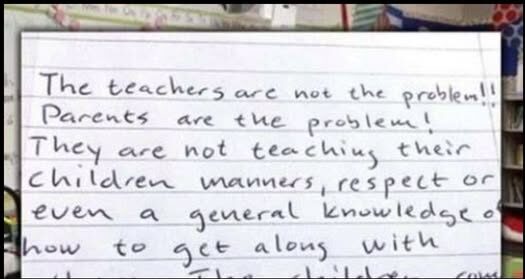
One retired teacher entered that debate in a particularly direct way when she wrote an open letter criticizing the tendency to blame educators for problems she believed began at home.
The teacher, Lisa Roberson, wrote the letter in 2017. It was published in the Augusta Chronicle and later spread widely online.
Years later, her words continue to generate discussion because they address an argument that remains familiar: when schools are struggling, how much responsibility belongs to teachers and how much belongs to parents?
The Letter Was Written Before the Pandemic
Roberson’s comments were written several years before the COVID pandemic dramatically changed education.
That timing is important because the letter was not a reaction to remote learning, school closures or the educational disruptions that followed the pandemic.
Instead, it focused on concerns that were already being debated in American schools in 2017.
During the pandemic, schools later underwent sweeping changes designed to keep students learning under unprecedented circumstances.
Those changes created additional disagreements among parents, educators and communities about how schools should operate.
Roberson’s letter therefore belongs to an earlier stage of the education debate, but many of the issues she raised remained recognizable afterward.
A Retired Teacher Pushes Back Against Critics
Roberson opened her letter by challenging people who attempt to reform public education without recent classroom experience.
Her frustration was clear.
“As a retired teacher, I am sick of people who know nothing about public schools or have not been in a classroom recently deciding how to fix our education system,”
Her argument was that teachers were being unfairly treated as the central cause of educational problems.
Instead, she believed too little attention was being paid to what children were learning before they ever entered the classroom.
Roberson then made the central point of her letter unmistakable.
“The teachers are not the problem! Parents are the problem! They are not teaching their children manners, respect or even general knowledge of how to get along with others.
Her criticism focused heavily on behavior, responsibility and preparation.
In her view, teachers were being expected to solve problems that should have been addressed by families before students arrived at school.
School Supplies Became One Example of the Larger Problem
Roberson used classroom supplies to illustrate what she considered a troubling imbalance in priorities.
She described students arriving with expensive personal items while lacking basic materials necessary for class.
“The children come to school in shoes that cost more than the teacher’s entire outfit, but have no pencil or paper. Who provides them? The teachers often provide them out of their own pockets.
The observation reflected a frustration familiar to many educators: teachers sometimes purchase classroom materials themselves when students arrive without what they need.
For Roberson, however, the issue was not simply the cost of pencils or paper.
She viewed it as evidence of a larger question about responsibility.
If a student arrives at school without basic supplies, she argued, it should not automatically become the teacher’s obligation to solve the problem.
She Asked People to Look More Closely at the Meaning of a “Failing” School
One of the strongest sections of Roberson’s letter challenged the way people judge schools that receive poor results or are publicly described as failing.
Rather than looking only at teachers or administrators, she encouraged people to examine the level of involvement shown by families and students.
“When you look at schools that are “failing,” look at the parents and students. Do parents come to parent nights? Do they talk with teachers regularly? Do they make sure their children are prepared by having the necessary supplies? Do they make sure their children do their homework?
The questions were deliberately practical.
Roberson was not discussing complicated education policy or curriculum design.
She was asking whether parents attend school events, communicate with teachers and make sure children are prepared to participate.
Those basic actions, in her view, could significantly influence what happens inside a classroom.
Communication Between Parents and Schools Was Central to Her Argument
Roberson continued by questioning whether schools are even able to maintain reliable contact with every family.
“Do they have working telephone numbers? Do the students take notes in class? Do they do their homework? Do the students listen in class, or are they the sources of class disruptions?
Her argument expanded beyond parental participation and placed responsibility on students as well.
She asked whether students were actively listening, taking notes and completing assignments.
She also questioned whether disruptive behavior was interfering with learning.
For Roberson, those details mattered when deciding whether a school itself had actually failed.
A teacher can prepare a lesson, but that does not guarantee students will participate.
A school can create opportunities for communication, but that does not guarantee parents will respond.
Those were the distinctions at the heart of her criticism.
Teachers Cannot Perform Every Role, Roberson Argued
Roberson concluded the letter with an especially forceful statement about what she believed educators could realistically accomplish.
“When you look at these factors, you will see that it is not schools that are failing but the parents. Teachers cannot do their jobs and the parents’ job. Until parent step up and do their job, nothing is going to get better!”
The statement summarized her entire position.
She believed schools were being asked to compensate for responsibilities that belonged primarily to families.
In her view, teachers could educate students, manage classrooms and provide support, but they could not completely replace parental guidance.
The strong language immediately made the letter controversial.
Why the Letter Spread So Widely
The letter gained attention because it expressed a frustration many people recognized, even if they did not agree with every conclusion.
Teachers who had experienced disruptive classrooms or purchased supplies with their own money could identify with parts of Roberson’s message.
Some parents also agreed that family involvement is essential to academic success.
Others objected to the broad suggestion that parents were the primary reason schools struggle.
The disagreement helped the letter spread because it invited people to take sides on a complicated issue using very direct language.
Instead of presenting a long policy argument, Roberson focused on everyday classroom experiences.
Homework, pencils, parent nights, classroom behavior and communication are situations familiar to families and educators alike.
The Letter Raises Questions About Where Education Begins
One of the deeper issues behind Roberson’s argument is whether education begins at school or at home.
Teachers are responsible for academic instruction, but children arrive in classrooms with habits and expectations already forming.
Roberson believed manners, respect and the ability to interact appropriately with others should be developed primarily within the family.
When those foundations are missing, she argued, teachers must spend classroom time addressing behavior rather than teaching.
That can affect not only the individual student but everyone else in the room.
A teacher attempting to manage repeated disruption may have less time available for instruction.
Roberson’s letter framed that problem as one that cannot be solved entirely through school reform.
Parents Can Influence What Happens Long Before the School Day Begins
The questions in the letter suggest that Roberson viewed preparation as an ongoing family responsibility.
Checking homework, ensuring children have school supplies and communicating with teachers may seem like small actions.
Taken together, however, they create routines around education.
Roberson’s position was that teachers cannot create those routines alone.
If a student repeatedly arrives without materials, ignores assignments or receives no reinforcement at home, the educator has limited control over what happens after the school day ends.
This was one reason she objected to blaming teachers whenever student performance declined.
Teachers Still Carry Significant Responsibility
The controversy surrounding the letter also reflects the fact that education cannot realistically be explained by one group alone.
Teachers remain responsible for instruction, classroom management and creating an environment where students can learn.
Parents, meanwhile, influence attendance, preparation, expectations and behavior outside school.
Students themselves also make choices about whether they complete work, listen, participate and respect classroom rules.
Roberson’s letter intentionally emphasized the responsibilities she believed were being overlooked.
That emphasis is one reason her words produced such a strong response.
The Debate Is Larger Than a Single Classroom
Discussions about struggling schools often involve far more than one teacher or one family.
People may disagree about funding, discipline, curriculum, class size, administrative policies and the role of government in education.
Roberson’s letter did not attempt to address every possible factor.
Instead, it challenged what she saw as an overly simple tendency to place responsibility on educators.
Her point was that school performance should also be examined through the behavior and involvement of students and parents.
That argument resonated with many readers because it shifted attention away from institutions and toward everyday choices made inside individual homes.
Parent Nights Became a Symbol of Involvement
One of Roberson’s questions concerned whether parents actually attend school events.
Parent nights are designed to create communication between families and educators.
For teachers, those meetings can provide an opportunity to discuss progress, behavior, assignments and concerns before problems become more serious.
Roberson suggested that when families do not participate, schools lose an important connection.
Her criticism was not simply that parents should appear at an event.
It was that education works differently when the adults responsible for a child remain actively connected to what is happening in the classroom.
Homework Was Another Point of Responsibility
Roberson repeatedly mentioned homework because it is one of the clearest places where school and home overlap.
A teacher can assign the work and explain it during class.
The student must ultimately complete it outside the classroom.
Parents may also influence whether homework is treated as important.
Roberson believed that when students repeatedly arrive without assignments completed, responsibility should not automatically fall on the teacher.
Her questions challenged readers to examine the entire process surrounding the student.
Classroom Behavior Can Affect Everyone
The retired teacher also focused on students who create disruptions.
A classroom is a shared environment.
When one student repeatedly interrupts lessons or ignores instructions, the consequences can extend to classmates who are trying to learn.
Roberson argued that teachers cannot be expected to solve every behavioral problem without support from home.
Her broader message was that discipline requires consistency.
If expectations at school are not reinforced elsewhere, teachers may struggle to maintain the environment needed for effective instruction.
Why Some Readers Strongly Disagreed
The letter’s broad language also invited criticism.
Not every parent who struggles to attend school events is uninvolved.
Families can face work schedules, transportation problems, financial pressure and other challenges that make participation difficult.
Students may also struggle academically or behaviorally for reasons that cannot be reduced to a lack of parental effort.
That is why the debate surrounding Roberson’s letter became more complicated than a simple choice between blaming teachers or blaming parents.
Her words were deliberately blunt, but the issues surrounding education are rarely that simple.
The Letter Still Resonates Because Responsibility Remains a Difficult Question
Years after its publication, Roberson’s message continues to circulate because it raises a question with no easy answer.
Who is responsible when a child struggles in school?
Teachers have an important role.
Parents have an important role.
Students themselves also have responsibilities.
Roberson believed public conversations had become too focused on educators while ignoring what happens outside school.
Her letter was an attempt to move some of that attention back toward family involvement.
A Viral Message That Continues to Divide Opinion
Lisa Roberson’s 2017 letter became memorable because it said directly what some educators had been saying more cautiously for years.
She believed teachers were being asked to carry responsibilities that extended well beyond teaching.
Her examples involved school supplies, homework, manners, communication and classroom discipline.
To supporters, those observations represented common sense.
To critics, placing the blame primarily on parents oversimplified the challenges faced by public schools.
The disagreement explains why the letter continued circulating long after its original publication.
It forces readers to think about education not simply as something delivered by a school, but as a partnership requiring participation from several sides.
The Central Question Has Never Completely Gone Away
Roberson’s letter was written before the pandemic, before remote learning reshaped classrooms and before another wave of public debate over education.
Yet its central question remains recognizable.
Teachers can provide instruction and structure during the school day, but their influence has limits.
Parents can encourage preparation, responsibility and respect, but they cannot control everything that happens inside a classroom.
Students must also participate in their own education.
The success or failure of a school therefore cannot always be explained by pointing toward one group.
Roberson nevertheless wanted readers to reconsider the assumption that educators should automatically receive the blame.
Her message remains controversial precisely because it challenges people to examine responsibilities closer to home.
A Conversation That Continues Years Later
Whether readers agree with Lisa Roberson or strongly reject her conclusions, the letter succeeded in starting a conversation.
It asked people to consider what teachers can reasonably be expected to accomplish and what must happen outside the classroom for education to succeed.
It also highlighted the frustration that can arise when educators feel responsible for problems they believe they cannot solve alone.
Parents, teachers and students all influence the school experience in different ways.
That reality makes assigning complete responsibility to any single group difficult.
Roberson clearly believed parents needed to assume a much larger share of accountability.
Years after she wrote those words, people are still debating whether she identified an uncomfortable truth or placed too much responsibility on families.
That continuing disagreement may be the strongest indication of why her letter became so widely discussed in the first place.