
Iowa Family Hid a Secret Message in Their Father’s Headstone — Then Officials Took a Closer Look
A Memorial That Looked Completely Traditional
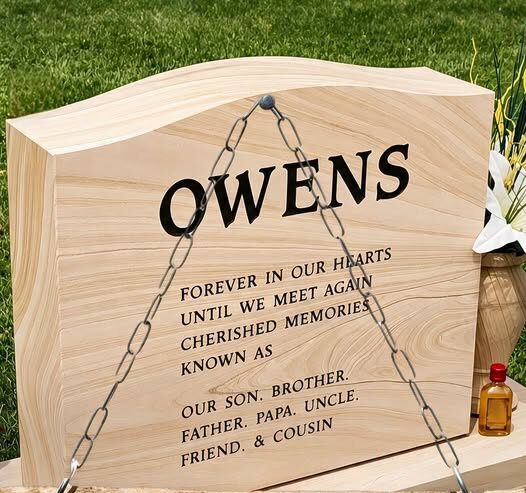
At first glance, the polished black headstone honoring Steven Paul Owens appears to be a conventional family memorial.
The monument stands inside Warren-Powers Cemetery in rural Polk County, Iowa, and contains several lines remembering Owens as a loved and important member of his family.
Nothing about the inscription immediately appears unusual.
But the family deliberately arranged the wording so that the first capital letter of each line creates a second message when read vertically from top to bottom.
That hidden message turned an otherwise traditional grave marker into the center of a dispute involving the Owens family, local residents, cemetery officials, and township leaders.
Steven Paul Owens Died at 59
Steven Paul Owens died in September 2021 at the age of 59.
When his children began planning his memorial, they wanted something that reflected more than a formal description of his family relationships.
They wanted the headstone to capture the humor and personality of the man they remembered.
The final inscription appeared respectful and conventional when read normally.
It consisted of seven lines:
“Forever in our hearts / Until we meet again / Cherished memories / Known as: / Our son, brother, father, papa, uncle / Friend & / Cousin.”
But the capital letters beginning those lines were chosen carefully.
The First Letters Reveal the Family’s Private Joke
Reading the inscription horizontally presents a familiar memorial message about love, memory, and family.
Reading the first letter of each line vertically produces a profanity-laced phrase.
The hidden wording was intentional.
It was designed as an acrostic, allowing the family to place a private joke into the memorial without printing the phrase openly across the stone.
For Owens’ children, the message was not meant simply as vulgar language.
They believed it reflected the distinctive way their father communicated with people he cared about.
The Headstone Was Installed in May 2022
The memorial was installed at Warren-Powers Cemetery on May 27, 2022.
Its appearance quickly attracted attention after people recognized what the first letters spelled.
The reaction was divided.
For the Owens family, the monument was a deeply personal representation of their father’s humor.
For township officials and some members of the surrounding community, the hidden message raised questions about what kind of language should be permitted in a shared cemetery.
The disagreement soon moved beyond the family itself.
Township Officials Object to the Hidden Phrase
The Camp Township Board of Trustees objected to the wording and moved toward having the headstone removed.
Officials argued that the cemetery was a public space used by many families and that standards of decency therefore applied to monuments placed there.
The township’s concern was not limited to whether the Owens family personally considered the message acceptable.
Officials believed they also had to consider everyone else who visited the cemetery.
“People have the right for decency, not just the one family,” a township representative said in a statement.
Officials Worried About Setting a Precedent
Township leaders also raised concerns about what could happen if the inscription remained in place.
Allowing one family to include profanity, even through an acrostic, could make it harder to reject similar or more explicit requests in the future.
From that perspective, the dispute became about cemetery oversight rather than simply one unusual headstone.
If officials allowed one unconventional memorial because the wording had personal significance, other families might expect the same freedom.
The township therefore viewed the situation as a question of where to establish a consistent boundary.
The Family Says the Message Captured Their Father Perfectly
Owens’ children strongly disagreed with the effort to remove the marker.
They argued that the hidden phrase represented their father’s actual personality and the unconventional way he expressed affection.
His daughter, Lindsay Owens Andrews, explained that the phrase carried a very different meaning within their family than strangers might assume.
“If he didn’t like you, he didn’t speak to you,” Lindsay told local reporters. “If you got him to tell you to f*** off, it meant he liked you.”
To the family, that context transformed the wording from an insult into a familiar expression connected to their memories of Owens.
His Children Say They Never Intended to Offend Anyone
Owens’ son, Zachary Owens, also defended the decision.
He said the family had not created the monument to provoke strangers or deliberately cause controversy.
Instead, they wanted the memorial to resemble the father they actually knew rather than presenting a sanitized version of his personality.
“No one’s forcing anyone to come out and look at it,” Zachary told KCCI-TV. “We did it because it was our father and we love him.”
The family viewed the stone as something created primarily for those who knew and loved Owens.
The Dispute Began Before the Stone Was Installed
The disagreement did not begin only after visitors noticed the hidden message.
Township trustees had already instructed the memorial company not to place the monument in the cemetery.
Despite that instruction, the manufacturer installed the headstone on May 27, 2022.
Once it was in place, township leaders were faced with a more complicated situation.
Instead of deciding whether to approve a proposed inscription, they had to determine whether an existing family memorial should be physically removed.
Township Officials Consider Legal Action
After the installation, township officials consulted legal counsel about possible removal of the stone.
That step elevated what might otherwise have remained a disagreement between a family and cemetery managers into a legal and community dispute.
The central question was no longer whether the hidden message was tasteful.
The issue became whether local cemetery authorities had the right to require its removal and whether the family’s desire to memorialize Owens in a personal way should prevail.
Both sides believed they were defending something important.
The Family Sees Humor Where Others See Profanity
The disagreement illustrates how the same words can have dramatically different meanings depending on context.
To someone who never knew Steven Owens, the acrostic may appear to be nothing more than profanity placed in a cemetery.
To his children, it was an inside joke connected directly to their father’s personality.
The family did not choose random offensive language.
They selected a phrase they said Owens regularly used with people he liked.
That personal meaning became the foundation of their defense of the memorial.
Cemeteries Are Both Personal and Shared Spaces
The controversy became difficult because cemeteries occupy two roles at the same time.
A grave marker is intensely personal to the family of the person buried beneath it.
It preserves a name, relationships, dates, memories, and sometimes elements of personality.
At the same time, the grave does not exist entirely in private.
It sits among other graves in a space regularly visited by families mourning their own loved ones.
The Owens dispute brought those two realities into direct conflict.
Traditional Memorials Are Becoming More Personal
The Owens family’s decision also reflects a broader change in the way some families approach memorialization.
Not every family wants a headstone limited to solemn phrases and traditional language.
For some, humor is an important part of remembering someone accurately.
A funny line, unusual nickname, private saying, or unconventional inscription can preserve a part of a person’s character that formal wording might miss.
For families who shared humor during life, continuing that humor after death may feel natural rather than disrespectful.
But Personal Expression Can Create Public Conflict
The challenge appears when that private expression is displayed permanently in a communal setting.
The Owens family believed they were speaking about one specific man and honoring him in a way he would have understood.
Township officials had to think about the cemetery as a whole.
Their concern was that permitting profane wording could make standards difficult to enforce in future cases.
A phrase considered affectionate by one family could be deeply offensive to another.
That tension made an easy compromise difficult to find.
The Acrostic Made the Situation Even More Unusual
The wording was not openly displayed as a single profane sentence.
The message was hidden within an otherwise respectful seven-line inscription.
A casual visitor could easily read the headstone without recognizing the secondary meaning.
Only someone who noticed the arrangement of the first letters would discover the joke.
That design allowed the family to combine a traditional memorial with something far more irreverent.
It also made the dispute unusual because the controversial phrase existed both visibly and indirectly at the same time.
The Headstone Became Part of Owens’ Story
Before the controversy, the inscription was intended to preserve a small part of Steven Owens’ personality for his family.
After the dispute began, the headstone itself became part of the story people associated with him.
The argument over its wording reflected exactly the kind of unfiltered humor his children said he possessed.
For his family, removing the monument would therefore mean removing something they believed genuinely represented him.
They remained determined to defend their choice.
Township Leaders Viewed the Issue Differently
Local officials were not responsible only for one family’s memorial.
They had obligations involving the cemetery as a shared community property.
Their objection focused on standards and the possibility that allowing the Owens stone to remain would undermine their ability to regulate future monuments.
The question therefore became larger than whether anyone personally found the inscription funny.
It involved what rules should apply equally to everyone using the cemetery.
A Debate About Who Gets the Final Word
At its heart, the controversy raised a simple but difficult question: who gets to decide how someone should be remembered?
The family knew Steven Owens personally and believed the acrostic perfectly represented him.
Cemetery officials were responsible for determining what could appear permanently within a shared public space.
Neither position was entirely disconnected from the purpose of a cemetery.
Families naturally want control over the words placed beside their loved ones.
Communities also maintain rules designed to preserve an environment that can be comfortably shared by many different people.
What Began as an Inside Joke Became a Community Dispute
The Owens family never expected the headstone to become the center of a larger conversation about expression and decency.
They said their intention was simple: remember their father honestly.
The hidden message was part of that honesty.
Township officials, however, believed allowing the inscription to remain could create problems extending far beyond this one grave.
As a result, a private family joke became a public debate involving legal counsel and cemetery policy.
A Memorial Designed to Sound Like the Man Himself
Steven Paul Owens died at 59 in September 2021.
His children could have chosen a conventional epitaph and ended the matter there.
Instead, they created an inscription that looked traditional while quietly preserving a piece of his unfiltered humor.
That choice brought criticism, threatened removal, and a debate over the limits of personal expression in a cemetery.
Yet the family continued to insist that their intention had never been to insult strangers.
They wanted their father’s memorial to sound like their father.
The Final Message Remains About Memory
Behind the controversy is a family trying to determine what should remain after someone they loved is gone.
The polished stone includes familiar words about being forever remembered, cherished, and connected through family.
Hidden inside those words is a joke that only makes sense when viewed through the personality of the man being memorialized.
For township leaders, that hidden phrase created a problem involving community standards.
For the Owens children, it preserved something deeply recognizable about their father.
The dispute therefore became more than an argument about a few letters engraved in stone.
It became a debate over whether a cemetery memorial should reflect traditional standards of public decorum or the authentic personality of the person whose name it carries.
For the Owens family, the answer has remained clear.
They believe their father deserved a final message that was unmistakably his own.