
Viral Beetroot Drink Claim Sparks Attention With Promises About Cancer, Diabetes and Liver Disease
A Bold Health Claim Is Circulating Around a Deep-Red Beetroot Drink
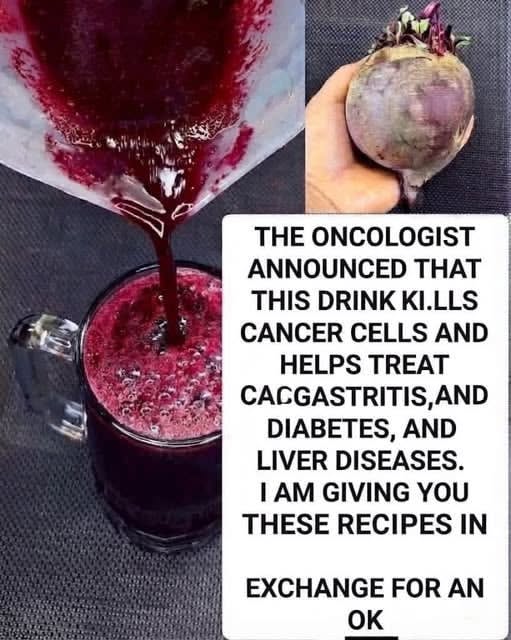
A striking image showing a dark red drink alongside a whole beetroot has attracted attention because of the extraordinary medical claims written across it.
The message says that an oncologist announced the drink can kill cancer cells and help treat gastritis, diabetes, and liver diseases.
Those are extremely serious claims involving several very different medical conditions.
However, the image itself does not identify the oncologist, provide a medical study, explain the ingredients of the drink, or offer evidence showing that the claimed treatments were scientifically established.
That distinction is important whenever a food or homemade beverage is presented as a treatment for major illnesses.
The Drink Appears to Be Based on Beetroot
The photograph prominently features a beetroot beside a glass filled with a deep burgundy liquid.
The color and presentation strongly suggest that beetroot is intended to be the main ingredient being promoted.
Beetroot is widely recognized as a food and can be consumed in several forms, including cooked, raw, blended, or juiced.
But a food being nutritious is not the same as proving that it can cure or treat serious medical conditions.
The image makes a much stronger promise than simply saying beetroot can be part of a balanced diet.
The Most Dramatic Statement Concerns Cancer
The strongest wording in the image is the claim that the drink “kills cancer cells.”
That kind of statement can easily be interpreted as suggesting that consuming the beverage can directly treat cancer.
Nothing visible in the image demonstrates that conclusion.
There is no description of a clinical trial, no dosage information, no explanation of which type of cancer is supposedly affected, and no evidence showing how the claim was tested.
Cancer is also not a single disease, making sweeping claims about one drink especially important to examine carefully.
Mentioning an Oncologist Gives the Message an Appearance of Authority
The text specifically says that “the oncologist” announced the supposed benefits.
Using a medical title can make a claim sound more trustworthy because oncology is a field associated with cancer diagnosis and treatment.
Yet the image gives no name.
It provides no hospital, clinic, medical organization, or other information that would allow the statement to be evaluated.
The authority implied by the wording therefore cannot be confirmed from the material presented.
The Image Also Makes Claims About Gastritis
Alongside cancer, the message says the drink helps treat gastritis.
Gastritis refers to inflammation involving the stomach lining, but the image offers no explanation for why the pictured drink would be considered a treatment.
No preparation method is provided.
No amount or frequency is specified.
No details are included about the circumstances in which the drink is supposedly useful.
As presented, the statement is simply an assertion.
Diabetes Is Included in the Same Sweeping Promise
The image also lists diabetes among the conditions the drink supposedly helps treat.
This is another major medical claim that should not be treated casually.
Diabetes involves blood-sugar regulation and can require ongoing medical management.
A social-media image showing a vegetable drink does not, by itself, establish that the beverage can treat the condition.
People seeing such posts may understandably become interested because simple food-based solutions can sound appealing.
That appeal makes careful interpretation especially important.
Liver Disease Is Mentioned Without Any Further Explanation
The claim extends even further by stating that the drink can help treat liver diseases.
Once again, no specific condition is identified.
The term covers a broad range of possible health problems, yet the image presents them together as though one drink could address them collectively.
No supporting information appears alongside the statement.
This makes the wording far more definitive than the evidence visible in the post.
One Image Combines Several Very Different Illnesses
Another reason the post stands out is the number of conditions it places together.
Cancer, gastritis, diabetes, and liver disease involve different organs, causes, symptoms, and forms of medical management.
When one beverage is promoted as helping with all of them at once, the claim becomes especially broad.
That does not automatically mean a food has no nutritional value.
It means nutritional value and proven medical treatment should not be confused.
The Image Promises Recipes but Does Not Actually Show Them
The wording also says that recipes are being offered “in exchange for an OK.”
This is a familiar engagement-driven format often used in social-media posts.
The viewer is encouraged to respond before receiving additional information.
However, the visible material contains no actual recipe.
There are no quantities, preparation instructions, or ingredients beyond the visual suggestion of beetroot.
Anyone seeing only the image therefore does not actually know what the supposed drink contains.
The Photograph Can Make the Claim Feel More Convincing
The image is visually simple but effective.
A whole beetroot appears at the top, while a thick red liquid is being poured into a glass.
The color creates an immediate connection between the vegetable and the beverage.
Beside it, the large block of text presents the medical claims in capital letters.
This combination can make the statement memorable even though the post provides very little supporting information.
A Natural Ingredient Is Not Automatically a Medical Treatment
Foods and vegetables can certainly be part of healthy eating habits.
But descriptions such as natural, homemade, or plant-based do not automatically establish that something can treat disease.
The image moves directly from showing beetroot to making claims about serious illnesses.
It does not explain the steps between those two ideas.
That missing information is precisely what would be necessary before such claims could reasonably be treated as medical conclusions.
The Phrase “Kills Cancer Cells” Requires Particular Caution
Claims that something “kills cancer cells” are especially powerful because they can sound like evidence of a cure.
Yet there is a major difference between a substance affecting cells under particular experimental circumstances and a drink being proven to treat cancer in people.
The image does not provide enough information to determine what the claim is based on.
It does not say whether any testing was performed or how the conclusion was reached.
For that reason, the wording should not be interpreted as proof that drinking the beverage can replace cancer treatment.
The Lack of Specific Information Is Noticeable
Reliable medical guidance normally requires considerably more detail than appears in this post.
The image does not identify who created the recipe.
It does not name the medical professional supposedly making the announcement.
It does not identify a study.
It does not explain which patients were involved.
It does not describe potential limitations, side effects, or interactions.
Instead, several major health promises are compressed into a few lines of text.
Simple Remedies Can Be Especially Attractive to People Facing Serious Illness
The emotional appeal of messages like this is easy to understand.
Serious medical conditions can involve complicated treatments, uncertainty, expense, and fear.
A familiar vegetable transformed into a simple drink can appear reassuring by comparison.
That is precisely why dramatic health claims involving everyday foods can spread quickly.
The solution sounds accessible, inexpensive, and easy to prepare.
But emotional appeal does not establish medical effectiveness.
The Post Should Not Be Read as Evidence That Treatment Is Unnecessary
Nothing in the photograph demonstrates that people diagnosed with cancer, diabetes, gastritis, or liver disease can safely replace medical treatment with the pictured drink.
The image does not provide enough information to justify such a decision.
A person dealing with one of these conditions could face serious consequences if treatment were delayed or abandoned because of an unsupported online claim.
Food and beverages can be discussed as part of diet, but that is fundamentally different from claiming that they replace medical care.
Beetroot Can Still Be Viewed as Food Without Making Extraordinary Promises
The caution surrounding the post does not require treating beetroot itself as something negative.
The issue is the strength of the claims attached to it.
A vegetable can be enjoyed as food without being promoted as a cure.
A juice can be consumed because someone likes its taste or wants to include it in their diet without assuming that it will eliminate cancer cells or treat several unrelated diseases.
Separating those two ideas makes the discussion much clearer.
The Image Gives No Information About Who Should Avoid the Drink
Another missing element is any discussion of individual circumstances.
The post addresses everyone as though the same drink would have the same effect for every person.
There is no reference to existing treatment, medications, individual health conditions, or dietary restrictions.
This is another reason broad medical promises made through a single graphic should be interpreted cautiously.
Health Claims Deserve More Than a Viral Caption
Major medical conclusions require evidence that can be examined.
A photograph and a bold sentence can attract attention, but they cannot answer the many questions raised by statements involving cancer or chronic disease.
Who tested the drink?
What exactly was in it?
How much was used?
What condition was treated?
How were the results measured?
None of those answers appears in the image.
The Word “Treat” Carries Significant Meaning
The post does not simply say that the beverage tastes good or contributes nutrients to a diet.
It specifically presents the drink in connection with treating illnesses.
That wording raises the standard of evidence considerably.
A treatment claim implies that the intervention can meaningfully affect the course of a medical condition.
The photograph does not provide evidence sufficient to establish that.
Why Posts Like This Can Spread So Quickly
The structure of the message is designed to attract attention immediately.
It combines a vivid red beverage, a recognizable vegetable, the authority of an unnamed oncologist, several frightening diseases, and the promise of a recipe.
The viewer is then encouraged to respond.
Each part makes the post more likely to trigger curiosity.
That does not mean the medical claims become more reliable simply because the presentation is persuasive.
The Safest Interpretation Is Also the Simplest
What the image clearly shows is a beetroot, a dark-red drink, and a collection of dramatic health claims.
What it does not show is evidence establishing those claims.
That distinction should remain central when interpreting the post.
Someone may choose to consume beetroot or beetroot juice as part of their normal diet, but doing so should not be confused with receiving proven treatment for cancer, diabetes, gastritis, or liver disease.
A Viral Claim Should Never Replace Individual Medical Advice
People diagnosed with serious medical conditions often require treatment plans tailored to their individual circumstances.
An image shared online cannot account for those differences.
It cannot review medical history, current medications, test results, or the exact nature of a diagnosis.
That is particularly important when a post makes claims involving conditions as serious as cancer and diabetes.
Anyone considering major dietary changes because of an existing illness should discuss them with an appropriate healthcare professional rather than relying on a viral image.
The Beetroot Drink May Be Eye-Catching, but the Claims Go Much Further
The deep-red drink shown in the image is likely to capture attention, especially alongside promises involving multiple diseases.
But the strength of a claim should be matched by the strength of its evidence.
In this case, the image does not provide the information necessary to verify that the beverage kills cancer cells or treats the other conditions listed.
The most responsible conclusion is therefore not that beetroot is a miracle cure.
It is that dramatic health claims deserve careful scrutiny before they influence important medical decisions.