
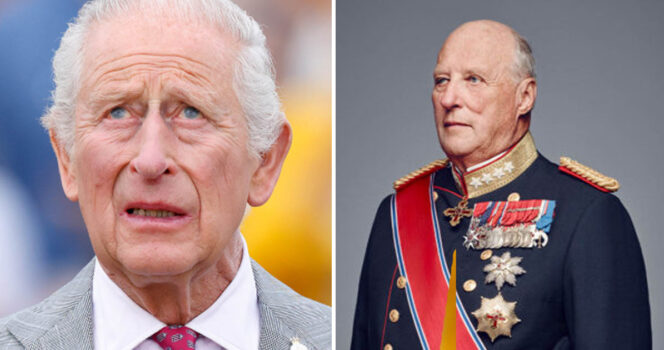
King Charles Pays Moving Tribute After the Death of Norway’s King Harald V at 89
Norway Mourns the Loss of Its Longtime King
Norway is mourning after the death of King Harald V, who spent 35 years on the throne and became one of the country’s most familiar and respected public figures.
The Norwegian royal house confirmed that Harald died peacefully at Rikshospitalet in Oslo on Friday, August 28, 2026.
He was 89 years old.
The announcement immediately prompted condolences from across Europe and beyond.
Among the most personal came from Britain’s King Charles III, who described Harald not only as a fellow monarch but also as a relative and longtime friend.
The Royal Palace Confirmed His Death
Norway’s royal household announced that King Harald died at 6:35 a.m.
Members of the royal family had been spending time at the hospital as his condition became increasingly serious.
Harald had been admitted earlier in August and was being treated for a bacterial infection in his blood.
The palace said he had initially responded to antibiotic treatment.
His health later deteriorated.
By August 27, officials described his condition as very serious.
The following morning, the palace announced his death.
King Charles Responds to the News
Within hours, King Charles released a message on behalf of himself, Queen Camilla, and the wider British royal family.
His words reflected both the official relationship between Britain and Norway and the personal bond between their royal families.
Charles said he and his wife had learned of Harald’s death with profound sadness.
He referred to the Norwegian monarch as his “dear cousin.”
That family connection made the tribute especially personal.
Charles Praised Harald’s 35 Years of Service
King Charles highlighted the length and character of Harald’s reign.
Harald became king in 1991 following the death of his father, King Olav V.
Over the next 35 years, Norway changed dramatically.
Its economy grew.
Its international role expanded.
Its society became more diverse.
And the monarchy itself adapted to changing expectations.
Charles credited Harald with guiding the country through that transformation with warmth, humility, and dedication.
A Tribute to a Relative and Friend
Charles’s message went beyond diplomatic language.
He said his entire family remembered Harald as a much-loved relative and friend whose kindness, compassion, and sense of duty had remained visible across decades.
The tribute reflected the unusually close connections among Europe’s royal families.
Britain and Norway share links that extend well beyond modern diplomacy.
Their royal families are related through Queen Victoria’s descendants and through Princess Maud of Wales, who became Queen of Norway.
The Family Connection Goes Back Generations
Princess Maud was the daughter of Britain’s King Edward VII.
She married Prince Carl of Denmark, who later became King Haakon VII of Norway after Norwegian independence in 1905.
Maud became Queen of Norway.
Their son became King Olav V.
Olav was King Harald’s father.
That makes the British and Norwegian royal houses closely connected through generations of family history.
For Charles, the relationship was therefore not simply ceremonial.
Britain and Norway Share a Long Historical Relationship
Charles also referred to the broader relationship between the two countries.
Britain was among the first nations to recognize Norwegian independence and establish diplomatic relations in 1905.
The two countries became even more closely connected during the Second World War.
When Germany invaded Norway in 1940, the Norwegian royal family and government eventually continued their work from exile.
Britain played an important role during that period.
Those shared experiences created political and personal ties that endured long after the war ended.
Harald Was Born Into a Royal Family in Exile and War
King Harald was born on February 21, 1937.
His early childhood was shaped by the Second World War.
After Germany invaded Norway, members of the royal family were forced to leave.
Harald spent part of his childhood abroad before eventually returning to Norway.
Those early experiences became part of the historical background of a king who would later become a symbol of stability and continuity.
He Became Crown Prince in 1957
Harald became crown prince when his father ascended the throne as King Olav V in 1957.
From that point, he spent decades preparing for his eventual role as monarch.
He represented Norway internationally.
He performed official duties.
And he developed the public style that would later define his reign.
Harald was generally seen as approachable, calm, and less formal than many earlier European royals.
His Marriage to Sonja Changed Norwegian Royal History
One of the defining personal stories of Harald’s life was his relationship with Sonja Haraldsen.
She was not born into royalty.
The couple faced years of uncertainty because a future king marrying a commoner remained controversial at the time.
Harald reportedly made clear that he did not intend to marry anyone else.
Eventually, his father approved the relationship.
Harald and Sonja married in 1968.
The marriage lasted nearly six decades.
Queen Sonja Remained Beside Him Throughout His Reign
When Harald became king in 1991, Sonja became queen.
Together, they represented Norway at home and internationally.
The couple became one of Europe’s longest-serving royal partnerships.
They raised two children, Princess Märtha Louise and Haakon, who would eventually succeed his father.
For many Norwegians, Harald and Sonja became familiar national figures whose public lives stretched across several generations.
Harald Became King in 1991
King Olav V died in January 1991.
Harald then became Norway’s king.
He took the traditional royal motto “Alt for Norge,” meaning “Everything for Norway.”
The words reflected a principle that remained closely associated with his reign.
Although Norway’s monarch does not govern politically, the king serves as a national symbol and performs extensive constitutional, ceremonial, and representative duties.
He Became Known as a Unifying Figure
Harald’s public role was often most visible during difficult national moments.
He spoke to the country after tragedies.
He attended memorials.
He met survivors and families.
His ability to communicate with warmth rather than distance helped strengthen public affection for him.
That quality became particularly important after the 2011 attacks in Oslo and on Utøya.
Harald’s presence during the period of national mourning helped reinforce his role as a symbol of unity.
His 2016 Speech Became Especially Memorable
One of Harald’s most widely remembered speeches came in 2016.
He spoke about what it meant to be Norwegian in a changing society.
The address emphasized diversity, belonging, faith, identity, and acceptance.
It became widely shared internationally because of its inclusive tone.
The speech reinforced Harald’s reputation as a monarch comfortable acknowledging that modern Norway looked different from the country he had known as a child.
He Remained Popular Throughout His Reign
Despite changes in attitudes toward monarchy across Europe, King Harald remained personally popular in Norway.
Polling repeatedly showed strong support for him.
His humor and informal style helped maintain that connection.
He was often photographed laughing during public events or speaking naturally with ordinary citizens.
That approach helped make the monarchy feel accessible rather than distant.
Sport Was an Important Part of His Life
Harald was also a passionate sailor.
Long before becoming king, he represented Norway in Olympic sailing competitions.
He participated in several Olympic Games and remained interested in sailing throughout his life.
Sport became another way the public related to him beyond formal royal duties.
He also regularly supported Norwegian athletes at international competitions.
His Health Became a Growing Concern in Recent Years
As Harald grew older, his health increasingly affected his official schedule.
He experienced several hospitalizations and periods away from public duties.
In 2024, he became ill while traveling in Malaysia.
He later received a permanent pacemaker.
Despite those difficulties, Harald repeatedly rejected the idea of abdication.
He described the role of king as a lifelong responsibility.
His Final Hospitalization Began in August
Harald’s final health crisis began in August 2026.
He was admitted to Rikshospitalet on August 17.
The palace later reported that he was receiving antibiotic treatment for a bacterial infection in his blood.
His condition was initially described as stable.
It then worsened.
Family members gathered at the hospital as concern grew across Norway.
Norway Waited for Updates
During the final days of Harald’s life, Norwegian media provided extensive coverage of his condition.
Members of the public gathered near the royal palace.
Political leaders altered schedules.
The royal family spent increasing amounts of time together.
When the palace described Harald’s condition as very serious, the country understood that the situation had become critical.
His Death Immediately Changed the Line of Succession
Under Norway’s constitutional system, the throne passed immediately to Harald’s son.
Former Crown Prince Haakon became King Haakon VIII.
There was no gap between reigns.
Haakon formally informed the Norwegian government of his father’s death later that day.
He also confirmed that he would retain the traditional royal motto “Alt for Norge.”
King Haakon Paid Tribute to His Father
The new king addressed the Norwegian people the following day.
His tribute was deeply personal.
He remembered Harald not only as a monarch but as a father, grandfather, husband, brother, and family figure.
Haakon described him as warm, safe, humorous, generous, and deeply committed to his values.
The speech gave Norwegians a glimpse of the man the royal family knew privately.
Queen Sonja Faces the Loss of Her Husband of Nearly 58 Years
For Queen Sonja, Harald’s death ended a relationship that had defined almost her entire adult life.
The couple married in 1968 after years of waiting for royal approval.
Their partnership survived enormous changes in Norwegian society and in the institution of monarchy.
Charles specifically included Sonja in his condolences.
He said he and Queen Camilla were sending their deepest sympathy to her and to the entire family.
Tributes Arrived From Around the World
King Charles was only one of many international leaders who responded.
Monarchs, presidents, prime ministers, and religious leaders offered condolences.
European royal families emphasized Harald’s personal warmth and decades of service.
Political leaders focused on his commitment to democracy, tolerance, and national unity.
The widespread reaction reflected both Norway’s international relationships and Harald’s unusually long time in public life.
A Musical Tribute Was Planned in Britain
Britain also prepared a ceremonial tribute to Harald.
His death was recognized through royal and military traditions reflecting the close relationship between the two monarchies.
Such gestures carry particular significance between royal families that share both political history and family connections.
Norway Began a Period of National Mourning
Flags were lowered and public memorials appeared throughout the country.
Thousands of people brought flowers, candles, and messages to royal sites.
Harald’s coffin was moved from the hospital to the Royal Palace.
Members of the public were given opportunities to pay their respects.
The funeral was scheduled to take place at Oslo Cathedral on September 9.
King Haakon VIII Begins His Reign
While Norway mourned Harald, constitutional life continued.
King Haakon VIII formally assumed his responsibilities as head of state.
His daughter Ingrid Alexandra became Crown Princess and first in line to the throne.
The transition marked the beginning of a new royal generation.
For many Norwegians, it was an emotional moment because Haakon had spent his entire public life preparing to succeed a father who remained widely admired.
Harald’s Legacy Will Be Closely Tied to Modern Norway
When Harald became king, Norway was a different country from the one he left behind 35 years later.
His reign covered economic transformation, growing international influence, social change, and national tragedy.
Through those decades, he largely maintained a reputation for stability and warmth.
His legacy is likely to be remembered less through political action than through tone.
He represented continuity while allowing the monarchy to adapt.
King Charles’s Words Reflected More Than Protocol
Royal condolence messages are naturally formal.
Charles’s tribute contained something more personal.
Calling Harald a dear cousin and beloved relative highlighted the family relationship behind the official connection.
The two men inherited crowns from separate countries, but they also inherited a network of family relationships connecting European royal houses across generations.
That is why Charles’s message carried meaning beyond ordinary diplomatic condolences.
A Farewell to a King and a Family Member
For Norway, August 28 marked the end of a reign that began in 1991.
For the Norwegian royal family, it marked the loss of a husband, father, grandfather, and brother.
For King Charles, it also meant saying goodbye to a relative and friend whose life had often run parallel to his own.
Harald spent decades representing Norway with a style built around duty, warmth, and accessibility.
Now his son begins a new chapter in the monarchy.
And as Norway prepares its final farewell, the tributes arriving from Britain and around the world show just how far King Harald’s relationships and influence extended beyond his own country.