
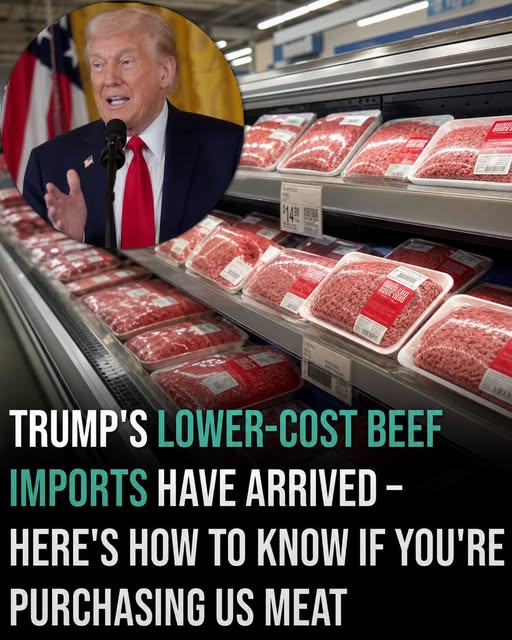
Buying Ground Beef? Here’s What “Product of USA” Really Means Under the New Rules
More Imported Beef Is Entering the U.S. Market
American shoppers facing high beef prices may soon encounter more imported beef in the supply chain following a temporary change announced by the Trump administration.
On August 26, 2026, President Donald Trump increased the amount of lean beef trimmings that can enter the United States under the lower tariff-rate quota.
The temporary increase totals 300,000 metric tons.
It is divided into three 100,000-metric-ton periods beginning September 1, October 1, and October 31.
The administration says the goal is to increase the supply available for ground beef and put downward pressure on consumer prices.
Why Lean Beef Trimmings Matter
Lean beef trimmings are commonly used in ground-beef production.
Processors can combine lean meat with fattier beef to produce ground beef with a desired fat percentage.
That means imported trimmings do not necessarily appear in stores as a separate product.
They may become part of ordinary packages of ground beef.
This has led many consumers to ask a simple question: How can you tell whether the beef you are buying is actually from U.S.-raised cattle?
Look for “Product of USA” or “Made in the USA”
One of the clearest indicators is a voluntary label stating “Product of USA” or “Made in the USA.”
Under USDA rules that became mandatory for companies using these claims on January 1, 2026, a single-ingredient meat product can carry those labels only when it comes from animals born, raised, slaughtered, and processed in the United States.
That is much stricter than the previous standard.
In earlier years, some imported meat could qualify for a U.S.-origin claim after relatively limited processing in America.
The new rule closed that loophole for companies choosing to use the claim.
But the Absence of That Label Does Not Automatically Mean Imported
This distinction is important.
“Product of USA” is a voluntary claim.
A package of American beef does not necessarily have to display it.
Therefore, if a package lacks those words, consumers should not automatically assume the meat came from another country.
It simply means the package is not making that specific USDA-regulated U.S.-origin claim.
Ground Beef Is Not Covered by Mandatory COOL
Another common misconception is that every package of ground beef in a supermarket must clearly identify where the cattle were raised.
That is not currently the case.
Congress removed beef, pork, ground beef, and ground pork from the federal mandatory Country of Origin Labeling program in 2015, with regulations updated in 2016.
As a result, retail ground beef generally does not have to carry the same mandatory country-of-origin information required for some other foods.
This is why simply searching for a country name on every ground-beef package may not always provide an answer.
A USDA Grade Does Not Tell You Where the Animal Came From
Labels such as “USDA Prime,” “USDA Choice,” and “USDA Select” are also frequently misunderstood.
Those terms refer to USDA quality grades.
They do not mean the cattle were necessarily born and raised in the United States.
The USDA inspection mark likewise indicates that the product was inspected under federal requirements.
It should not be interpreted by itself as proof of U.S. origin.
“Processed in the USA” Is Not the Same Claim
Consumers should also pay attention to the exact wording.
A statement describing where meat was cut, packaged, or processed is not necessarily the same as saying the animal was born and raised there.
Under the newer USDA rule, the phrases “Product of USA” and “Made in the USA” have a specific meaning when used on qualifying meat products.
Other geographic claims can describe more limited production steps.
Reading the full phrase is therefore more useful than simply seeing the letters “USA” somewhere on the package.
Why the Administration Increased Imports
The administration says the domestic cattle supply remains unusually tight.
The White House cited a U.S. cattle herd near its lowest level in decades, along with drought, wildfire conditions, disease concerns, and restrictions affecting cattle movements from Mexico.
USDA forecasts cited by the administration also indicate reduced U.S. beef production in 2026 compared with 2025.
At the same time, consumer demand remains strong.
The temporary tariff change is intended to make additional lean beef available for ground-beef production while ranchers work to rebuild domestic herds.
The 300,000 Tons Are Temporary
The new quota increase is not a permanent unlimited opening of the U.S. market.
It applies during a limited period in 2026.
The first 100,000 metric tons became eligible beginning September 1.
The second tranche begins October 1.
The final tranche begins October 31 and runs until the additional quota is filled or the end of November.
The administration has also directed officials to monitor whether the imported trimmings actually produce the expected price savings.
What Shoppers Should Remember
Consumers who specifically want beef from cattle born and raised in America now have a stronger labeling standard to look for.
“Product of USA” and “Made in the USA” have real meaning under the USDA rule that took effect in 2026.
But there are also two important cautions.
The claim is voluntary, so American beef may be sold without it.
And USDA quality grades such as Prime or Choice describe quality rather than country of origin.
The Exact Words on the Package Matter
With additional imported lean beef entering the U.S. supply chain, shoppers interested in origin should pay closer attention to labeling rather than relying on assumptions.
A USDA inspection symbol does not automatically mean U.S.-raised cattle.
A quality grade does not establish origin.
And the absence of a “Product of USA” claim does not automatically prove that meat is foreign.
But when a package of single-ingredient beef specifically says “Product of USA” or “Made in the USA” under the current USDA standard, consumers can know that the animal was born, raised, slaughtered, and processed in the United States.
For shoppers who care about where their beef comes from, those few words are now among the clearest clues on the package.