
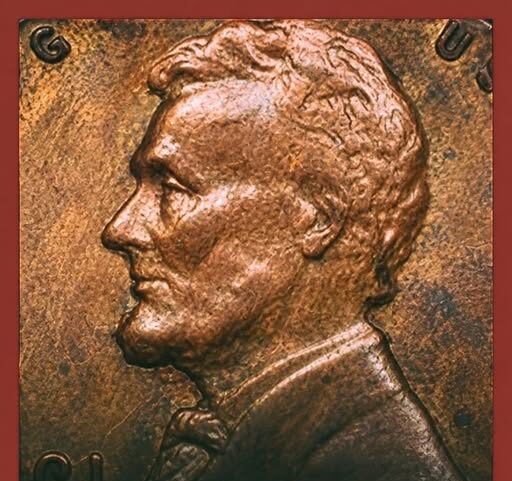
This 1943 Penny Sold for $336,000—Here’s Why Collectors Still Search for One
A Wartime Change at the U.S. Mint Accidentally Created One of America’s Most Famous and Valuable Lincoln Cent Errors
At first glance, it looks like an ordinary old penny.
Abraham Lincoln appears on the front.
Two wheat stalks frame the reverse.
The date reads 1943.
But one small detail changes everything.
The coin is bronze.
That is exactly what a normal 1943 Lincoln cent was not supposed to be.
And in July 2022, one Philadelphia 1943 Bronze Lincoln Cent graded PCGS AU50 sold at Heritage Auctions for an extraordinary $336,000.
Most 1943 Pennies Were Made From Steel
During World War II, copper was considered an important strategic material.
It was needed for wartime manufacturing, including electrical equipment and ammunition-related uses.
So for 1943, the U.S. Mint changed the Lincoln cent from its familiar bronze composition to zinc-coated steel.
More than a billion of the silvery-gray steel cents were produced across the Philadelphia, Denver and San Francisco mints.
Those regular steel cents remain common today.
But something went wrong during the transition.
A Few Old Bronze Blanks Apparently Remained Behind
Numismatists generally believe that a small number of bronze planchets—the blank metal discs used to make coins—remained in the production system after 1942.
Those leftover blanks were accidentally mixed with the new steel planchets.
They were then struck with 1943 Lincoln cent dies and released.
The result was a 1943 penny made from the previous year’s bronze alloy.
It became one of the most famous transitional errors in American coin collecting.
The Mistake Was Easy to Overlook
Imagine receiving one in change during the 1940s.
It still looked like a Lincoln cent.
It still had the familiar Wheat Cent design.
But while the ordinary 1943 coins were gray or silver-colored, the error pieces looked much more like traditional reddish-brown pennies.
That difference eventually attracted attention.
The First Confirmed Examples Created a Sensation
Rumors about copper-colored 1943 cents circulated almost immediately, but PCGS notes that confirmed examples began attracting serious attention during the 1940s.
Some genuine pieces were discovered in ordinary circulation, helping create the enduring dream that an extremely valuable penny could turn up in everyday change.
That story became part of American coin-collecting folklore.
Only a Tiny Number Are Known
Despite decades of searching, genuine examples remain exceptionally rare.
Current PCGS research lists roughly 15 to 17 confirmed Philadelphia examples, one known Denver example and six confirmed San Francisco examples.
That rarity explains why authenticated pieces can command enormous prices.
The $336,000 Coin Came From Philadelphia
One Philadelphia example graded AU50 by PCGS was sold by Heritage Auctions on July 17, 2022.
The final price was $336,000.
AU50 means the coin had circulated but retained substantial original detail.
For collectors, the combination of rarity, famous history and condition helped make it enormously desirable.
But $336,000 Is Not Even the Record
The most spectacular 1943 bronze cent is the unique example from the Denver Mint.
Only one 1943-D Bronze Lincoln Cent is known.
In 2010, that coin changed hands for $1.7 million.
That sale demonstrates just how dramatically value can vary depending on mintmark, condition, provenance and rarity.
San Francisco Examples Are Also Extremely Rare
The 1943-S Bronze Cent was struck at the San Francisco Mint.
PCGS currently lists only a handful of confirmed examples.
One AU58 example sold for $282,000 in 2016, while other authenticated specimens have brought six-figure prices.
For serious collectors, all three mint versions belong among the most desirable Lincoln cent errors ever produced.
How Can You Tell a Bronze 1943 Cent From a Normal One?
The simplest first check is a magnet.
A normal 1943 steel cent should be attracted to a magnet.
A genuine bronze example should not.
That does not prove a coin is authentic, but it can quickly eliminate many ordinary steel cents.
Weight Is Another Important Clue
PCGS says a genuine bronze 1943 cent should weigh approximately 3.11 grams.
A normal zinc-coated steel cent weighs about 2.70 grams.
A precise digital scale can therefore provide another useful preliminary test.
But weight alone is still not enough for authentication.
Collectors Also Examine the Number “3”
Because the coin is so valuable, altered dates have existed for decades.
One common fake starts with a 1948 cent and modifies the final digit to resemble a 3.
Experts therefore study the shape of the date carefully.
The final digit must match the genuine style used on authentic 1943 cents.
Some Fakes Are Simply Copper-Plated Steel Cents
Another common trick involves coating a normal 1943 steel cent with copper.
At first glance, the result can look convincing.
But the magnet test usually exposes it immediately.
If the supposedly bronze 1943 cent sticks strongly to a magnet, it is almost certainly a plated steel cent rather than the famous error.
Professional Authentication Is Essential
Because genuine examples can be worth six or even seven figures, collectors should not rely solely on appearance.
PCGS specifically emphasizes professional authentication because of the large number of altered and counterfeit coins associated with this famous error.
A legitimate specimen needs to survive detailed examination of its metal composition, weight, date style, strike characteristics and other diagnostics.
Condition Can Change the Price Dramatically
Two genuine 1943 bronze cents can sell for very different amounts.
A worn example may still be enormously valuable because of its rarity.
But a coin retaining stronger detail, better surfaces or more original color can command significantly more.
Mint location also matters.
The unique Denver example occupies an entirely different level of rarity from the already rare Philadelphia coins.
Its History Adds to the Appeal
The 1943 bronze cent combines several things collectors love.
It comes from wartime America.
It resulted from an obvious production mistake.
It is extremely rare.
And genuine examples really did escape the Mint and enter circulation.
That final detail gives the coin a mythology that few rarities can match.
Some Were Literally Found in Circulation
PCGS records that genuine examples were discovered in ordinary circulation, including coins found by young collectors decades ago.
That history explains why collectors still inspect old Wheat cents carefully.
The chances of casually finding one today are extremely small, but the original discoveries proved that these coins really did escape into public hands.
A Normal 1943 Steel Cent Is Not Worth Hundreds of Thousands
This is an important distinction.
More than one billion normal steel cents were struck in 1943.
Many remain available to collectors for modest prices today.
The extraordinary values apply only to authenticated off-metal bronze errors—not simply any penny dated 1943.
The Mint Error Happened at All Three Mints
Examples have been confirmed from Philadelphia, Denver and San Francisco.
Philadelphia coins have no mintmark beneath the date.
Denver coins carry a “D.”
San Francisco coins carry an “S.”
The Denver version is particularly famous because only one genuine example is currently known.
Why Collectors Still Check Old Penny Jars
For most people, a jar of old pennies is worth exactly what it appears to be worth.
But famous discoveries like the 1943 bronze cent make searching irresistible.
Every Wheat Cent represents a tiny piece of American history.
And every once in a great while, a manufacturing mistake transforms one into something extraordinary.
The Coin’s Fame Has Lasted for Generations
The 1943 bronze cent has appeared in newspapers, magazines and collecting stories for decades.
PCGS describes it as one of the ultimate Lincoln cent discoveries and among the most famous American error coins.
Its appeal is easy to understand.
It looks ordinary enough to overlook.
Yet an authenticated example can be worth more than many houses.
One Tiny Wartime Mistake Created a Numismatic Legend
The U.S. Mint intended to conserve copper by producing steel pennies in 1943.
Instead, a few leftover bronze blanks apparently entered the presses.
Those accidental coins escaped into circulation.
Decades later, they remain among the most valuable and closely watched Lincoln cents ever produced.
The Final Answer
If you find a copper-colored 1943 Lincoln cent, do not assume it is automatically valuable.
Most unusual-looking examples are altered, plated or otherwise not genuine bronze errors.
But an authentic 1943 Bronze Lincoln Cent is a completely different story.
A Philadelphia specimen sold for $336,000 in 2022, and the unique Denver example has sold for $1.7 million.
That is why, more than eight decades after the coins were struck, collectors still stop when they see a 1943 penny that looks just a little too copper-colored.