
Part 2 of 2
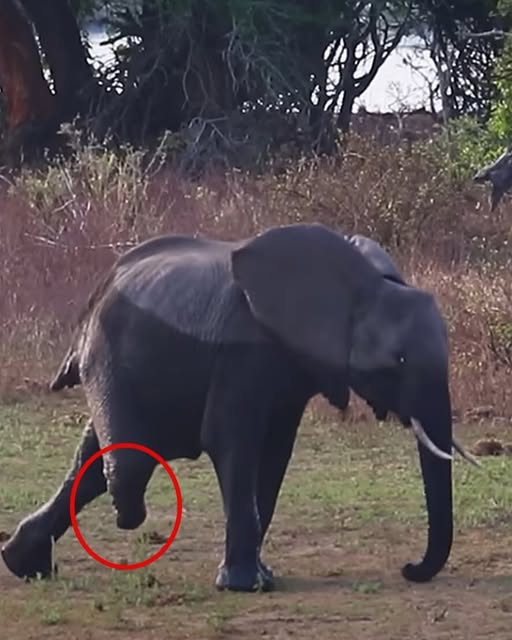
Vutomi’s survival is remarkable not only because she learned to walk on three legs.
It is remarkable because she continued to live as part of a wild elephant herd.
Elephants are intensely social animals.
They travel in family groups.
They communicate over long distances.
They remember water sources, feeding areas and migration routes.
And they respond closely to the movements of the other elephants around them.
For Vutomi, that social world appears to have remained intact.
Observers have seen her moving with other elephants rather than living alone.
That matters.
A three-legged elephant faces challenges that would be difficult even under controlled conditions.
In the wild, those challenges are constant.
There are long distances to cover.
Uneven ground.
Heat.
Predators.
Competition for resources.
And the simple physical strain of supporting an enormous body on only three limbs.
Yet Vutomi continues to navigate that environment.
She moves slowly when necessary.
She rests.
She enters water.
She feeds.
And she keeps traveling.
Her herd remains nearby.
It is tempting to describe that as deliberate compassion in exactly the same way humans might show it.
But wild animal behavior is more complicated than that.
What can be said with confidence is that elephants form strong social bonds and often remain closely coordinated with members of their group.
That social structure can be especially important for vulnerable animals.
For Vutomi, simply remaining embedded in the herd may have helped her enormously.
She did not need to navigate the landscape entirely alone.
She still had the presence of other elephants around her.
She could follow their movements.
Rest when the group rested.
Move when they moved.
And remain part of the familiar social structure that defines elephant life.
That may be one reason her story resonates so strongly with people.
At first glance, the image is heartbreaking.
A massive wild animal missing one of the limbs that should support her for life.
But the longer you watch Vutomi, the less her story feels defined by loss.
Instead, it becomes a story about adaptation.
Her gait is different.
Her balance is different.
Her pace may be different.
But she still moves forward.
And that is the part people remember.
There is something powerful about watching an animal continue doing ordinary things after surviving something extraordinary.
Vutomi does not appear to spend her life performing resilience.
She simply lives.
She walks toward water.
She stands among other elephants.
She moves through the bush.
She disappears into the landscape with the herd.
Those moments can seem almost uneventful.
But that is exactly what makes them meaningful.
For an elephant that lost a leg, an ordinary day is an achievement.
Every journey is proof that her body found another way.
Every step shows that adaptation does not always look dramatic.
Sometimes it looks like a slow, uneven walk through the grass.
Sometimes it looks like standing quietly in water while the herd gathers nearby.
Sometimes survival is simply continuing with life after the world has changed completely.
Vutomi’s story has also become a reminder of the dangers wild animals face from human-made hazards.
If her injury was caused by a snare or trap, as some reports have suggested, then her survival carries an additional message.
Discarded wire, traps and other hazards can have lifelong consequences for wildlife.
Even animals powerful enough to survive them may carry the effects permanently.
That is why anti-poaching work, habitat protection and the removal of dangerous snares remain so important across wildlife reserves.
But Vutomi is not remembered simply as a victim.
She is remembered because she kept going.
Her missing leg is the first thing most people notice.
After watching her for a while, it stops being the only thing they see.
They see an elephant moving through her home range.
An animal maintaining her place within the herd.
A survivor who adapted to a body permanently changed by injury.
There is no miracle ending.
Her leg did not grow back.
The difficulty did not disappear.
She simply learned to live with it.
And the elephants around her continued to move through the landscape with her.
That is perhaps the most powerful part of Vutomi’s story.
She was never required to become what she had been before.
She only had to find a way to become what she could still be.
Vutomi walks on three legs, but she does not walk alone.
And every quiet step through the African bush is proof that resilience is not always about returning to the life you had before—it can also mean learning how to keep moving in the life you have now.