
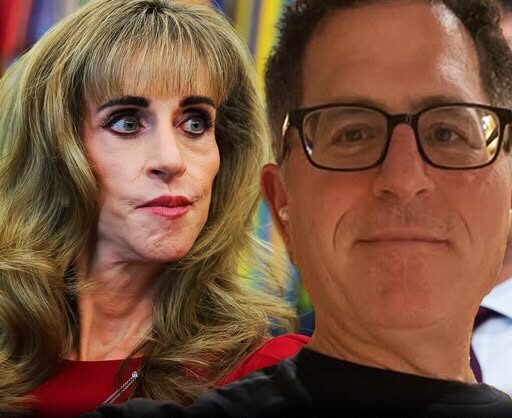
Susan Dell Mocked Online After $6.25 Billion Gift to Children, but Husband Michael’s Quiet Response Drew Attention
After the Billionaire Couple Appeared at the White House to Discuss a Historic Financial Commitment to 25 Million Children, Susan Faced Personal Attacks About Her Appearance. Rather Than Directly Confronting the Criticism, Michael Began Sharing Messages From Grateful Families.
Michael and Susan Dell arrived at the White House to discuss a financial commitment that could affect millions of American families.
The couple had pledged $6.25 billion to help establish investment savings for 25 million children across the United States.
It was an enormous sum of money, with the potential to give eligible children a starting balance that could remain invested for years.
But after Susan appeared alongside her husband and President Donald Trump on October 7, 2026, a very different conversation began spreading online.
Instead of discussing the children’s accounts, some social media users focused on her physical appearance.
Photographs and video clips from the Oval Office prompted mocking comments and personal criticism.
The reactions quickly attracted attention.
Supporters condemned the insults, arguing that the conversation had moved away from the couple’s financial commitment and toward unnecessary judgments about Susan’s looks.
Among those defending her were conservative commentator Mike Cernovich and Eric Trump, the president’s son.
But Michael Dell’s response attracted attention for a different reason.
He did not publish a lengthy statement arguing with the people criticizing his wife.
Instead, he began sharing messages from parents and children who said the financial contributions had already made a difference to their families.
One father described discovering $250 in the accounts of each of his two sons.
Other messages, apparently written by children, thanked the Dell family for helping them begin saving for the future.
The posts created a striking contrast with the personal attacks.
While some people debated Susan’s appearance, others were discussing money that had been deposited into children’s investment accounts.
The White House Event Was Supposed to Focus on Children’s Futures
On October 7, 2026, Michael and Susan Dell joined President Donald Trump at the White House.
The event marked a major development in the rollout of federally supported investment accounts commonly known as Trump Accounts.
Michael Dell, the founder and chief executive of Dell Technologies, spoke about the $6.25 billion commitment he and Susan had announced in December 2025.
The contribution was designed to provide $250 each to 25 million eligible American children.
These deposits were intended to give children an early opportunity to participate in long-term investing.
The funds would be placed in accounts that invest in qualifying stock-market index funds, rather than distributed as cash for immediate spending.
At the White House event, Michael provided an update on the initiative’s progress.
He announced that ten million accounts had received funding as of that morning.
He also said the remaining commitments were expected to be completed by the end of the week.
Michael Dell Reflected on How His Own Business Began
During his remarks, Michael recalled starting his technology business with approximately $1,000 while he was a college student.
The company he founded would eventually become one of the world’s best-known technology businesses.
He used that experience to explain why he and Susan believed that early access to investment capital could matter.
In his view, small financial beginnings can sometimes create opportunities over time.
His comments connected the children’s savings initiative with his personal history as an entrepreneur.
Michael also encouraged parents to help their children understand investing and long-term financial growth.
The remarks reflected his stated belief that young people could benefit from learning about ownership and financial planning.
But the future value of any investment depends on market performance, contributions, fees, and other factors.
A starting deposit does not guarantee a particular financial outcome.
Susan Dell Delivered a Personal Message to Children
Susan also spoke during the event.
Rather than focusing primarily on the financial mechanics of the accounts, she discussed messages the family had received from parents, grandparents, and children.
She described hearing from young people who dreamed of becoming entrepreneurs, nurses, doctors, and engineers.
Those letters appeared to have made a significant impression on her.
Her remarks emphasized that the commitment was about more than an initial deposit.
She wanted children to understand that their ambitions and opportunities mattered.
She concluded with a direct message:
“We believe in you.”
It was a simple statement intended for the young people whose accounts were receiving the contributions.
Yet the public discussion following the event quickly moved in another direction.
Social Media Users Began Commenting on Susan’s Appearance
After footage of the Oval Office appearance circulated, some online commenters began making personal remarks about Susan Dell.
The criticism focused on her facial appearance rather than the details of the financial initiative.
Some users speculated about cosmetic treatments or procedures.
Others used mocking language and shared unflattering descriptions.
Those comments attracted additional reactions, creating a broader discussion about how public figures, particularly women, are treated online.
However, photographs and video clips do not establish someone’s medical or cosmetic history.
There is no reason to treat strangers’ assumptions about Susan’s appearance as verified medical facts.
The visible result was that an event about children’s savings became the subject of an online appearance-related controversy.
The Criticism Sparked a Strong Response
Not everyone agreed with the attention being directed toward Susan’s appearance.
Some commentators argued that the personal remarks were unnecessarily cruel.
Others questioned why the focus had shifted away from the $6.25 billion commitment.
The debate drew responses from people who supported the investment initiative and from those who objected more generally to appearance-based ridicule.
The reactions demonstrated how quickly discussion surrounding a public event can change.
A financial announcement involving millions of children had become an argument over the treatment of one of its principal donors.
Mike Cernovich Defended Susan Dell
Conservative commentator Mike Cernovich was among those who publicly criticized the online mockery.
He argued that the remarks directed toward Susan were unfair and inappropriate.
His response brought additional attention to the criticism.
The controversy also became part of a wider conversation about the boundaries between criticizing a public figure’s actions and attacking their physical appearance.
Those are different forms of commentary.
The public can examine the structure, benefits, limitations, and political context of the children’s investment program without relying on personal insults.
Eric Trump Also Spoke Out
Eric Trump, one of President Donald Trump’s sons, posted a defense of Susan and Michael Dell.
He highlighted the size of the couple’s commitment to children’s investment accounts.
He also condemned the personal attacks Susan had received.
Eric described the online responses as especially troubling given the scale of the philanthropic contribution.
His message thanked Susan and expressed appreciation for the couple’s efforts.
The post was widely circulated by outlets covering the controversy.
It showed that the criticism had attracted attention well beyond the original social media users who commented on the photographs.
Michael Dell Chose Not to Engage Directly With the Insults
Michael’s public activity following the controversy took a different form.
Rather than issuing an extended rebuttal, he reposted messages describing the effects of the contributions on families.
He shared expressions of gratitude from parents who said their children had received deposits.
He also circulated images of what appeared to be handwritten letters from young recipients.
Some news outlets interpreted these posts as a quiet response to the treatment of his wife.
However, Michael did not explicitly state that every repost was intended as a reply to the criticism.
What can be observed is the content he chose to amplify.
Instead of repeating the insults, the posts featured families discussing the contributions.
One Father’s Message Drew Particular Attention
Among the messages Michael shared was a post from a parent using the name Wingfoot on X.
The father said he had registered accounts for his children without expecting to receive a private contribution.
He explained that his family lived in a relatively affluent area.
Then, according to his account, an unexpected deposit appeared.
Both of his sons had received $250 attributed to the Dell initiative.
He expressed appreciation and said the experience had changed how he viewed the company and the family behind the donation.
His message became one of the examples used to illustrate the direct effect of the pledge.
For that family, the abstract announcement of billions of dollars had become two identifiable contributions in children’s accounts.
Another Person Thanked Susan for Helping a Grandchild
Michael also shared a message from someone who said a grandson had received $250 in a Trump Account.
The person thanked Susan and urged others to stop criticizing her appearance.
That message combined two reactions.
One was appreciation for a financial contribution.
The other was disagreement with the online treatment of Susan.
It reflected how the controversy had become connected to the experiences of people receiving the deposits.
Not every family participating in the program necessarily shares the same views about its structure or its political associations.
But the posts highlighted people who welcomed the money placed in their children’s accounts.
Then Came the Handwritten Notes From Children
Some of the most personal messages shared by Michael appeared to be handwritten thank-you letters from children.
One child thanked the Dell family for the money placed in a savings account.
Another expressed gratitude for help saving toward the future.
The notes were brief.
They did not describe complex investment strategies or predict how much the accounts would eventually be worth.
They simply conveyed appreciation.
The letters attracted attention because they offered a human perspective on a very large financial commitment.
The pledge involved billions of dollars and millions of accounts.
But the handwritten messages brought the focus back to individual children and families.
Why Those Messages Created Such a Contrast
The online criticism and the thank-you letters represented very different conversations.
One centered on the appearance of a woman participating in a public event.
The other concerned children beginning to save money.
By sharing the messages from families, Michael highlighted the second conversation.
That does not establish what he privately thought about the attacks.
Nor does it mean that the financial program is beyond criticism.
It does show that he chose to promote recipient experiences rather than publicly repeating the hostile comments about his wife.
The Dells Announced Their Commitment in December 2025
The $6.25 billion initiative was not introduced for the first time in October 2026.
Michael and Susan Dell originally announced the commitment on December 2, 2025.
The funding was intended to extend investment opportunities to children who were too old to qualify for a separate $1,000 federal contribution for newborns.
The program became part of the wider Trump Accounts initiative established through federal legislation.
The Dells pledged to contribute $250 to accounts belonging to 25 million eligible children.
Multiplying those figures produces the total commitment of $6.25 billion.
The October 2026 White House appearance provided an update on the funding rather than announcing a completely new pledge.
What Are Trump Accounts?
Trump Accounts are tax-advantaged investment accounts created for eligible children in the United States.
The accounts are designed to hold long-term investments rather than serve as ordinary checking accounts.
The program was established under legislation signed in 2025.
In October 2026, the administration announced automatic account enrollment for eligible children.
However, families may still need to activate or claim accounts to manage them and use available features.
The accounts generally invest in qualifying low-cost index funds tied to the broader stock market.
The money is intended to grow over time, with rules governing contributions and withdrawals.
The Federal $1,000 Deposit Is Different From the Dell Gift
One important distinction is that the federal government contribution and the Dells’ donation are separate.
The government provides a one-time $1,000 contribution for eligible children born between January 1, 2025, and December 31, 2028.
The Dells’ $250 contribution targets a different group.
It is intended for 25 million eligible children born between 2016 and 2024.
Not every child with a Trump Account qualifies for the Dell contribution.
And receiving the $250 private donation should not be confused with receiving the $1,000 government deposit.
Families should check the applicable eligibility criteria for each source of funding.
How Were Children Selected for the $250?
According to Invest America’s October 2026 guidance, the Dell contribution was allocated using geographic income data.
The initiative initially prioritized children living in lower-income ZIP codes.
It then expanded the selection until the target of 25 million children was reached.
The published final threshold, as of October 9, 2026, was a ZIP code with median family income of $117,300 or less.
The measure was based on U.S. Census Bureau data.
Eligibility was determined by a ZIP code’s median family income, not necessarily by an individual household’s actual earnings.
That explains why some families living in otherwise affluent communities reported receiving the contribution.
Some Children in Military Families Were Included
Invest America also stated that eligible children living on military bases were included in the contribution program.
The initiative provided special consideration for children in foster care.
As of October 2026, funding had been reserved for foster children, with certain implementation details still being developed.
Those contributions were expected to follow a separate timetable.
The broader program therefore involved more than a single uniform deposit process.
Families in different circumstances could encounter different account activation and allocation procedures.
Does Every American Child Receive $250?
No.
The Dell commitment covers 25 million selected children, not every child in the United States.
The program applies to eligible children born during the specified years and selected through its geographic criteria.
Some children may have accounts without receiving the Dell gift.
Others may qualify for the separate federal contribution instead.
Parents seeking accurate information can consult the official Trump Accounts and Invest America resources rather than assuming eligibility from social media posts.
The specific rules matter because similar-looking account balances may come from different funding sources.
Why an Early Investment Can Matter
The idea behind the program is that money invested at a young age has a longer period in which it may grow.
Returns can be reinvested, creating the possibility of compound growth.
For example, a child receiving an initial deposit may eventually have a larger balance if investments appreciate.
Additional contributions from parents, employers, or others could also affect the eventual value.
However, stock-market investments involve risk.
Prices can rise and fall.
Returns are not guaranteed, and the amount available in adulthood depends on actual investment performance.
Claims that every child will become wealthy should therefore be viewed as projections rather than promises.
Families May Contribute Additional Money
Under the program’s rules, families and other eligible contributors can add money to a child’s account, subject to annual limits.
Employers may also participate through qualifying contribution arrangements.
The accounts are intended to encourage long-term saving and investing.
But families have different financial circumstances.
Some may be able to contribute regularly.
Others may depend primarily on the initial deposit.
That difference is relevant when evaluating the program’s potential benefits.
Supporters and Critics See Different Implications
Supporters of the investment accounts argue that the program can introduce children to asset ownership at an early age.
They also believe that initial contributions may help families begin investing who otherwise would not have done so.
Critics have raised concerns that children from wealthier households may ultimately benefit more because their families can afford larger ongoing contributions.
Others question how the program compares with existing education savings options or other forms of assistance.
The long-term impact will depend on eligibility rules, investment performance, participation, and household resources.
These are substantive issues that can be debated independently of the personal comments directed toward Susan Dell.
Susan Dell Has a Long History of Philanthropic Work
Susan Dell is not known solely for being married to the founder of Dell Technologies.
She has spent decades working in philanthropy and other professional fields.
In 1999, she and Michael established the Michael & Susan Dell Foundation.
The foundation has supported initiatives focused on education, health, economic opportunity, and families.
Its work has included efforts in the United States and internationally.
The couple’s October 2026 announcement builds on that broader philanthropic history.
The $6.25 billion commitment is unusually large, but it is not their first involvement in projects directed toward children.
Before Philanthropy, Susan Worked in Business and Fashion
Susan’s career has included work in real estate and fashion design.
She founded several fashion labels, including Phi.
Her design experience brought her into another highly visible industry before the recent White House appearance.
She also created inaugural gowns worn by members of the Bush family in 2001.
Her professional background and philanthropic work form a more complete picture of her public life than the short video clips that circulated in October.
The online attention to her appearance did not reflect the full range of that history.
Michael and Susan Have Been Married for Decades
Michael and Susan met in Austin, Texas, in 1988.
They married in 1989.
The couple have four children: Alexa, Kira, Juliette, and Zachary.
Over the years, they have combined family life with business and philanthropic responsibilities.
Their joint foundation has become a major part of their public identity.
The children’s investment initiative was announced in both of their names, emphasizing that it was a shared philanthropic commitment.
The $6.25 Billion Figure Represents a Major Commitment
The scale of the donation attracted considerable attention when it was first announced.
At $250 per child, a commitment covering 25 million children totals $6.25 billion.
It represents one of the largest private financial commitments directed toward children in the United States.
However, the donation is structured as deposits into investment accounts rather than direct cash payments to households.
That distinction affects how and when families can use the funds.
It also means the future financial benefit cannot be determined solely from the size of the initial contribution.
October 7 Marked a Significant Implementation Update
When Michael and Susan returned to the White House in October 2026, their remarks focused on progress since the original announcement.
Michael stated that ten million accounts had already been funded.
He said the remaining allocation was expected to be completed by the end of that week.
Subsequent Invest America guidance reported that 25 million children had been allocated the $250 contributions.
The updated figures helped show how the initiative had moved from an announced commitment toward actual account funding.
That transition was central to the White House event.
President Trump Praised the Couple
During the Oval Office appearance, President Trump thanked Michael and Susan for supporting the account initiative.
He emphasized the scale of the donation and spoke about the program’s goal of encouraging investment from childhood.
After Susan’s remarks, he praised her speech and jokingly suggested that she should consider running for public office.
The exchange occurred during an event that also promoted the administration’s broader account-enrollment policy.
The program is politically associated with Trump because of the legislation that created it and the name used for the accounts.
But the funding commitment from the Dells is a separate private philanthropic contribution.
The Online Mockery Overshadowed Part of the Announcement
Despite the size of the contribution, much of the immediate social media discussion focused on Susan’s appearance.
That shift illustrates a familiar feature of online attention.
Short video clips and photographs can circulate separately from the context in which they were recorded.
Viewers may encounter an image without hearing the accompanying explanation about the event.
As posts are shared and commented on, discussion can move away from the original subject.
In this case, a presentation about children’s investment accounts became entangled with personal comments directed toward one of its donors.
Michael’s Reposts Changed the Focus of His Own Feed
As the criticism continued, Michael used his X account to amplify messages from families.
His reposts featured people discussing the $250 contributions.
Some expressed appreciation for the financial support.
Others defended Susan against the criticism.
The handwritten notes attributed to children brought an additional emotional element.
They showed young people thanking the family for helping them save.
Those posts did not settle questions about the long-term merits of the account program.
But they did highlight how some recipients experienced the initiative.
A Child’s Thank-You Note Became a Different Kind of Headline
One of the messages shared online came from a child grateful to have money invested for the future.
Another letter expressed appreciation for the chance to begin saving.
The notes were not elaborate.
They reflected ordinary feelings of gratitude.
For a child, $250 may be understood differently than it is by adults discussing billions of dollars.
It can represent the first visible balance in an account intended to remain invested for years.
The letters also demonstrated how the initiative could be explained to children as an introduction to saving.
In that sense, they brought the discussion back to the people the donation was intended to reach.
Why Michael’s Approach Drew Attention
Public controversies often prompt immediate arguments between the people involved.
Social media encourages direct replies, statements, and escalating exchanges.
But Michael did not make the insults the center of his own public communications.
Instead, the messages he shared focused on recipient families.
Some outlets described that choice as an understated defense of Susan.
Others emphasized the contrast between online ridicule and the gratitude expressed in the posts.
The interpretation of his intentions remains an inference.
What is documented is that he publicly amplified accounts of the contribution reaching children.
The Controversy Also Raised Questions About Online Treatment of Women
Susan’s experience became part of a broader discussion about appearance-based criticism.
Women who participate in public events frequently face commentary about their clothing, hair, facial features, and age.
Such reactions can draw attention away from the purpose of their appearance.
In Susan’s case, the initial event concerned financial contributions to children’s accounts.
The subsequent criticism focused instead on her physical characteristics.
Observers can disagree about the account program’s design or its relationship to government policy.
Those disagreements do not depend on judgments about someone’s appearance.
Unverified Claims Also Circulated Online
The appearance-related controversy generated misleading social media content.
One claim suggested that the animated television series South Park had teased an episode involving Susan.
A fact-check published on October 12 found that the image supporting the claim was AI-generated.
There was no evidence that the show had announced such an episode or that Susan had publicly reacted to it as alleged.
The example illustrates how fabricated images can become attached to a real controversy.
Readers should distinguish authentic reporting from altered or invented social media material.
The Families’ Messages Became the Other Side of the Story
While the criticism received attention, the messages from parents and children provided another perspective.
One father described two unexpected $250 deposits.
Another person thanked Susan for a contribution made to a grandchild’s account.
Children sent messages about saving for the future.
Those accounts were personal expressions of gratitude, not independent evaluations of the entire federal program.
Nevertheless, they described experiences that had become possible through the Dells’ commitment.
They also explained why Michael might have chosen to draw attention to the responses of participating families.
The Program’s Long-Term Results Remain to Be Seen
Although the initiative has allocated substantial funding, its full financial effects will unfold over many years.
Children receiving the deposits in 2026 are at different ages.
The length of time their money remains invested will vary.
Market performance will influence future balances.
Additional contributions may also create differences between accounts.
Some families will be able to invest regularly, while others may not.
As a result, the eventual outcomes are uncertain.
The $250 deposit establishes an initial investment, not a guaranteed amount of wealth at adulthood.
The Dells’ Public Message Was About Opportunity
Throughout their remarks, Michael and Susan described the initiative in terms of future possibilities.
Michael spoke about the benefits of learning to invest at a young age.
Susan focused on the dreams children had shared in letters.
Their stated objective was to help children begin building financial resources.
Whether the program achieves broader economic goals will require time and evidence.
But the October 7 event made clear what the couple wanted the initiative to represent.
They hoped that the deposits would encourage families to think about saving and investing over the long term.
What Happened After Susan Dell Was Mocked?
The sequence of events is important.
On December 2, 2025, Michael and Susan Dell announced the $6.25 billion commitment.
On October 7, 2026, they appeared at the White House to discuss the program’s implementation.
Susan spoke about letters from children and the importance of believing in their futures.
After video clips circulated, some social media users criticized her appearance.
Mike Cernovich, Eric Trump, and other commentators defended her.
Michael then shared posts from parents who reported receiving $250 for their children, along with handwritten messages of gratitude.
The posts attracted coverage because they offered a notably different response from an angry public confrontation.
They focused on the children and families involved in the program.
Michael Dell’s Quiet Response Became the Most Memorable Part of the Controversy
When Michael and Susan Dell appeared at the White House on October 7, the purpose was to discuss a major financial initiative.
The couple had committed $6.25 billion to help 25 million eligible American children start long-term investment accounts.
Susan used the occasion to describe the letters they had received from young people with dreams of becoming doctors, nurses, engineers, and entrepreneurs.
She told the children that she and Michael believed in them.
But online discussion soon shifted toward mocking remarks about her appearance.
Supporters condemned the criticism, including Eric Trump and Mike Cernovich.
Michael did not directly engage in a lengthy public argument about the insults.
Instead, he shared messages showing how some parents and children had experienced the financial contributions.
A father reported finding $250 in each of his sons’ accounts.
A grandparent thanked Susan for a contribution to a grandchild.
And handwritten notes from children expressed appreciation for being able to save money for the future.
Those messages did not answer every question about the Trump Accounts program.
They did not guarantee future investment returns or settle debates about financial policy.
But they brought attention back to the individual families behind the enormous figures announced at the White House.
Rather than centering his public response on the people criticizing his wife, Michael used his platform to highlight those thanking the couple.
His precise intentions have not been publicly explained.
Yet the contrast was clear.
While some social media users were discussing Susan Dell’s appearance, the messages Michael shared were discussing children’s futures.
And the handwritten notes offered a reminder that behind a multibillion-dollar commitment were millions of individual accounts, each intended for a young person who may one day put those savings toward an important goal.
For Susan, the controversy brought unexpected attention to her appearance.
For Michael, the public response consisted largely of sharing what families had to say.
And for the children receiving the contributions, the lasting significance will depend less on the social media debate than on what those investments become over time.