
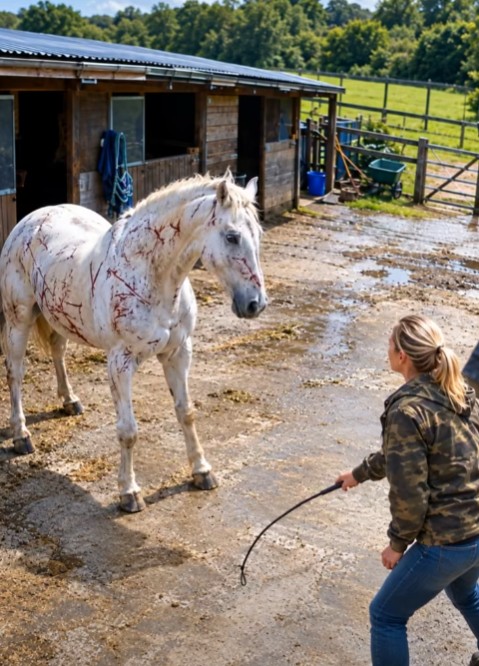
No One Dared Approach the Scarred White Stallion — Until a Woman Entered the Arena and Whispered One Word
No One Dared Approach the Scarred White Stallion — Until a Woman Entered the Arena and Whispered One Word
Everyone at the horse auction had already made up their minds about the enormous white stallion standing inside the arena.
His body was covered with old scars. His pale eyes seemed unusual, and his behavior had frightened even experienced horse handlers.
He resisted ropes, reacted aggressively when anyone approached, and had developed a reputation as an animal that could not be trusted.
Several owners had tried to control him. Every attempt appeared to make his behavior worse.
Now, standing before a crowd of potential buyers, the stallion seemed to have reached the end of the road.
Nobody wanted him.
Then a woman in worn jeans, heavy boots, and a faded military jacket stood up from the second row.
Ignoring warnings from the handlers, she approached the arena and stepped inside.
The stallion immediately tensed.
People shouted for her to move away, certain that the horse was about to charge.
But the woman stopped a short distance from him and spoke a single word.
“Snow.”
What happened next left the entire auction arena silent.
The White Stallion Nobody Wanted to Buy
The horse had been brought to the auction under number 27.
He was an enormous white stallion whose appearance immediately attracted attention.
His coat carried numerous old scars, some more noticeable than others.
His pale eyes added to the unusual impression he made on people who saw him for the first time.
But his appearance was only part of the reason potential buyers were reluctant to approach.
The stallion had become known for reacting aggressively around people.
He sometimes lunged toward handlers, attempted to bite, and reared when confronted with equipment.
The sight of a rope could be enough to make him react defensively.
On several occasions, he had reportedly struck the doors of his stall with such force that workers feared he might damage them.
By the time he arrived at this auction, his reputation had become almost impossible to escape.
Several Owners Had Already Given Up on Him
During the preceding months, the stallion had reportedly passed through several different hands.
Each new owner believed that the animal could eventually be brought under control.
Some approached the situation with confidence, expecting that their experience would succeed where others had failed.
But the results were consistently disappointing.
The horse resisted attempts to saddle him and reacted strongly when people tried to restrain him.
Rather than becoming calmer, he appeared increasingly fearful and defensive.
Eventually, people began describing him as impossible to handle.
His behavior made even experienced trainers cautious.
Some reportedly preferred to keep their distance and use long equipment when working near him.
At a previous auction, one handler had refused to lead the horse into the arena without assistance.
His reputation followed him everywhere.
The Scars Raised Questions Nobody Could Answer
Perhaps the most disturbing detail was the condition of the stallion’s coat.
Old scars marked different parts of his body, particularly along his sides.
People who examined him could see that he had experienced injuries in the past.
But the precise circumstances were unclear.
Some believed the marks had developed when the horse attempted to escape from an enclosure.
Others suspected that a previous owner had treated him harshly.
The auction workers reportedly avoided discussing the subject in detail.
Without reliable records, nobody could establish exactly how every scar had been caused.
However, those who worked around the stallion noticed a recurring pattern.
Whenever someone moved too quickly or raised a hand suddenly, the horse often reacted as though he expected something unpleasant to happen.
That behavior suggested fear could be playing an important role in his responses.
The Auction Begins With Tension in the Air
When the stallion was brought into the arena, the crowd immediately became interested.
People had already heard about the difficult white horse.
Some leaned forward to watch how he would behave.
Others exchanged comments about his reputation.
Near the fence, one man laughed and referred to the animal as unstable.
Another suggested that nobody would want to bring such a horse home.
For the stallion, the unfamiliar surroundings and attention appeared unsettling.
He pulled against the lead and shifted nervously.
Then he struck the metal barrier with his hoof.
The sudden sound drew even more attention.
The handler tightened his grip, attempting to maintain control.
But the horse abruptly moved forward, forcing the man to step away.
Even the Handler Struggled to Control Him
The incident near the fence reinforced everything the crowd believed about the stallion.
He appeared tense and unwilling to cooperate.
His movements were unpredictable, making it difficult for the handler to guide him.
The animal’s size added to the concern.
A frightened horse can unintentionally create serious danger because of its strength and rapid reactions.
In this case, the stallion had already demonstrated behavior that required experienced handling.
The auctioneer attempted to continue the sale.
But the atmosphere had changed.
Potential buyers watched cautiously rather than showing interest.
No one seemed willing to take responsibility for the animal.
As the bidding continued, the price dropped.
Still, nobody raised a paddle.
The Price Kept Falling, but Nobody Wanted Him
For most horses, an auction offers the possibility of a new owner and a different environment.
For number 27, the event seemed to confirm that his reputation had become a serious obstacle.
His scars worried people.
His behavior frightened them.
And the uncertainty surrounding his history made potential buyers even more reluctant.
The auctioneer continued trying to attract interest.
But the crowd remained hesitant.
Some people appeared convinced that the horse would never become manageable.
Others seemed unwilling to invest the time and resources required to understand his behavior.
As the price fell, the stallion continued shifting nervously inside the arena.
He had no way of knowing that someone in the audience was watching him for a completely different reason.
A Woman in the Second Row Suddenly Stands Up
Among the spectators sat a woman who appeared to be approximately thirty-five years old.
She was dressed simply, wearing old jeans, sturdy boots, and a faded military jacket.
She had been watching the stallion closely.
Unlike other people in the crowd, she did not seem focused on his aggressive reputation.
Her attention remained fixed on his appearance and movements.
For several moments, she sat silently.
Then she stood up.
Without joining the conversation around her, she moved toward the arena fence.
The trainer noticed her approaching and immediately warned her to keep her distance.
The horse had already reacted aggressively toward several people, he explained.
Getting too close could be dangerous.
But the woman continued watching the stallion.
The Trainer Warns Her Not to Come Closer
From the trainer’s perspective, allowing an unfamiliar person near the stallion was an unnecessary risk.
Experienced handlers had already struggled with him.
Someone without a clear understanding of the animal’s behavior could easily be injured.
The trainer repeated his warning.
Yet the woman seemed absorbed in what she was seeing.
She studied the stallion’s face and the unusual color of his eyes.
The horse continued moving restlessly inside the enclosure.
His hooves struck the ground as he shifted his weight.
The handler prepared to lead him away.
Then the woman did something nobody expected.
She opened the arena gate.
She Walked Into the Arena Despite the Warnings
The unexpected movement caused immediate alarm.
Someone shouted for the gate to be closed.
Several men moved toward the woman, apparently intending to stop her.
But she raised her hand, signaling for them to remain where they were.
Then she entered the arena.
People watching from the stands could see the stallion’s reaction.
His body stiffened.
His nostrils flared, and his ears moved backward.
He appeared intensely alert to the person standing before him.
The trainer warned that he might charge.
Entering an enclosure with a frightened, reactive horse is extremely dangerous, and such an approach should not be attempted without appropriate professional precautions.
But in the story, the woman continued moving slowly until she was approximately four meters away.
Then she stopped.
The Stallion’s Reaction Frightened Everyone Watching
The enormous horse stood facing the woman.
His muscles were tense, and he shifted uneasily between his hooves.
Everyone nearby seemed to expect another aggressive reaction.
Some spectators watched in silence.
Others called out warnings.
The trainer gripped the fence, prepared for the possibility that the stallion might suddenly move.
But the woman did not attempt to grab him or force him to approach.
She remained where she was.
For a brief moment, the two stood facing each other.
Then she spoke.
It was not a shouted command.
It was a familiar name.
One Word Changed the Entire Atmosphere
“Snow.”
The woman spoke softly.
According to the account, the stallion stopped moving.
His attention remained fixed on her.
She repeated the name, this time with even more tenderness.
“Snow, my boy…”
The horse’s expression and posture appeared to change.
He stopped tossing his head.
His ears slowly lifted, and he remained unusually still.
The people watching had never seen him respond this way.
Only moments earlier, he had resisted the handler and frightened potential buyers.
Now he was standing quietly, listening to a woman who seemed to know something nobody else did.
The Horse Took a Step Toward Her
What happened next astonished the spectators.
Instead of moving aggressively toward the woman, the stallion approached at a slow pace.
He took one step.
Then another.
The arena became quiet as people watched the enormous animal move toward her.
The woman remained still.
She did not pull on a rope or attempt to restrain him.
According to the story, the horse continued approaching until he reached her.
Then he stretched his neck forward.
His nose touched her shoulder.
The gesture was gentle.
For a horse with such a frightening reputation, the sudden change seemed almost impossible to believe.
The Woman Whispered Something That Explained Her Reaction
As the stallion touched her shoulder, the woman closed her eyes.
She appeared deeply moved.
Then she whispered another sentence.
“I knew it was you.”
Those words suggested that she had not entered the arena simply because she felt sorry for the horse.
She believed she recognized him.
The unusual eyes, his appearance, and perhaps the way he responded to the familiar name had brought back a memory.
The woman slowly raised her hand toward his forehead.
The trainer remained worried about the animal’s reaction.
But the stallion allowed her to touch him.
Then he lowered his head and leaned closer.
A Horse Everyone Feared Finally Allowed Someone Near
The change in the stallion’s behavior surprised everyone present.
The same animal that had resisted handlers now stood quietly beside the woman.
She rested her hand against his forehead.
He did not pull away.
Instead, he appeared comfortable enough to remain close.
It was a striking contrast to the behavior the crowd had witnessed earlier.
Even the auctioneer reportedly lowered his microphone.
People began whispering as they tried to understand what had happened.
The trainer finally asked the question on everyone’s mind.
How had she managed to calm a horse that nobody else could approach?
Her answer was simple.
“I didn’t do anything,” she replied. “He simply recognized me.”
The Woman Reveals Her Connection to Snow
The explanation began many years earlier.
According to the story, the stallion had once belonged to the woman’s father.
She had grown up around the horse while he was young.
During those years, she developed a close relationship with him.
She spent time caring for him and became someone he trusted.
He allowed her to brush his coat, offer food from her hand, and lead him into the fields.
Those experiences had created familiar routines between the young woman and the horse.
For her, Snow was not simply an animal she remembered from childhood.
He represented an important part of her family’s life.
And when she saw the unusual stallion standing inside the auction arena, something about him seemed familiar.
Her Father’s Death Changed Everything
After her father died, the family farm was sold.
The horses were included in the sale.
Snow was separated from the woman who had spent so much time caring for him.
She tried to discover where he had gone.
But the horse changed owners more than once, making his location increasingly difficult to trace.
Eventually, she lost track of him altogether.
The years passed.
She did not know exactly where Snow was living or what circumstances he had experienced.
That uncertainty made the encounter at the auction especially emotional.
She had not expected to find her childhood companion standing before a crowd of strangers.
And she certainly had not expected to see him covered in scars and regarded as impossible to handle.
The Horse She Remembered Was Very Different
When the woman thought back to Snow’s younger years, she remembered an animal who had trusted her.
He had allowed her to care for him and guide him through familiar routines.
That memory contrasted sharply with the stallion’s behavior at the auction.
Now he reacted defensively toward handlers and appeared frightened by sudden movements.
His body also carried numerous scars.
The changes were deeply troubling.
The woman began to understand that the horse’s current behavior might have developed through difficult experiences after leaving the family farm.
The account attributes his fear and aggression to years of harsh treatment and repeated attempts to force him into obedience.
Although the specific history of every injury was not independently documented in the story, the explanation offered a reason for his defensive reactions.
His Aggression May Have Hidden Something Else
Animals sometimes display defensive behavior when they are frightened or have learned to associate particular situations with distress.
A horse that reacts strongly to handling may not simply be stubborn or naturally aggressive.
Fear, previous experiences, pain, and other factors can influence behavior.
In Snow’s case, the narrative suggests that repeated negative experiences had damaged his willingness to trust people.
Handlers saw an animal that lunged, bit, and resisted.
But the woman remembered a horse who had once been gentle around someone familiar.
That difference became central to understanding his behavior.
It also highlighted why labeling an animal as hopeless can overlook the circumstances contributing to its reactions.
The Familiar Voice Brought Back a Different Response
In the story, the turning point came when the woman spoke Snow’s name.
He had heard that name during the years he spent on her father’s farm.
The sound was associated with someone who had cared for him.
When she repeated it, he appeared to respond differently from the way he reacted to unfamiliar handlers.
His posture softened, and he approached her without being forced.
That response suggested the possibility that he recognized her voice or familiar cues.
However, recognizing a familiar person does not eliminate the risks associated with handling a frightened horse.
Real animals can behave unpredictably, even around people they know.
Within the narrative, though, the encounter became a powerful symbol of a connection that had survived years of separation.
The Crowd Finally Understood Why She Had Entered
Until the woman explained her history with Snow, the spectators had little reason to understand her actions.
They saw a stranger approaching an animal with a reputation for aggression.
Most assumed she was taking an unnecessary risk.
But she had recognized something familiar in the horse’s appearance.
The unusual eyes and other details had reminded her of the animal she once knew.
Her decision to speak his name came from that recognition.
When Snow approached her and allowed her to touch him, the crowd witnessed a side of the horse they had not seen before.
The animal they had dismissed as impossible suddenly seemed capable of responding calmly to a familiar person.
The discovery changed the meaning of the entire auction scene.
The Woman Made Her Decision
After explaining their history, the woman remained beside Snow.
She gently stroked his neck.
According to the account, the stallion released a quiet breath and rested his head against her shoulder.
The gesture appeared to confirm the connection that had developed years earlier.
She had spent a long time trying to locate him after the family farm was sold.
Now he was standing directly in front of her.
Despite the scars and difficult reputation, she recognized the horse she remembered.
She turned toward the auctioneer.
Then she made an announcement that surprised the people watching.
Her Final Words Silenced the Auction
The woman looked toward the auctioneer and spoke calmly.
“You don’t need to put him up for auction anymore.”
Her words made it clear that she intended to take responsibility for the horse.
The auctioneer wanted to understand exactly what she meant.
“Do you want to buy him?”
The woman looked into Snow’s familiar pale eyes.
Then she smiled faintly.
“No. I want to take him home.”
For her, the stallion was more than an unwanted animal being offered at a reduced price.
He was a part of her past.
He was connected to memories of her father, the family farm, and the years she had spent caring for him.
The reunion offered the possibility of returning him to an environment where someone understood his history.
Why Snow’s Story Is About More Than a Horse Auction
The emotional force of the story comes from the difference between how the crowd viewed the stallion and how the woman remembered him.
To the people at the auction, Snow was dangerous and unwanted.
His scars and defensive behavior seemed to confirm that he would be difficult to manage.
But the woman saw something else.
She remembered a young horse who had trusted her and shared important moments of her childhood.
Those memories helped her recognize him even after years apart.
Her response suggested that an animal’s difficult behavior should not automatically erase its history or potential for recovery.
It also illustrated how strongly people can remain connected to animals they once cared for.
A Reminder That Trust Can Be Difficult to Rebuild
Snow’s reported behavior highlights an important issue in animal welfare.
Horses that have experienced frightening or painful situations may develop strong reactions to certain types of handling.
Forcing them into situations they find threatening can increase fear rather than resolve it.
Helping a distressed animal requires patience, appropriate professional care, and careful attention to possible medical causes of its behavior.
In the story, Snow’s response to the woman is presented as an emotional reunion.
But rebuilding trust in a real horse with serious defensive reactions would ordinarily require time and experienced support.
One peaceful encounter would not guarantee that all difficulties had disappeared.
Still, the narrative captures an important idea: an animal’s behavior may have a history that strangers cannot immediately see.
The White Stallion Everyone Feared Finally Found Someone Who Remembered Him
When Snow entered the auction arena as number 27, nobody seemed interested in offering him a home.
He was covered in scars, frightened by handling, and known for reacting aggressively toward people.
Potential buyers watched cautiously as the price fell.
Then a woman rose from the crowd and approached him.
Despite the danger, she entered the arena and spoke a name that nobody else appeared to recognize.
“Snow.”
The stallion’s response changed the atmosphere.
He became still, approached her slowly, and allowed her to touch his forehead.
Only afterward did the woman explain that he had belonged to her late father and that she had spent years searching for him.
The horse who appeared impossible to handle was the same animal she remembered caring for during her childhood.
His difficult experiences had changed his behavior, but the story suggests that his connection with her had not entirely disappeared.
When the auctioneer asked whether she wanted to purchase him, her answer carried the emotional meaning of their reunion.
She did not see Snow as an unwanted horse with a frightening reputation.
She saw a familiar companion who had finally returned to her life.
And after years of separation, she wanted nothing more than to take him home.