
Wheel of Fortune Fans Furious After Contestant Loses $40,000 Over Controversial Bonus Round Puzzle — Viewers Question Whether It Was Fair
Wheel of Fortune Fans Furious After Contestant Loses $40,000 Over Controversial Bonus Round Puzzle — Viewers Question Whether It Was Fair
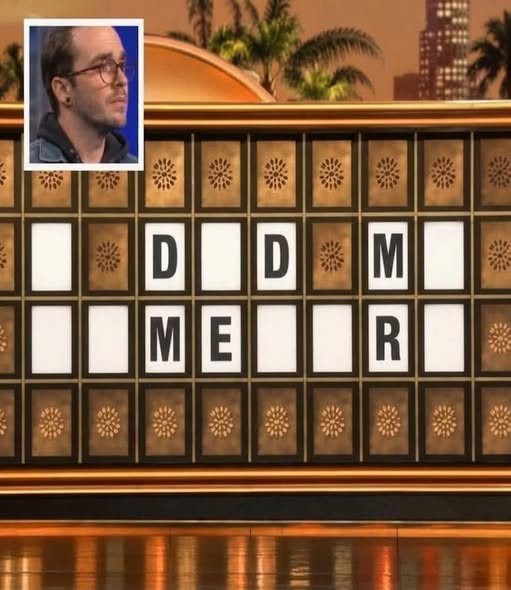
A Valentine’s Day episode of Wheel of Fortune has sparked controversy among viewers after a contestant lost his opportunity to win an additional $40,000 in the Bonus Round.
Conner Kemmsies, a pilot who had delivered an impressive performance throughout the game, entered the final round hoping to finish with another major victory.
But his last challenge proved much more difficult than expected.
The puzzle’s answer was “I DID MY HOMEWORK.”
When Conner failed to solve it before the timer expired, he lost the additional cash prize.
Missing a Bonus Round puzzle is nothing unusual on Wheel of Fortune. Even highly skilled contestants sometimes struggle under the pressure of a ticking clock.
However, this particular puzzle prompted a different reaction from viewers.
Some fans argued that the phrase was confusing and did not fit its assigned category naturally enough to provide a reasonable challenge.
Others questioned why a contestant who had performed so well earlier in the episode should face what they considered an unusually awkward final puzzle.
As the discussion spread across social media, the focus shifted from Conner’s disappointing loss to a larger question about the popular game show.
Was the puzzle genuinely difficult, or was it unfairly confusing?
A Strong Performance Before the Controversial Final Round
Conner Kemmsies entered the episode with the same goal as other Wheel of Fortune contestants: solve puzzles, accumulate winnings, and earn a chance at the Bonus Round.
According to the account of the episode, the pilot performed impressively throughout the competition.
He demonstrated the ability to recognize phrases, make decisions under pressure, and advance through the main game.
His performance eventually secured him a place in the final round.
For contestants, reaching the Bonus Round represents an important opportunity.
It provides a chance to increase their winnings significantly through one final puzzle.
For viewers, it is often the most suspenseful part of the episode.
After watching someone perform well through several rounds, audiences naturally become invested in whether that person can finish with another victory.
Conner’s appearance in the final round created exactly that kind of anticipation.
The Bonus Round Offered Another $40,000
Once Conner reached the Bonus Round, the stakes became even higher.
He had an opportunity to add $40,000 to his winnings.
The amount represented a significant prize, making the final puzzle particularly important.
Under the show’s familiar format, the contestant must use the available letters and clues to determine a phrase before time expires.
Although the process may appear straightforward to viewers watching from home, the pressure can make it more difficult.
Contestants have limited time to interpret the letters, recognize possible words, and identify the complete answer.
Even a phrase that appears obvious after the reveal can be challenging when only some of its letters are visible.
For Conner, however, the issue was not simply the pressure.
It was the nature of the puzzle itself that later attracted criticism.
The Puzzle That Started the Backlash
The answer to Conner’s final challenge was “I DID MY HOMEWORK.”
On its own, the sentence is familiar.
Most people have heard or used the expression, particularly in connection with school or completing an assignment.
But solving a Wheel of Fortune puzzle involves more than recognizing whether a sentence makes grammatical sense.
The contestant must interpret it within the category provided by the game.
According to the account, some viewers felt that the phrase did not naturally match the assigned category.
That perceived mismatch became the main source of criticism.
Fans argued that the wording encouraged interpretations different from the intended answer.
The supplied account does not identify the exact category label or Conner’s selected letters, so the puzzle’s fairness cannot be independently judged from the answer alone.
Nevertheless, the reported reaction showed how strongly some viewers felt about the final challenge.
Conner Ran Out of Time Before Finding the Answer
As the Bonus Round continued, Conner attempted to work through the puzzle.
But the correct phrase did not come to him before the timer expired.
The result was a disappointing ending to an otherwise successful game.
When the solution was revealed, the answer appeared simple to some people in hindsight.
Yet others believed the puzzle was difficult for reasons unrelated to the contestant’s abilities.
They questioned whether the combination of its wording and category created unnecessary confusion.
Conner did not receive the additional $40,000.
For viewers who had been rooting for him, the loss felt particularly frustrating because he had already demonstrated his abilities throughout the episode.
That disappointment helped fuel the discussion afterward.
Why Viewers Thought the Puzzle Was Unfair
The central criticism concerned whether the answer was a reasonable fit for its category.
Categories are an important part of Wheel of Fortune because they help contestants narrow down possible solutions.
A category gives context to the letters that appear on the board.
Without that context, many puzzles could have numerous possible answers.
When viewers believe a phrase does not fit the category naturally, they may feel that the puzzle has become unnecessarily confusing.
That appears to have been the concern surrounding Conner’s final challenge.
Some fans reportedly argued that the answer was too obscure in context.
Others said they struggled to understand what the puzzle was asking, even while watching comfortably at home.
The controversy was therefore not simply about whether Conner knew an everyday phrase.
It concerned whether the clues gave him a fair opportunity to identify that phrase.
Social Media Reactions Intensified the Discussion
Following the episode, disappointed viewers reportedly turned to social media to share their reactions.
Some defended Conner, arguing that his performance in the main game demonstrated that he was a capable contestant.
Others focused on the construction of the final puzzle.
They questioned whether the answer required too much guesswork or lacked a clear connection to the category.
For longtime fans, the criticism reflected expectations developed over years of watching the show.
They are accustomed to puzzles that challenge contestants while still producing a satisfying moment when the answer becomes clear.
When an answer seems awkward or unexpectedly difficult to interpret, that satisfaction may be replaced by frustration.
However, the opinions expressed online do not establish that the show’s rules were violated.
They reflect dissatisfaction with how the final challenge was presented.
Another Detail Made the Ending More Frustrating
The puzzle was not the only element of the episode that attracted attention.
The Bonus Wheel reportedly landed on the minimum cash prize again.
For some viewers, that created an additional sense of disappointment.
They had watched Conner compete successfully, reach the Bonus Round, and face a difficult final puzzle.
The revealed cash amount then became another subject of discussion.
Some longtime fans reportedly questioned whether repeated appearances of the lowest cash prize made the show’s final round feel less exciting.
However, a wheel landing on a particular amount does not by itself demonstrate anything improper.
Chance is an established part of Wheel of Fortune.
Without verified information about prize distributions over time, repeated low-value outcomes cannot establish that the game is being manipulated or intentionally made predictable.
The Balance Between Skill and Luck
Wheel of Fortune has remained popular partly because it combines two elements that audiences enjoy.
The first is skill.
Contestants must recognize words and phrases, use available clues, and make decisions within limited time.
The second is luck.
The wheel introduces outcomes that contestants cannot fully control.
A strong player can make intelligent choices and still experience an unfavorable result.
Likewise, a contestant may benefit from a fortunate spin while struggling with a difficult puzzle.
That combination creates suspense.
But it also means that viewers may disagree about what constitutes a fair challenge.
Conner’s experience brought that tension into focus because his strong performance ended with an unsuccessful Bonus Round.
What Makes a Bonus Round Puzzle Feel Fair?
A successful game show puzzle needs to be difficult enough to create suspense without becoming impossible to interpret.
Contestants should have a reasonable opportunity to reach the answer using the information provided.
That does not mean every puzzle must be easy.
The Bonus Round is designed to test players under pressure, and difficult solutions are part of the experience.
However, categories are expected to provide meaningful context.
When the connection between a category and an answer is unclear, some viewers may feel that the contestant is being asked to guess rather than solve.
That distinction explains much of the criticism directed at the episode.
For dissatisfied fans, the problem was not that Conner failed.
It was that they believed the puzzle itself contributed unnecessarily to the failure.
Why Solving From Home Can Feel Different
Watching a game show from the comfort of home is not the same experience as competing in the studio.
Viewers can consider possible answers without facing the same immediate pressure as contestants.
There are no studio lights directed at them, no audience waiting for their response, and no significant prize depending on their decision.
That difference can affect how quickly someone recognizes a phrase.
However, viewers also see the puzzle from a different perspective.
Some may recognize clues a contestant misses.
Others may find themselves equally confused.
In Conner’s case, the account describes fans who struggled with the solution even while watching from home.
For those viewers, their own difficulty reinforced the belief that the puzzle was unusually challenging.
Why the Valentine’s Day Episode Drew So Much Attention
The controversy occurred during a Valentine’s Day episode, a time when viewers might expect a lighthearted and entertaining competition.
Holiday-themed programming often creates a festive atmosphere.
Audiences tune in hoping to enjoy familiar entertainment and memorable moments.
Conner’s strong performance appeared to be building toward an exciting conclusion.
But instead of celebrating an additional $40,000 victory, viewers watched him run out of time.
The unexpected outcome became the episode’s most discussed moment.
And because the answer itself seemed questionable to some people, the reaction extended beyond ordinary disappointment.
The puzzle became a subject of debate about the way the game is designed.
Longtime Fans Have High Expectations for Wheel of Fortune
Wheel of Fortune has been part of American television for generations.
Its familiar format has helped make it a regular viewing tradition for many households.
Audiences recognize the spinning wheel, the letter board, and the excitement of contestants trying to solve puzzles.
That familiarity creates expectations.
Fans want the rules to remain understandable and the challenges to feel consistent.
They also want to believe that contestants have a fair opportunity to succeed.
When a particular puzzle appears inconsistent with those expectations, viewers may react strongly.
For some, Conner’s final-round experience raised concerns about puzzle selection.
For others, it was simply an example of how unpredictable the Bonus Round can be.
Was the Puzzle Too Difficult or Simply Unlucky?
There are different ways to interpret Conner’s loss.
One interpretation is that the puzzle was unusually difficult and did not provide a clear enough connection to its category.
That is the concern expressed by some dissatisfied viewers.
Another interpretation is that even familiar phrases can be challenging when a contestant has limited letters and only a few seconds to respond.
Under that view, the unsuccessful result would be part of the normal uncertainty of the Bonus Round.
The supplied account does not provide enough information to determine definitively which explanation is more persuasive.
Seeing the full puzzle board, category, and letters available to Conner would be important for assessing the difficulty.
What is clear is that the answer prompted stronger criticism than a routine unsuccessful puzzle might receive.
The $40,000 Prize Added to the Disappointment
The amount at stake made the final moments especially significant.
An additional $40,000 could represent a life-changing sum for many contestants.
That raises the emotional stakes when someone comes close to winning.
For Conner, the opportunity was there until the timer expired.
Once the puzzle went unsolved, the bonus prize was lost.
Viewers who had been impressed by his earlier performance naturally felt disappointed.
But the larger prize also made the perceived difficulty of the puzzle more consequential.
A questionable phrase might generate only mild discussion during an ordinary round.
When that same concern involves a major bonus prize, the reaction can be much stronger.
Could the Show Change How It Selects Puzzles?
Some fans have reportedly expressed hope that producers will take the criticism seriously.
That does not necessarily mean the show needs to abandon challenging puzzles.
Difficulty is essential to the entertainment value of the competition.
However, viewers may expect producers to consider whether answers fit their categories clearly.
Consistency in wording can help preserve confidence in the game.
Likewise, reviewing feedback may reveal whether certain puzzle formats create unnecessary confusion.
The supplied account does not indicate that Wheel of Fortune has announced any rule or puzzle-selection changes in response to this episode.
For now, those possibilities remain suggestions rather than confirmed developments.
Why Viewer Confidence Matters to a Long-Running Game Show
The appeal of a television competition depends partly on the audience’s belief that the game is being conducted fairly.
Viewers do not need every contestant to win.
In fact, unsuccessful attempts contribute to suspense and make victories more exciting.
But audiences generally expect the challenges to follow understandable rules.
When an answer feels confusing, they may begin questioning whether the contestant received a reasonable opportunity.
Repeated criticism can therefore become important for a show with a loyal following.
Maintaining trust requires balancing unpredictable outcomes with consistent expectations.
For Wheel of Fortune, that balance has long been part of its entertainment appeal.
Conner’s Performance Shouldn’t Be Forgotten
Much of the discussion has focused on the unsuccessful Bonus Round.
But the account makes clear that Conner played an impressive game before reaching that final challenge.
He demonstrated the skills needed to progress through the competition and earn the opportunity to play for more money.
His inability to solve one puzzle does not erase that performance.
Even accomplished contestants can struggle when the available clues do not immediately suggest an answer.
And in a game involving both luck and skill, one disappointing outcome is not a complete measure of a player’s ability.
For viewers who enjoyed watching him compete, his strong performance remains an important part of the episode.
The Controversy Highlights a Familiar Game Show Debate
Arguments about difficult puzzles are not unique to Wheel of Fortune.
Whenever a television competition asks people to solve problems under pressure, audiences may disagree about whether a challenge was reasonable.
Some enjoy puzzles that require an unexpected way of thinking.
Others prefer clues that lead naturally toward a recognizable solution.
That difference in expectations can become especially noticeable during final rounds involving major prizes.
Conner’s unsuccessful attempt became a focal point for those disagreements.
The phrase “I DID MY HOMEWORK” was familiar enough in everyday conversation, but some viewers believed it did not work well in the puzzle’s context.
That distinction turned an ordinary loss into a broader discussion about fair competition.
What Happens Next for Wheel of Fortune?
At this stage, the reported controversy centers on viewer reactions rather than any established finding of wrongdoing.
There is no evidence in the supplied account that the outcome was manipulated or that production rules were violated.
The complaints concern puzzle wording, category clarity, and dissatisfaction with the Bonus Wheel’s prize outcome.
Whether those criticisms lead to any changes remains unknown.
Wheel of Fortune continues to rely on the combination of familiar gameplay, suspense, and contestant performances that has sustained its popularity.
The challenge for any long-running show is to preserve those qualities while responding to the expectations of its audience.
One controversial episode does not establish a broader problem, but it can create an opportunity to examine feedback.
Wheel of Fortune’s $40,000 Bonus Round Loss Leaves Fans Debating Fairness
Conner Kemmsies entered the Bonus Round of Wheel of Fortune following a strong performance in the main game.
With another $40,000 available, the pilot had a chance to end the Valentine’s Day episode with a major additional prize.
But the final puzzle proved too difficult for him to solve before time expired.
Its answer, “I DID MY HOMEWORK,” prompted criticism from viewers who believed the wording did not fit the assigned category naturally.
The reaction became more intense when the Bonus Wheel reportedly landed on the minimum cash amount again.
Some fans questioned whether the episode had provided a fair and satisfying conclusion.
Others saw the disappointing outcome as part of the challenge and unpredictability of the game.
No verified rule violation has been established, and the precise category information would be necessary for a complete assessment of the puzzle.
Still, the discussion illustrates how strongly viewers care about the show’s balance between skill, luck, and fairness.
For Conner, the episode ended without the additional $40,000.
For the audience, it left a question that continues to inspire debate: should a Bonus Round puzzle be difficult because the answer is challenging to recognize, or does it become unfair when the clue itself feels confusing?