
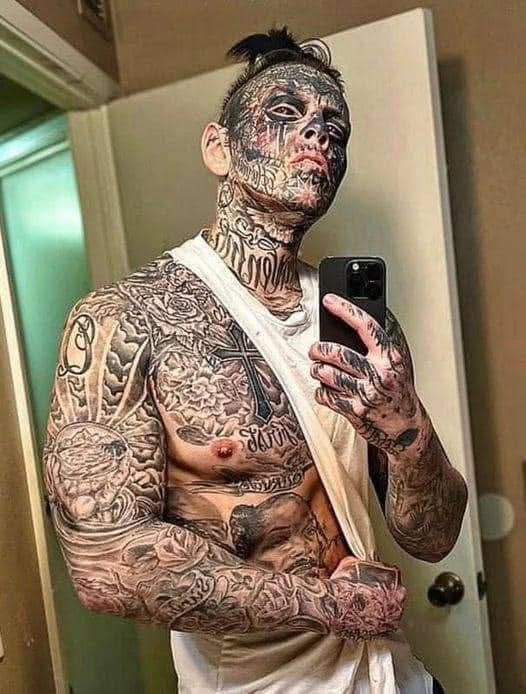
Man Who Survived Cancer Spends $70,000 Transforming His Body With Tattoos, Including His Eyeballs
TikTok Star Quest Gulliford Reveals His Extraordinary $70,000 Body Transformation
TikTok personality Quest Gulliford has attracted widespread attention for his extraordinary collection of tattoos, revealing that he has spent approximately $70,000 transforming his appearance through body art.
Among his most unusual modifications are tattoos covering his face and pigment injected into his eyeballs, a particularly risky procedure that has become one of the most talked-about aspects of his transformation.
But Gulliford’s appearance represents more than an interest in unconventional body modification.
As a cancer survivor, he connects his tattoos with personal experiences, resilience, and the determination to express his individuality after confronting a serious illness.
His journey began when he was just 18 years old, with facial tattoos that initially met resistance from his mother.
Since then, his collection has expanded into an extensive transformation that has required years of personal commitment and substantial financial investment.
Through TikTok, Gulliford has shared aspects of that journey, including the mental preparation involved in undergoing an eyeball tattoo procedure reportedly costing $10,000.
His story has generated interest not only because of the striking results but also because of the experiences and personal meaning behind his decisions.
How His Interest in Tattoos Became a Defining Part of His Life
For some people, tattoos are small decorative choices associated with particular memories or personal preferences.
For Gulliford, body art has developed into a much more extensive form of self-expression.
Rather than limiting his tattoos to areas that can easily be concealed, he chose to incorporate them into highly visible parts of his appearance.
His face became one of the first areas involved in that transformation.
Starting facial tattoos at 18 meant making a decision that would have an immediate and lasting effect on how other people perceived him.
Unlike tattoos covered by clothing, facial artwork remains visible during ordinary social interactions.
That visibility has become part of the identity Gulliford presents publicly.
As his collection grew, he continued developing a distinctive appearance shaped by his own preferences rather than conventional expectations.
His Mother Initially Disapproved of the Decision
Gulliford’s early interest in facial tattoos did not receive immediate approval from everyone close to him.
His mother initially opposed the decision, reflecting the concerns that can arise when a young adult chooses a highly visible and permanent body modification.
Facial tattoos can significantly change someone’s appearance, making them different from less noticeable forms of body art.
For Gulliford, however, the decision was part of a personal journey toward expressing himself through his body.
His mother’s initial reaction highlights the difference between how individuals may understand their own appearance and how family members respond to major changes.
Despite that early disapproval, Gulliford continued pursuing tattoos as an important part of his identity.
Over time, his body art became increasingly extensive, eventually representing a financial investment of tens of thousands of dollars.
The Remarkable Cost of His Tattoo Collection
One of the most striking details about Gulliford’s transformation is the amount of money involved.
He has spent approximately $70,000 on tattoos and body modifications, reflecting the scale of his commitment to changing his appearance.
That figure represents a substantial personal investment in artwork that has become a permanent feature of his body.
The total also demonstrates that his transformation has gone far beyond a small number of individual designs.
His collection includes highly visible modifications, with his dyed eyeballs standing out as an especially unusual feature.
For Gulliford, the financial cost is connected to the personal importance he assigns to body art.
Rather than describing his tattoos merely as decoration, his story emphasizes the experiences, memories, and ideas that individual designs can represent.
The $10,000 Eyeball Tattoo That Captured Attention
Among all his modifications, Gulliford’s eyeball tattooing has attracted particular interest.
He has described spending approximately $10,000 on the procedure, making it one of the most expensive individual elements discussed in his transformation.
Unlike conventional tattoos applied to the skin, eyeball tattooing involves introducing pigment into the eye.
The procedure is significantly different from decorating an arm, leg, or other ordinary tattoo location.
It involves an extremely delicate part of the body and carries potentially severe medical risks.
Gulliford’s decision to undergo such a modification has therefore attracted attention beyond the appearance of the final result.
People have also been interested in what led him to accept the risks involved and how he prepared himself psychologically for the experience.
What He Shared in His Viral TikTok Video
Gulliford brought attention to the procedure through a TikTok video discussing the mental preparation required before having his eyeballs tattooed.
The video generated interest because the procedure is both visually unusual and medically concerning.
His account focused on the psychological aspect of deciding to undergo a modification involving needles near an exceptionally sensitive area.
For viewers unfamiliar with extreme body modification, the idea of deliberately changing the appearance of the eyes can be difficult to understand.
Gulliford’s explanation offered insight into the commitment behind his choice.
It also demonstrated how social media allows individuals with unconventional appearances to communicate their motivations directly to an audience.
Rather than being understood only through photographs, his transformation became part of a personal narrative he could discuss in his own words.
Why Eyeball Tattooing Is Especially Dangerous
Eyeball tattooing carries risks that distinguish it from ordinary decorative tattooing.
The eyes contain delicate structures responsible for vision, and damage to those structures can have serious consequences.
Introducing pigment into the eye can lead to complications including infection, inflammation, and permanent visual impairment.
Severe injuries may threaten a person’s ability to see.
These risks make the procedure medically controversial and unsuitable to treat as a routine cosmetic decision.
The fact that Gulliford underwent the procedure does not mean similar modifications are safe for other individuals.
His experience illustrates the extreme end of body modification, where personal expression can involve potentially irreversible medical consequences.
Any discussion of his transformation must therefore distinguish the personal significance of his choices from the physical dangers associated with them.
His Cancer Survival Is Central to His Story
Gulliford’s experience as a cancer survivor provides an important dimension to his relationship with body art.
His tattoos are associated with resilience and the personal significance of overcoming serious adversity.
Surviving cancer can influence how someone thinks about their body, personal identity, and the future.
For Gulliford, body modification has become one way of expressing aspects of his experiences and individuality.
His tattoo collection is therefore connected with more than visual appearance.
It also reflects the importance he assigns to his personal journey.
The details available about his story do not establish a specific connection between every individual tattoo and a particular event during his illness.
However, the broader relationship between his survival experience and his chosen form of self-expression remains a defining element of his public identity.
Tattoos as Symbols of Strength and Resilience
Individual tattoos can carry meanings that are not immediately obvious to someone viewing them.
A design may represent a difficult experience, a personal achievement, or a value that remains important to its wearer.
Gulliford has presented his body art as a collection connected to personal meaning rather than simply an attempt to create a striking appearance.
His experiences with cancer have contributed to the story surrounding those choices.
For him, tattoos provide a visible way of expressing resilience and individuality.
Although outsiders may focus primarily on the dramatic changes to his face and eyes, those features represent only part of the larger narrative.
The personal significance of body art does not always correspond to how surprising or unusual a particular design appears to the public.
Why His Appearance Generates Strong Reactions
Gulliford’s extensive tattoos and altered eye color create an appearance that differs considerably from conventional expectations.
Such visible modifications naturally attract attention because they affect features people ordinarily use to recognize and communicate with one another.
Facial tattoos alone can change the way a person’s appearance is perceived.
Adding pigmentation to the eyeballs creates an even more dramatic visual difference.
As a result, his social media content can generate curiosity among viewers who have little experience with extensive body modification.
Some people may interpret his appearance as a bold expression of individuality, while others may focus on the medical risks or permanence of the changes.
Those differing reactions demonstrate how strongly personal appearance can influence public discussion.
The Role of TikTok in Sharing His Transformation
TikTok has provided Gulliford with a platform to discuss the decisions behind his distinctive appearance.
Through short-form video, he can share experiences that might otherwise be understood only through images or brief descriptions.
His discussion of the $10,000 eyeball tattoo demonstrates how an unusual personal decision can become the subject of widespread online interest.
The visual nature of the platform also makes body modification a particularly noticeable subject.
Viewers can immediately recognize the extent of his tattoos before learning the personal experiences connected to them.
Gulliford’s videos help connect those visual impressions with explanations of his motivations.
That combination has contributed to the attention surrounding his transformation.
How Body Art Became Part of His Identity
Gulliford began pursuing visible tattoos when he was young, and the changes have continued to shape his appearance.
What started with facial tattoos at 18 developed into a far larger collection.
Over time, the investment grew to approximately $70,000.
His transformation now represents a recognizable aspect of his identity as a social media personality.
For someone who has made such extensive changes, tattoos are not merely separate decorative additions.
They contribute to how the individual presents himself to the world.
In Gulliford’s case, that presentation is connected with ideas of survival, personal strength, and the freedom to make choices about his appearance.
The Difference Between Personal Expression and Medical Safety
Gulliford’s story brings together two subjects that should be considered separately: the freedom to express personal identity and the risks associated with certain physical modifications.
His tattoos have personal significance, and his experiences as a cancer survivor form an important part of that meaning.
At the same time, procedures involving the eyes present serious safety concerns.
Recognizing the personal motivations behind his decisions does not reduce the potential dangers of injecting pigment into such a sensitive organ.
Likewise, acknowledging those risks does not require dismissing the emotional significance he attaches to his body art.
Both aspects are important for understanding why his transformation has attracted such attention.
A Transformation Shaped by Personal Experience
The most important feature of Gulliford’s story is the connection between his appearance and the experiences that have shaped his life.
He survived cancer and developed a highly visible form of self-expression through extensive tattoos.
His willingness to undergo unusual modifications has made him recognizable to online audiences.
But the personal meaning associated with his body art remains central to how he explains his choices.
From his first facial tattoos at 18 to the far more extensive transformation that followed, Gulliford has continued making decisions that reflect his individual preferences.
The initial concerns expressed by his mother did not prevent him from pursuing that direction.
His appearance today reflects the cumulative result of those decisions.
Why the $70,000 Figure Is Only Part of the Story
The amount Gulliford has spent on tattoos is an attention-grabbing detail.
Seventy thousand dollars represents a substantial expenditure, particularly when devoted to permanent changes in appearance.
The reported $10,000 cost of his eyeball tattooing adds another striking element to the total.
However, focusing exclusively on the financial figures risks overlooking the personal reasons he has given for pursuing body art.
His transformation is linked to individuality, resilience, and the experience of surviving a serious illness.
The money demonstrates the scale of his investment, but it cannot fully describe what the tattoos mean to him.
That distinction helps explain why his story continues to interest audiences beyond the initial surprise of seeing his appearance.
Quest Gulliford’s Journey Continues to Attract Attention
Quest Gulliford has turned his body into an extensive collection of tattoos, investing approximately $70,000 in modifications that include his face and eyeballs.
Beginning with facial tattoos at 18, he continued making changes despite his mother’s initial disapproval.
His experience as a cancer survivor has become closely connected with the meaning he assigns to his body art.
Through TikTok, he has discussed his transformation and the psychological preparation involved in undergoing an especially risky $10,000 eyeball tattoo procedure.
Those revelations have drawn attention to both the extraordinary appearance he has created and the substantial dangers associated with certain forms of body modification.
For Gulliford, his tattoos are an expression of personal identity and perseverance.
His story illustrates how physical appearance can become a way of communicating experiences that are not immediately visible to others.
It also provides a reminder that unusual body modifications can involve serious health risks, regardless of the personal meaning attached to them.
Behind the dramatic tattoos and altered eyes is the experience of someone who survived cancer and chose to express his individuality through permanent body art.
That connection between survival, personal choice, and an unconventional appearance remains the defining feature of Gulliford’s transformation.