
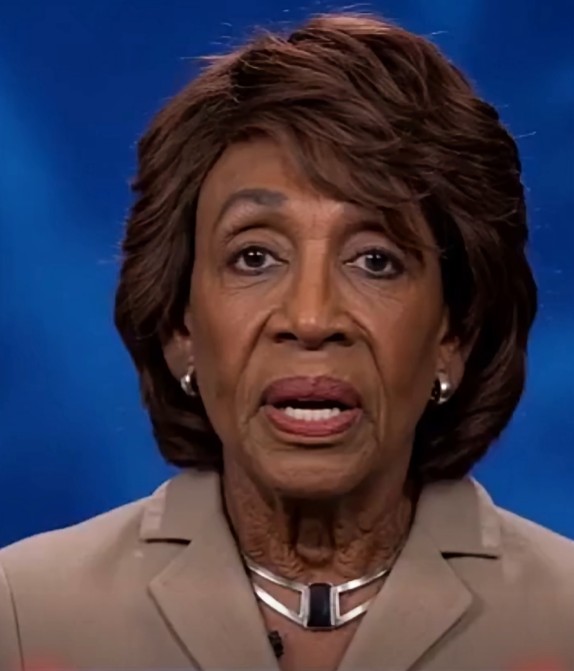
Maxine Waters Asked Whether 100 Is Too Old for Congress — Her Response Sparks Debate Over Age Limits
The Veteran California Democrat Rejected the Idea of Mandatory Retirement for Politicians, Then Turned the Conversation Toward Donald Trump. But Her Remarks Came as a Younger Challenger Was Questioning Whether Washington Needs New Leadership.
How old is too old to serve in Congress?
It’s a question that has become increasingly prominent in American politics as some of the nation’s most recognizable elected officials continue serving well into their seventies and eighties.
But when longtime Democratic Representative Maxine Waters was confronted with the question, she refused to give a specific age.
Not 80.
Not 90.
Not even 100.
Instead, Waters argued that Americans should evaluate elected officials based on their accomplishments, effectiveness, and record in office.
The California congresswoman made the remarks during an unexpected exchange with TMZ producer Jacob Wasserman outside the U.S. Capitol on May 14, 2026.
At the time, Waters was 87 years old.
She has since celebrated her 88th birthday.
And while the conversation began with a straightforward question about age limits, it quickly developed into a discussion about President Donald Trump, political accountability, and who should decide when a politician has served long enough.
The Question That Started the Entire Exchange
Waters had just attended a Working Families press conference when Wasserman approached her.
The producer introduced himself and explained that he wanted to ask a question from the perspective of a younger American.
He suggested that some members of Generation Z believe the country’s political leadership is too old.
Rather than immediately agreeing or disagreeing, Waters explained how she believed elected officials should be judged.
She argued that voters should examine what politicians actually do in office.
What have they accomplished?
What can they be credited for?
And what can they legitimately be criticized for?
Her position was that these questions provide a more meaningful basis for political decisions than a person’s birth date alone.
When Wasserman summarized her argument, Waters responded with three words:
“Performance and effectiveness.”
It was a concise answer to a complicated question.
But the interviewer wasn’t finished.
Then Donald Trump’s Age Entered the Conversation
Wasserman shifted the discussion toward President Donald Trump.
At the time of the May interview, Trump was approaching his 80th birthday.
The producer asked whether someone of that age might be too old to serve as president.
He also referenced the public debate that had surrounded former President Joe Biden’s age.
Waters made clear that she had strong opinions about Trump.
However, rather than arguing that his age disqualified him, she focused on her objections to his leadership.
She criticized his administration and raised concerns about his conduct in office.
Her comments included allegations concerning his business interests, political promises, and the concentration of presidential power.
These were Waters’ political assessments, not findings independently established by the brief interview.
But they demonstrated that her objections to Trump were not primarily based on how old he was.
She was criticizing what she viewed as his actions.
Waters Accused Trump of Damaging American Democracy
During the exchange, Waters delivered particularly forceful criticism of the president.
She accused Trump of undermining democratic institutions and failing to fulfill promises.
She also questioned his family’s financial interests involving cryptocurrency.
Waters has been an outspoken critic of Trump for years, frequently challenging his administration’s policies and conduct.
Trump and his supporters have disputed many of the criticisms directed at his leadership, defending his agenda and executive actions.
In this interview, however, Waters’ remarks were part of a broader argument about how voters should assess public officials.
She was making the case that decisions should be based on a leader’s record.
And that principle, she maintained, should apply regardless of age.
The Interviewer Pressed Her With a 100-Year-Old Hypothetical
Wasserman returned to his original question.
If age alone shouldn’t determine whether someone can serve, was there any upper limit?
He proposed an extreme hypothetical.
What if a politician were 100 years old but remained an effective advocate for constituents?
Should that person still be eligible to serve?
Waters did not identify an age at which someone should automatically retire.
Instead, she repeated her central position.
“The people should evaluate who should be in office with their vote, and that’s it.”
The response effectively ended the conversation.
For Waters, the final decision belonged to the electorate.
But the exchange raised a larger question that Americans continue debating.
Should voters alone determine when a politician is too old to serve, or should there be mandatory limits?
Why the Interview Attracted Attention
The video drew attention partly because of Waters’ own age.
Born on August 15, 1938, she is among the oldest members of the House of Representatives.
She has served in Congress since January 1991.
That means she has spent more than 35 years representing communities in Southern California.
Her long tenure gives her extensive experience with legislation, congressional oversight, and political negotiations.
But it also makes her part of a wider national discussion about generational change in Washington.
Some Americans believe lengthy experience is an important asset.
Others question whether elected officials should remain in power for several decades.
Waters’ remarks placed those competing views directly in the spotlight.
Her Political Career Began Long Before Congress
Maxine Waters was born in St. Louis, Missouri, and later moved to California.
She earned a bachelor’s degree from California State University, Los Angeles, in 1970.
Before entering Congress, she worked in education and community programs.
She also served in the California State Assembly from 1977 until 1991.
During that period, she developed a reputation as an outspoken political figure focused on civil rights, economic opportunity, and issues affecting underserved communities.
In 1990, she was elected to the U.S. House of Representatives.
She took office in January 1991.
Over the following decades, she became one of the Democratic Party’s most recognizable members of Congress.
She also served as chair of the House Financial Services Committee.
Her supporters frequently point to her experience and long history of public service.
Critics question whether decades in office can create obstacles to new leadership.
Those disagreements became especially relevant during her 2026 reelection campaign.
A Younger Challenger Wanted a Different Direction
When Waters gave the TMZ interview in May, she was preparing for California’s June 2 congressional primary.
Among her challengers was Myla Rahman, a Democratic nonprofit executive in her early fifties.
Rahman argued that her district needed leadership more closely connected to the daily challenges faced by younger families.
She highlighted issues such as housing affordability, the cost of living, raising children, and maintaining a household in Southern California.
Her argument centered on generational representation.
Rahman pointed out that Waters had already been in Congress for decades.
She also emphasized that many district residents were substantially younger than the incumbent representative.
For Rahman, that difference was relevant to questions about political priorities and personal experience.
But Waters rejected the idea that a candidate’s age should be the deciding factor.
Rahman Said Voters Wanted New Leadership
During the primary campaign, Rahman described conversations with residents who wanted a different approach to representation.
She argued that the concerns of renters, working parents, and families struggling with rising costs deserved greater attention.
Rahman also emphasized her own experiences raising children and navigating everyday financial pressures.
Her campaign framed the election as a choice about the future of the district.
Waters presented a different argument.
She emphasized her experience, relationships, record of service, and continued commitment to constituents.
Both candidates were asking voters to evaluate what kind of representation they wanted.
And the primary ultimately provided a clear result.
The June Primary Has Already Been Decided
Although the original May interview took place before the primary election, the results are now known.
California held its statewide primary on June 2, 2026.
In the 43rd Congressional District, Waters received 75,693 votes, representing approximately 63.8 percent of the total.
Republican Cristian Morales finished second with 20,009 votes, or approximately 16.9 percent.
Myla Rahman received 17,847 votes, approximately 15 percent.
Another Democratic candidate, David Sedlik, received about 4.3 percent.
Under California’s top-two primary system, the two candidates receiving the most votes advance to the general election, regardless of political party.
That means Waters and Morales advanced to the November 3 election.
Rahman’s challenge ended in the primary.
The results showed that Waters retained substantial support among participating primary voters despite the debate over her age and length of service.
Why Age Has Become Such a Major Political Issue
Questions about aging political leaders are not new.
But the issue has received greater attention in recent election cycles.
Joe Biden’s age became a major subject of public discussion during his presidency.
Concerns about his public appearances, communication, and ability to continue serving were repeatedly raised by political opponents, commentators, and some members of his own party.
In 2024, Biden withdrew from the presidential race after a period of intense scrutiny.
Donald Trump, who turned 80 on June 14, 2026, has also faced public questions about his age.
However, age alone does not establish an individual’s physical health, cognitive abilities, or effectiveness in office.
Those are separate questions that require specific evidence.
That distinction was central to Waters’ response.
Should Congress Have Mandatory Retirement Ages?
There is currently no maximum age for serving in the U.S. House of Representatives or Senate.
The Constitution establishes minimum ages.
A person must be at least 25 to serve in the House.
Senators must be at least 30.
Presidential candidates must be at least 35.
But the Constitution does not establish an upper age limit for those offices.
As a result, eligible candidates can continue seeking election regardless of age.
Supporters of mandatory retirement rules argue that age limits could encourage generational turnover and create more opportunities for younger candidates.
Opponents argue that such rules would exclude potentially capable officials solely because of their age.
They also contend that voters already have the ability to remove ineffective leaders through elections.
Waters clearly aligned herself with the latter argument during the interview.
Age Limits and Term Limits Are Different Questions
Although the two issues are frequently discussed together, age limits and term limits are not the same thing.
An age limit would prevent a politician from serving after reaching a specified age.
A term limit would restrict how long someone could hold a particular office, regardless of age.
For example, a person first elected to Congress at 30 could be affected by a term limit long before reaching retirement age.
Conversely, someone entering Congress at 75 could face an age limit after only a few years.
Both proposals raise questions about democratic choice, political experience, and turnover in government.
Neither is currently imposed on members of Congress through a nationwide constitutional restriction.
Changing congressional eligibility rules would involve significant constitutional considerations.
What About the Presidency?
The presidency is governed by a different set of constitutional requirements.
The Constitution establishes a minimum presidential age of 35.
It also requires candidates to satisfy citizenship and residency qualifications.
The Twenty-Second Amendment limits a person to being elected president no more than twice.
However, there is no constitutional maximum age for the presidency.
That means a candidate’s age can become a campaign issue without automatically making the candidate ineligible.
Voters may consider age alongside policy positions, leadership experience, performance, and other factors.
Waters’ comments suggested that she believes those judgments should remain with voters rather than be determined by a fixed age threshold.
Experience Versus Generational Change
One of the central disagreements in the debate concerns the value of experience.
Long-serving politicians often develop extensive knowledge of legislative procedures, federal agencies, and the communities they represent.
They may also build relationships that help them negotiate policy and secure support for local priorities.
Supporters of experienced incumbents frequently cite those advantages.
But advocates for generational change raise different concerns.
They argue that younger leaders may bring new perspectives on technology, housing, education, employment, and other issues affecting emerging generations.
They also question whether long political careers can limit opportunities for new candidates.
Neither experience nor youth automatically determines how effectively someone will serve.
The challenge for voters is deciding which qualifications and records matter most to them.
Waters Has Also Been Active in Immigration Protests
The congresswoman’s political activity has extended beyond debates over age and reelection.
In early 2026, she publicly criticized federal immigration enforcement operations in Los Angeles.
She appeared at demonstrations opposing Immigration and Customs Enforcement, commonly known as ICE.
At one protest, she defended the right of people to demonstrate and criticized law enforcement tactics.
Immigration enforcement had become a major subject of disagreement between the Trump administration and local activists.
Supporters of the administration defended stronger enforcement of federal immigration laws.
Critics raised concerns about civil liberties, enforcement practices, and the treatment of immigrant communities.
Waters’ participation reflected her longstanding position on immigration and civil rights issues.
Some Los Angeles Demonstrations Later Turned Confrontational
During protests in downtown Los Angeles in late January and early February 2026, large crowds gathered to oppose federal immigration enforcement.
Many participants demonstrated peacefully.
However, smaller groups became involved in confrontations with law enforcement officers near the federal detention center.
Police reported incidents involving thrown objects, property damage, and refusals to comply with dispersal orders.
Officers used crowd-control measures, including chemical irritants.
Multiple arrests were reported.
Local reporting distinguished between the larger peaceful demonstrations and the smaller confrontations that occurred later.
There is no basis in the cited reporting to attribute those confrontations to Waters simply because she attended or supported an anti-ICE demonstration.
The events nevertheless illustrated the intensity of the political disagreements surrounding immigration enforcement.
Why Her Public Activism Matters to the Age Debate
Waters has continued participating in public events, press conferences, congressional activities, and political demonstrations during her late eighties.
She points to her ongoing work as evidence of her commitment to public service.
Her supporters view that activity as part of a longstanding record of advocacy.
Her critics may evaluate the same record differently, focusing on policy outcomes or whether a change in representation is warranted.
Those are the kinds of competing assessments that Waters herself argued voters should make.
Her position does not require everyone to agree that she is effective.
Rather, it maintains that the judgment should be made through elections instead of an automatic age restriction.
What Her Exchange With TMZ Actually Established
The May interview was brief, but it revealed a consistent position.
Waters did not endorse a mandatory retirement age for members of Congress.
She did not say that 80-year-olds should automatically be excluded from the presidency.
And she did not identify 100 as an age at which someone should be prohibited from serving.
Instead, she repeatedly returned to performance, effectiveness, and voter choice.
Her criticism of Trump was separate from the question of whether his age alone made him unfit for office.
She opposed his leadership based on her political assessment of his actions.
That distinction is important when interpreting the exchange.
The November Election Presents Another Test
With the June primary completed, Waters is now preparing to face Republican Cristian Morales in the November 3, 2026, general election.
Her earlier Democratic challenger, Myla Rahman, is no longer on the general-election ballot.
For Waters, the election provides another opportunity to present her record to voters.
For Morales, it provides an opportunity to argue for different representation.
The contest will be decided by eligible voters in California’s 43rd Congressional District.
Its outcome has not yet been determined.
But the debate surrounding Waters’ age and lengthy congressional career is likely to remain part of the broader discussion about political leadership.
The Larger Question Facing American Voters
Maxine Waters’ response to TMZ highlighted a fundamental disagreement about how political leadership should be evaluated.
Should elected officials face mandatory retirement at a particular age?
Or should voters retain the ability to elect and reelected candidates regardless of how old they are?
There are arguments on both sides.
Age limits could establish a consistent point for generational turnover.
But they could also prevent voters from choosing candidates they believe remain effective.
Allowing unrestricted reelection preserves voter choice.
However, it also means longstanding incumbents may continue serving for decades if they retain sufficient electoral support.
Those tradeoffs are not unique to one party or politician.
They apply to Democrats, Republicans, and independent candidates alike.
Maxine Waters Has Made Her Position Clear
At 88, Maxine Waters remains one of the longest-serving and oldest members of the U.S. House of Representatives.
She has represented Southern California in Congress since 1991.
She faced a younger Democratic challenger in the June 2026 primary and won enough support to advance comfortably to the general election.
And she has continued speaking publicly about issues ranging from financial oversight to immigration enforcement.
When asked whether there should be a mandatory age limit for political office, she declined to support one.
Her reasoning was straightforward.
Voters should examine the work their representatives perform and decide whether they deserve another term.
Even when confronted with the hypothetical example of a 100-year-old politician, she refused to establish a universal cutoff.
The exchange may not have settled the national debate about aging politicians.
But it clarified where Waters stands.
For her, the decisive question is not how many birthdays an elected official has celebrated.
It is what that official has accomplished and whether voters want that person to continue representing them.
Do you believe elected officials should face a mandatory retirement age, or should voters always make that decision at the ballot box? Share your thoughts in the comments.