
Mysterious Hairless Creature Caught on Camera Near U.S.–Mexico Border — But Officials Reveal a Surprising Detail
Strange Camera-Trap Images From Northern Mexico Show a Pale, Long-Tailed Figure That Investigators Have Struggled to Identify. One Researcher Claims It Could Be Responsible for Mysterious Animal Attacks, but Authorities Say a Crucial Piece of Evidence Is Missing.
Something unusual has captured attention in northern Mexico.
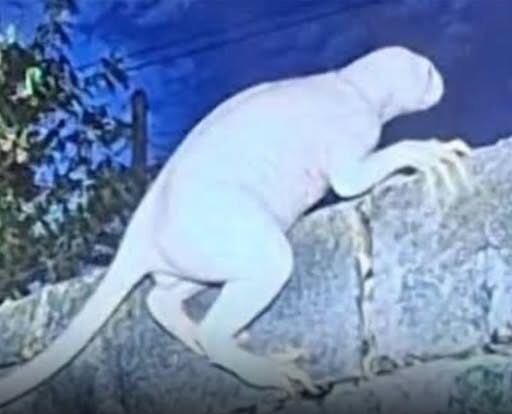
In the rural Valley of Juárez, near the border between Mexico and the United States, a series of photographs and video clips reportedly shows a pale, hairless figure moving through an outdoor area.
Its appearance is difficult to explain from the available images.
It seems to have an elongated body.
A long tail.
And limbs that some observers have described as unusually thin.
At first glance, the figure could be mistaken for an unfamiliar animal.
But the people investigating the footage believe there may be more to the story.
Mexican UFO researcher Jaime Maussan and his team have publicly presented the material, suggesting that it shows a creature unlike the animals normally found in the region.
They have also connected the figure to reports of missing or dead farm animals.
Those allegations have prompted speculation about everything from an unusual reptile to the legendary chupacabra.
Some theories have gone even further.
But as the story spreads, one important detail has emerged.
Local authorities say they have received no official reports confirming that a mysterious creature is attacking animals in the area.
And without independent evidence, the identity of the figure remains an open question.
The Images That Started the Mystery
The controversy gained attention in October 2026 when researchers associated with Jaime Maussan presented photographs reportedly obtained from camera traps in the Ciudad Juárez area.
Local media reported on the presentation around October 17.
The team claimed the images showed an animal-like figure that did not resemble familiar wildlife.
In some of the material, the figure appears close to a wall or other structures.
Its pale body contrasts with the darker surroundings.
And its long tail contributes to an unusual silhouette.
Later reports described additional footage that the team said was captured on October 14, between approximately 7 p.m. and 8 p.m.
However, the publicly available material has not been independently authenticated through a complete scientific examination.
That distinction is important.
A photograph can show something unfamiliar without proving that the subject is a new species, an extraordinary creature, or a threat to nearby residents.
For now, the images are the center of the mystery.
Investigators Estimated the Figure Was Nearly Six Feet Long
One of the most striking claims concerns the figure’s size.
According to Maussan’s team, the creature may measure approximately 1.8 meters, or nearly six feet, from its head to the end of its tail.
The tail alone was estimated to measure around three feet.
Those numbers attracted attention because they suggest an animal considerably larger than some of the small creatures commonly seen around homes and farms.
But the measurements were not obtained by physically examining an animal.
Instead, investigators reportedly estimated its dimensions by comparing the figure with nearby bricks or sections of a wall.
That method can provide a rough approximation, but it has limitations.
The animal’s distance from the camera, the viewing angle, and the perspective of the image can all affect apparent size.
Without reliable scale measurements and access to the original recording, the estimate cannot be treated as a confirmed physical measurement.
So while the six-foot figure has become one of the most repeated details in the story, it remains an estimate.
What Exactly Does the Creature Look Like?
Descriptions of the mysterious figure vary depending on the source.
Some reports call it reptilian.
Others describe a hairless animal with unusually long limbs.
Maussan has compared its appearance to a gargoyle, a term commonly associated with strange carved figures found on historic buildings.
Other accounts emphasize its tail and its apparent ability to climb.
But those descriptions are interpretations of limited visual material.
They are not established biological characteristics.
A low-quality image can make an ordinary animal appear unfamiliar.
Unusual lighting can alter the appearance of skin or fur.
Movement can distort the shape of limbs.
And a partially obscured body may appear different from what it would look like in clear daylight.
These possibilities do not establish what the figure is.
They simply explain why researchers need better evidence before reaching a conclusion.
Then Came the Claims About Missing Farm Animals
The story became more unsettling when investigators began discussing alleged attacks on animals.
Maussan has suggested that the unidentified figure could be connected to reports involving chickens, roosters, rabbits, and other animals kept by local residents.
In public statements, he described the supposed creature as a predator.
He also repeated accounts suggesting that multiple birds had been killed during a single night.
Those claims contributed to growing online interest.
For families who keep animals on rural properties, the possibility of an unidentified predator would naturally be concerning.
But the available evidence does not establish that the figure in the photographs attacked any animal.
No independently verified footage has been presented showing the photographed figure carrying out those attacks.
And no publicly documented biological examination has connected the figure to any reported animal deaths.
At this stage, the alleged attacks and the camera-trap images remain separate claims without a demonstrated connection.
Local Officials Revealed an Important Detail
As speculation spread, reporters contacted local authorities to determine whether official agencies had received reports of a dangerous unidentified animal.
The response raised questions about the claims.
Ciudad Juárez Civil Protection director Sergio Rodríguez said his department had received no official reports or evidence confirming the presence of the alleged creature.
He also said the agency had not documented the unusual animal attacks being discussed publicly.
According to local reporting, recent Civil Protection activity in the area had concerned damage related to rainfall rather than encounters with an unidentified predator.
That does not prove that every witness account is false.
People sometimes discuss incidents privately without contacting authorities.
But it means the public claims have not been supported by the official reports that might ordinarily help establish a pattern of incidents.
For a story involving an allegedly dangerous animal, that absence of corroboration is significant.
Authorities Across the U.S. Border Reported No Similar Incidents
The Valley of Juárez lies near the international border, making the story interesting to residents of both Mexico and Texas.
As reports circulated, questions arose about whether a similar animal had been seen on the American side.
The El Paso County Sheriff’s Office reportedly told journalists that it had received no reports involving an unusual creature or unexplained farm-animal deaths connected to the allegations.
That response added another important piece of context.
There was no independently documented pattern of similar incidents on the Texas side of the border.
Again, the absence of official reports cannot identify the figure in the images.
But it does limit what can responsibly be claimed about the situation.
There is currently no verified evidence of a mysterious predator moving across the border and threatening livestock.
Could It Be an Animal Already Known to Science?
One of the simplest possibilities is that the figure represents an animal that has been misidentified because of the quality of the recording.
Some online observers have suggested a lizard or another reptile.
Others have mentioned the possibility of an animal with unusual pigmentation or an escaped exotic pet.
These suggestions have not been confirmed.
But they illustrate why visual identification can be difficult.
Animals may look very different depending on lighting, distance, posture, and camera angle.
A familiar animal can appear almost unrecognizable when photographed in poor conditions.
Even a long tail can create misleading impressions if the rest of the body is partly hidden.
To identify the figure reliably, specialists would need clearer footage or physical evidence.
They would also need accurate information about where and how the images were obtained.
The Research Team Says Common Animals Have Been Considered
During the presentation of the photographs, Maussan’s team claimed that animal specialists had reviewed the material.
According to local reports, the team said those reviewers did not identify the figure as a rat, rabbit, raccoon, or another familiar animal.
That claim has attracted attention because it suggests the researchers attempted to compare the images with known wildlife.
However, the names, methods, and complete findings of those specialists have not been publicly documented in a way that permits independent evaluation.
Without that information, it is impossible to determine how comprehensive the assessment was.
Nor does an inability to identify an animal from photographs establish that it represents an unknown species.
Sometimes the available material simply lacks enough detail to support a reliable identification.
That may be the case here.
Why Some People Are Comparing It to the Chupacabra
As the images circulated, comparisons with the chupacabra quickly emerged.
The chupacabra is a creature from modern Latin American folklore, traditionally associated with unexplained attacks on livestock.
Stories about it became especially prominent during the 1990s.
Descriptions have varied widely.
Some accounts depict a reptilian creature.
Others describe a dog-like animal with little or no fur.
Because the Juárez figure has been described as hairless and allegedly linked to farm-animal attacks, the comparison was almost inevitable.
But the chupacabra remains a creature of folklore rather than a scientifically established species.
Previous animals described as chupacabras have sometimes been identified as known mammals affected by conditions such as mange.
There is no evidence establishing that the figure photographed in Chihuahua is a chupacabra.
The comparison reflects the similarities between the story and an existing legend, not a confirmed identification.
Jaime Maussan Has Suggested an Even More Extraordinary Possibility
Maussan is widely known in Mexico for his investigations and public statements about UFOs and alleged unexplained phenomena.
His involvement brought additional attention to the photographs.
During discussions of the Juárez case, he suggested that the figure might have an origin beyond conventional explanations.
Among the possibilities he raised was the idea of an interdimensional being.
However, there is no scientific evidence connecting the figure to another dimension.
The photographs do not establish an extraordinary origin.
They also do not demonstrate that the subject possesses abilities beyond those of known animals.
An unusual appearance, even if accurately recorded, would not by itself support such conclusions.
Extraordinary explanations require independent, testable evidence.
That evidence has not been presented in this case.
What Would Investigators Need to Solve the Mystery?
Determining what appears in the images would require more than speculation.
Investigators would benefit from obtaining the original, unedited camera recordings.
They would need accurate timestamps and information about the equipment used.
The exact location and dimensions of nearby objects could help establish the figure’s size.
Independent wildlife specialists could examine the material without relying on conclusions proposed by the original investigators.
Additional footage from different angles might reveal anatomical features that are currently difficult to distinguish.
And if a real animal were located, noninvasive observations or appropriate biological evidence could help determine its species.
For the alleged attacks, investigators would need separately documented incidents.
That could include verified reports from animal owners, veterinary examinations, or other reliable evidence establishing the cause of the losses.
Without those steps, the mystery cannot be resolved confidently.
Why Camera-Trap Footage Can Be Misleading
Camera traps are widely used by wildlife researchers.
They can record animals that are difficult to observe directly, especially those active at night.
But they also have limitations.
Some cameras use infrared illumination, which can change the way an animal’s body appears.
Low resolution may hide important details.
Motion blur can distort the shape of limbs or tails.
And an animal passing close to the lens may appear much larger than expected.
These issues become especially important when an unusual animal is identified from only a small number of images.
A single frame may capture an awkward movement that does not represent the animal’s normal appearance.
That is why wildlife identification often benefits from multiple recordings, different viewing angles, and additional observations.
Without that context, even experienced observers may struggle to determine exactly what they are seeing.
The Difference Between an Unidentified Animal and an Unknown Species
There is an important distinction that is often overlooked in stories about mysterious creatures.
An unidentified animal is simply an animal whose identity has not yet been established.
That can happen because an image is unclear, the subject is partly hidden, or the available evidence is incomplete.
An unknown species, by contrast, is a much more specific scientific claim.
Establishing a new species generally requires detailed evidence that distinguishes it from known organisms.
Researchers may examine anatomy, genetics, geographic distribution, and other characteristics.
They must also compare their findings with existing scientific descriptions.
The photographs from Chihuahua do not currently provide that level of evidence.
Therefore, describing the figure as unidentified is reasonable.
Calling it a newly discovered species would be premature.
Why the Story Has Attracted So Much Attention
Mysterious wildlife images often spread quickly because they combine several elements that naturally capture curiosity.
There is an unusual visual.
There is uncertainty about what it shows.
And there are competing explanations.
In this case, the setting adds another layer of interest.
The Valley of Juárez is close to an international border.
The alleged creature has been associated with livestock attacks.
And a prominent UFO investigator has publicly discussed the case.
Together, those details have turned a small collection of images into an international mystery story.
But popularity does not establish accuracy.
A claim can attract widespread attention while remaining unsupported by reliable evidence.
That is why the distinction between what was photographed and what has been alleged matters so much.
What Local Residents Should Know
For people living in rural areas, unexplained animal losses can be a genuine concern.
Chickens, rabbits, and other small animals may be vulnerable to a variety of familiar predators.
When an animal disappears or is found dead, identifying the cause can help owners protect the rest of their animals.
But unusual photographs should not automatically be treated as evidence of a new threat.
Residents who encounter unfamiliar wildlife should avoid approaching or attempting to capture it themselves.
They can document observations from a safe distance and contact appropriate local wildlife or animal-control authorities.
Reliable reports can help professionals determine whether an actual wildlife problem exists.
In the Juárez case, the available official statements do not establish that residents are facing an unidentified dangerous predator.
That is a reassuring distinction, even while the photographs remain unexplained.
Could More Evidence Be Released?
Maussan and his team have indicated that they intend to continue investigating the alleged creature.
Local reports have described plans to examine additional material and potentially gather more footage.
If clearer images or independently verifiable evidence become available, the assessment could change.
Researchers might identify the figure as a known animal.
They might determine that the original images were misleading.
Or they might find that additional investigation is necessary.
At present, there is not enough reliable information to predict the outcome.
The important point is that any new evidence should be evaluated independently.
Claims about size, behavior, and origin should be tested rather than accepted simply because they are unusual.
What Has Actually Been Confirmed?
Several parts of the story are supported by published reporting.
Researchers associated with Jaime Maussan presented images that they described as showing an unidentified figure in the Juárez area.
They made claims about the figure’s appearance and estimated size.
They also suggested a possible connection to alleged attacks on animals.
But other important questions remain unanswered.
The figure’s species has not been independently established.
Its estimated size has not been confirmed through direct measurement.
No publicly available biological evidence has demonstrated that it represents an unfamiliar organism.
And the alleged animal attacks have not been independently linked to the subject of the images.
Authorities in Ciudad Juárez and across the border in El Paso have reported no official incidents confirming the claims.
That is the current state of the evidence.
The Most Surprising Detail May Be What’s Missing
At first, the photographs are what make the story intriguing.
A pale figure appears in the darkness.
Its unusual shape raises questions.
And its reported size makes it sound even more mysterious.
But the most important detail may not be something visible in the images.
It may be the evidence that has not yet been produced.
There is no confirmed specimen.
No independently verified biological sample.
No established scientific identification.
And no official pattern of unusual animal attacks that has been linked to the figure.
Those missing pieces make it impossible to determine whether the images show an ordinary animal, a misleading visual, or something else.
The uncertainty is real.
But uncertainty should not be mistaken for proof of an extraordinary explanation.
A Border Mystery That Still Has No Confirmed Answer
The strange images from the Valley of Juárez have become one of the more unusual stories circulating in October 2026.
They have inspired curiosity, speculation, and comparisons with longstanding legends.
Jaime Maussan believes the material deserves further investigation.
Others have suggested that the figure could be a known animal seen under unusual conditions.
And local officials have emphasized that they have received no evidence confirming the alleged attacks.
For now, none of those competing explanations has established the figure’s identity.
That leaves the case unresolved.
But it also leaves room for a straightforward answer if better evidence eventually emerges.
Many wildlife mysteries become less mysterious when researchers obtain clearer photographs, reliable measurements, or physical evidence.
Until then, the most responsible conclusion is also the simplest.
A strange figure was presented in photographs and video from northern Mexico. Its identity remains unconfirmed, and the more extraordinary claims surrounding it have not been substantiated.
Whether future investigation reveals a familiar animal or something genuinely unexpected, the answer will depend on evidence rather than speculation.
And that is what makes this mystery worth following.
What do you think the unusual figure could be: a known animal captured from a strange angle, an escaped exotic species, or something investigators have yet to identify? Share your thoughts in the comments.