
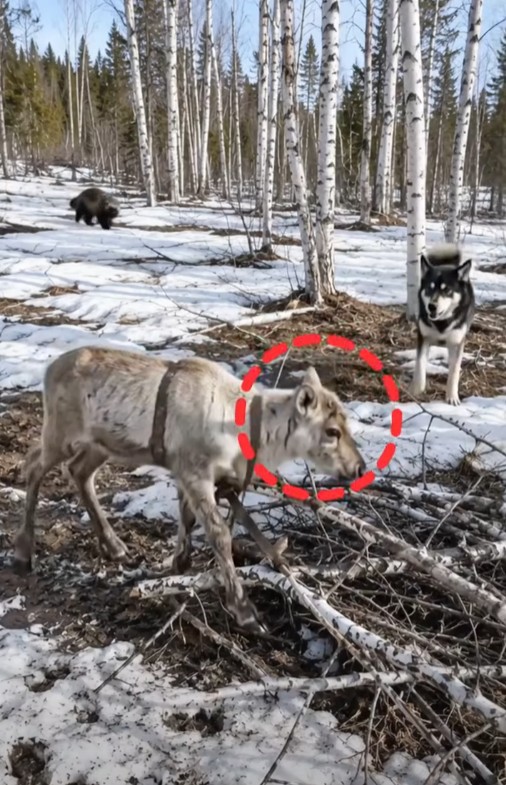
A Wolf Appeared While a Man Was Walking His Reindeer Through a Snowy Forest — Then His Dogs Discovered Something Unexpected
A Winter Caretaker Was Guiding a Reindeer Back to Safety When a Gray Wolf Emerged From the Trees. But When His Two Dogs Noticed Movement Near a Fallen Tree, the Encounter Took an Unexpected Turn.
The forest was almost silent when a gray wolf appeared between the snow-covered spruce trees.
Forty-five-year-old Erik Larsen stopped immediately.
Beside him stood a reindeer named Niko and two dogs, Koda and Luna, who had accompanied him along a remote winter trail.
Only moments earlier, Erik had been guiding the reindeer back toward its enclosure after checking a feeding station at a small northern wildlife facility.
Now, approximately fifty yards away, a wolf stood watching from the edge of a clearing.
Koda gave a sharp warning bark.
Luna moved closer to Erik, her ears pointing toward the animal.
Niko shifted nervously against the lead rope.
Erik knew that one sudden movement could make an already uncertain situation more dangerous.
But the wolf was not the only problem waiting along the trail.
When Erik attempted to return to the enclosure, he discovered that a fallen tree had blocked their path.
And before help could arrive, his dogs noticed something hidden beyond the snow-covered branches.
This fictional wildlife story follows an unexpected encounter, a difficult decision, and a discovery that changes how the caretaker understands the situation.
A Peaceful Winter Afternoon Takes an Unexpected Turn
Erik had spent many winters working with reindeer at a small wildlife facility in a northern forest.
He was familiar with the area’s trails, changing weather, and the challenges of caring for animals during heavy snowfall.
That afternoon, he had taken Niko along a forest route after checking a remote feeding station.
His two dogs, Koda and Luna, walked nearby.
Fresh snow covered the ground, while tall spruce trees surrounded the narrow trail.
The temperature was dropping, and new snowflakes had begun settling over their earlier tracks.
Erik expected an ordinary return to the enclosure.
Then he noticed movement between the trees.
A low gray shape passed behind a fallen trunk.
At first, he could not identify it.
But when the animal stepped into the clearing, he recognized the unmistakable outline of a wolf.
The Gray Wolf Stands at the Edge of the Clearing
The wolf remained approximately fifty yards away.
Its gray coat blended with the surrounding snow and dark trees.
For several moments, it simply watched.
Koda barked again, drawing Erik’s attention to his dogs.
He immediately gave a familiar command to keep them beside him.
Luna responded quickly.
Koda remained alert but did not pursue the wolf.
Niko became restless, shifting its weight and pulling against the lead rope.
Erik maintained control without making abrupt movements.
He had heard reports of wolves being observed near the facility during previous winters.
However, he had never encountered one while personally guiding a reindeer along this particular trail.
He understood that the safest response was to avoid provoking the animal and seek assistance if necessary.
Erik Notices Something Unusual About the Wolf
As Erik watched from a distance, he noticed that the wolf appeared thin.
However, he knew that judging a wild animal’s physical condition from fifty yards away was unreliable.
The wolf took several steps toward the clearing before stopping near a cluster of young trees.
Its attention appeared to shift between the forest and the animals accompanying Erik.
The caretaker could not determine whether it was hunting, investigating an unfamiliar situation, or simply traveling through the area.
He did not attempt to approach it.
Instead, he slowly turned toward the trail leading back to the enclosure.
His priority was keeping Niko and the dogs together.
He also wanted to avoid a confrontation with an animal that was behaving unpredictably.
A Fallen Spruce Tree Blocks the Way Home
Erik began guiding Niko backward along the trail.
The reindeer hesitated but eventually followed his steady movements.
Koda and Luna remained close.
After several minutes, Erik reached a narrow section of the forest where the trail curved between heavy branches.
He stopped.
A large spruce limb had collapsed across the route.
The obstruction had not been there when he passed through the forest earlier that morning.
Heavy snow appeared to have brought the branches down.
Erik examined the fallen tree and quickly realized that Niko could not safely step across it.
The branches were tangled, and the surrounding ground was uneven.
An alternative route was visible nearby, but it passed through deeper snow.
Then Erik looked behind him.
The wolf was still near the clearing.
He was now dealing with two separate hazards: an obstructed trail and a wild predator somewhere behind his group.
The Caretaker Calls for Assistance
Erik removed a radio from his jacket and contacted the wildlife facility.
A colleague named Anna answered.
She asked for his location and whether everyone was safe.
Erik explained that a fallen spruce limb had blocked the return trail.
He also reported the wolf near the clearing.
Anna asked whether Niko and the dogs were secure.
Erik confirmed that all three animals remained beside him.
She advised him to remain calm while she contacted the facility’s wildlife supervisor.
Erik agreed to wait in a position where he could monitor the surrounding forest.
He kept the reindeer close and continued watching for movement among the trees.
Then Luna suddenly lowered her head toward a nearby ditch.
The Two Dogs Notice Something Hidden in the Snow
While Erik waited for instructions, Luna began sniffing toward a snow-covered depression beside the trail.
Koda turned away from the distant wolf and focused on the same area.
Both dogs appeared interested in something beyond the fallen branches.
Erik followed their gaze.
He noticed a series of tracks crossing the trail near the obstruction.
The impressions were smaller than the hoofprints left by an adult reindeer.
He wondered whether another animal had recently passed through the clearing.
Then he heard a faint rustling sound.
It came from beneath a cluster of snow-covered shrubs.
Erik stood still and watched.
Something was moving behind the branches.
A Young Reindeer Emerges From Behind the Fallen Tree
A moment later, a small wild reindeer appeared from the vegetation.
The young animal moved slowly through the deep snow.
Its steps were uneven.
As Erik watched, he noticed that one rear leg appeared to drag slightly.
The animal struggled to move across the snowy ground.
It was clearly having difficulty, although Erik could not determine the cause from where he stood.
For several seconds, he watched the young reindeer make its way past the shrubs.
Then he glanced toward the tree line.
The wolf was still nearby.
Suddenly, the encounter seemed more complicated than he had originally believed.
Was the Wolf Following the Injured Reindeer?
Erik began to consider a different explanation for the wolf’s presence.
Perhaps the animal had been following the struggling young reindeer.
Perhaps it had noticed the reindeer’s unusual movements and remained in the area.
Or perhaps the wolf had simply been traveling through the same section of forest.
Erik could not know for certain.
But the discovery changed his understanding of the situation.
He was no longer watching only a wolf near his own animals.
There was also a potentially injured wild reindeer nearby that might require professional assistance.
He reached for his radio again.
Erik Reports the Discovery to the Facility
Anna responded when Erik contacted her for a second time.
He described the smaller reindeer and its difficulty walking.
He explained that one rear leg appeared to be dragging and that the animal was moving slowly through deep snow.
Anna instructed him not to approach the wild reindeer or attempt to capture it.
Handling an unfamiliar injured animal could create additional danger for both the animal and the person trying to help.
She told Erik that a wildlife response team would need to assess the situation.
Erik agreed.
He kept Niko and the dogs together while continuing to observe the young animal from a safe distance.
Nearby, the wolf moved along the tree line.
Its attention appeared to shift toward the clearing.
A Difficult Decision in the Snow-Covered Forest
Erik understood that approaching the injured reindeer would not necessarily help.
The animal was wild, frightened, and already struggling to move.
His presence, along with the dogs and Niko, could increase its stress.
The nearby wolf also made the situation unpredictable.
Instead of attempting a rescue on his own, Erik focused on protecting the animals under his care.
He guided his group toward a wider section of the trail with better visibility.
Koda and Luna remained beside him after repeated commands.
Niko appeared calmer once they stopped moving through the narrow passage.
Erik contacted Anna again and requested assistance finding a safer way around the fallen tree.
She confirmed that help was approaching from the facility.
The Wolf Disappears Behind the Trees
As Erik waited, the wolf moved behind a cluster of spruce trees.
Within moments, it disappeared from view.
Erik did not assume that the animal had left the area.
He continued scanning the forest while keeping the dogs secured.
The disappearance created uncertainty rather than immediate reassurance.
The wolf could have continued deeper into the forest.
It could also have remained somewhere beyond the trees.
Without a clear view, Erik could not determine its location.
He remained in the open section of the trail and waited for his colleagues.
Then, from the direction of the enclosure, he heard the distant sound of an approaching snow vehicle.
Help Finally Arrives From the Wildlife Facility
Several minutes later, Anna arrived with a maintenance worker named Thomas.
They stopped the snow vehicle at a safe distance and secured their equipment before approaching on foot.
Erik explained what had happened.
He showed them where the wolf had last been visible.
He also identified the area where the young wild reindeer had emerged from the shrubs.
Anna contacted the regional wildlife authorities and provided the updated information.
Thomas examined the blocked trail and the surrounding terrain.
He identified a safer passage around the fallen spruce limb.
The team agreed that their immediate responsibility was to return Niko and the dogs to the enclosure without disturbing the injured wild animal.
They Choose Not to Approach the Injured Animal
Although the young reindeer appeared to need help, Erik and his colleagues understood that an unplanned intervention could make matters worse.
Wild animals may react unpredictably when frightened or approached by people.
An injured animal can also become more vulnerable if forced to move suddenly.
For that reason, the team left the assessment to trained wildlife responders.
Anna had already provided the animal’s approximate location and a description of its movements.
Erik focused on guiding Niko safely through the alternative passage.
Thomas helped assess the terrain, while Koda and Luna remained under control.
The group avoided moving toward the area where the wolf had last appeared.
With careful coordination, they began their return to the facility.
Niko and the Dogs Return Safely to the Enclosure
The alternate route was slower than the original trail.
Deep snow and uneven ground required patience.
But the team had identified a passage that avoided the fallen branches.
Erik continued guiding Niko while monitoring the reindeer’s movements.
Koda and Luna stayed close.
Anna and Thomas assisted as needed.
Eventually, the group reached the facility.
Niko was returned to its winter enclosure, where it could settle after the unusual afternoon.
The dogs were also brought safely back.
For Erik, the immediate danger had passed.
But he continued thinking about the young wild reindeer they had discovered in the forest.
The Next Morning Brings an Important Update
The following morning, Erik received information from the regional wildlife office.
Responders had located the young reindeer near the original clearing.
They had assessed its condition and arranged further care according to local wildlife procedures.
The update confirmed that trained personnel had reached the animal.
However, it did not establish the precise cause of the reindeer’s difficulty walking.
The wolf had not been observed during the responders’ assessment.
Officials also could not determine whether it had been hunting the young reindeer or simply passing through the area.
Erik appreciated that they avoided drawing conclusions without sufficient evidence.
The encounter had been unusual, but the animals’ behavior could not be explained with certainty.
The Winter Operations Team Reviews What Happened
Back at the facility, Anna discussed the incident with the winter operations team.
The blocked trail had created a significant problem during an already unpredictable wildlife encounter.
The staff agreed that forest routes should be inspected more frequently following heavy snowfall.
Fallen trees and accumulated snow could make familiar paths difficult or unsafe for animals and handlers.
Thomas arranged for the large spruce limb to be removed safely.
The team also reviewed the importance of maintaining communication equipment and following established wildlife response procedures.
For Erik, the experience reinforced the value of remaining calm when unexpected problems arise.
His decision to keep the dogs close and contact experienced colleagues had helped the group return safely.
Why Wolves May Appear Near Reindeer Habitat
Wolves are natural predators in ecosystems where wild reindeer and other large hoofed animals live.
Their movements may be influenced by prey availability, seasonal conditions, territory, and other environmental factors.
During winter, deep snow and difficult terrain can affect the movement of both predators and prey.
However, observing a wolf near a reindeer does not automatically prove that a hunt is taking place.
Wild animals may travel through the same habitat for many different reasons.
In this fictional story, the wolf’s presence raises questions about the injured young reindeer.
But its actual motivation remains unknown.
That uncertainty is important because animal behavior should not be interpreted as though every movement has a clear human-like intention.
Why Erik Did Not Allow His Dogs to Chase the Wolf
One of the most important decisions in the story occurs when Erik prevents Koda and Luna from pursuing the wolf.
Dogs can become excited or defensive when encountering unfamiliar wildlife.
Allowing them to chase a wild predator could expose them to injury and escalate an already dangerous situation.
It could also disturb other animals in the surrounding habitat.
Erik uses familiar commands to keep both dogs beside him.
By maintaining control, he reduces the likelihood of an uncontrolled confrontation.
In real wildlife encounters, appropriate responses depend on the species, location, and circumstances.
People working around large predators should follow local wildlife authority guidance and established safety procedures.
Why Injured Wildlife Needs Professional Assessment
The young reindeer in the story appears to have difficulty using one of its rear legs.
That observation suggests a possible problem, but it does not reveal a diagnosis.
Injury, exhaustion, terrain conditions, or other factors can affect an animal’s movements.
Determining the cause may require an assessment by qualified wildlife professionals.
Attempting to approach or capture a wild animal without proper training can cause additional stress and create safety risks.
In some circumstances, intervention may not be appropriate at all.
Wildlife responders must consider the animal’s condition, species, environment, and applicable regulations before deciding what to do.
In Erik’s case, reporting the observation rather than attempting an improvised rescue allows the appropriate team to evaluate the situation.
The Dogs’ Discovery Changes the Meaning of the Encounter
At the beginning of the story, the wolf appears to be the central threat.
Erik sees it standing near the clearing and immediately focuses on keeping Niko and the dogs safe.
Then the fallen spruce tree prevents the group from returning along their usual route.
While they wait for help, Koda and Luna notice something near the snow-covered ditch.
Their attention leads Erik to discover a young reindeer struggling through the snow.
Suddenly, the situation becomes more complex.
The wolf may have been interested in the injured animal, but no one can establish that with certainty.
The discovery reminds Erik that the forest contains many overlapping animal movements and survival challenges.
What initially appeared to be a simple encounter between a wolf and a caretaker turns into a broader wildlife situation requiring careful judgment.
A Few Days Later, Erik Returns to the Forest Trail
Several days after the incident, the fallen spruce limb had been cleared from the trail.
The winter operations team had reviewed the route, and the immediate obstruction was gone.
Erik returned to the forest with Koda and Luna.
Fresh snow covered the clearing.
The surrounding spruce trees stood quietly beneath the pale winter sky.
There was no sign of the wolf.
The young reindeer was no longer visible near the shrubs.
Erik paused briefly beside the location where the encounter had begun.
Then he called his dogs and continued toward the enclosure.
The trail looked peaceful again.
The Important Lesson Behind This Winter Wildlife Story
This fictional encounter illustrates how quickly an ordinary outdoor activity can become complicated when wildlife, weather, and difficult terrain intersect.
Erik begins the afternoon with a straightforward responsibility: return Niko safely to its enclosure.
But the appearance of a wolf and the discovery of a blocked trail force him to reconsider his route.
When his dogs draw attention to a struggling young reindeer, he faces another decision.
Rather than attempting to approach the animal, he contacts people equipped to assess the situation.
The team prioritizes keeping the dogs secured, guiding Niko home, and informing the regional wildlife authorities.
Those decisions lead to a safe return for the animals under Erik’s care and an appropriate professional response to the injured reindeer.
The story does not portray the wolf as deliberately seeking human help or behaving with a confirmed motive.
Instead, it highlights the importance of observation, patience, and respecting the uncertainty of wild animal behavior.
A Quiet Ending in the Snow-Covered Forest
By the end of the fictional story, Niko is resting comfortably in its enclosure.
Koda and Luna have returned to their familiar routine.
The fallen tree has been removed, and the wildlife response team has assessed the young reindeer.
The wolf’s whereabouts remain unknown.
Erik never learns exactly why the predator appeared near the clearing that afternoon.
But he knows that remaining calm and seeking assistance helped him protect the animals entrusted to his care.
As he walks the repaired trail with his dogs, the forest looks much as it did before the encounter.
Fresh snow covers the ground, and the dark spruce trees stand silently around the clearing.
He calls Koda and Luna closer and continues toward the facility.
In a winter landscape where wild animals must navigate changing conditions to survive, Erik’s experience serves as a reminder that careful decisions and respect for wildlife can matter more than dramatic action.
This article is a fictional, dramatized wildlife narrative. Erik Larsen, the specific encounter, and the described sequence of events are not presented as a verified real-life incident. Anyone encountering wolves or injured wildlife should follow local safety guidance and contact qualified wildlife authorities when assistance is needed.