
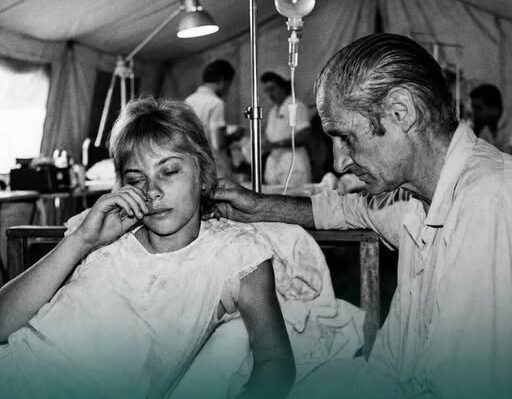
17-Year-Old Girl Falls 10,000 Feet From a Plane Into the Amazon Rainforest — What She Did Over the Next 11 Days Is Almost Unbelievable
On Christmas Eve in 1971, Juliane Koepcke Was the Sole Survivor of a Plane Crash That Killed 91 People. Injured and Alone in the Peruvian Rainforest, She Faced Hunger, Infection, and Dangerous Terrain Before Making a Discovery That Would Save Her Life.
On Christmas Eve in 1971, 17-year-old Juliane Koepcke was sitting beside her mother aboard a passenger plane flying over Peru.
They were supposed to be traveling home for Christmas.
Instead, their flight was about to become one of the most extraordinary survival stories in aviation history.
Outside the aircraft, a violent thunderstorm had developed.
Lightning flashed across the sky.
The plane began shaking as it entered severe turbulence.
Passengers grew increasingly frightened.
Then, according to Juliane’s later recollections, her mother turned toward her and said something she would never forget.
“That is the end, it’s all over.”
Moments later, the aircraft broke apart in midair.
Juliane suddenly found herself falling toward the Amazon rainforest, still strapped into her seat.
She was approximately 10,000 feet above the ground.
Then everything went dark.
When she regained consciousness, she was lying alone in the jungle.
The plane was gone.
Her mother was nowhere to be seen.
And the dense rainforest surrounding her seemed to stretch endlessly in every direction.
Somehow, the teenager had survived a fall that should have been fatal.
But she was injured, disoriented, and miles from the nearest settlement.
What happened during the next 11 days would turn her into one of history’s most remarkable survival stories.
A Christmas Eve Flight That Ended in Disaster
On December 24, 1971, Juliane Koepcke and her mother, Maria, boarded LANSA Flight 508 in Peru.
The flight was traveling from Lima toward Pucallpa, with a scheduled stop along the route.
Juliane’s father, Hans-Wilhelm Koepcke, was a German zoologist who worked in the Peruvian rainforest.
Her mother was an accomplished ornithologist who studied birds.
The family had spent years living and conducting research in Peru.
Juliane was familiar with the rainforest because of her parents’ scientific work.
She had grown up surrounded by conversations about wildlife, plants, rivers, and the dangers of tropical environments.
That knowledge would later become crucial.
But as the aircraft took off, Juliane had no reason to imagine she would soon be forced to survive alone in the wilderness.
She was simply a teenager traveling with her mother during the Christmas holidays.
The Plane Enters a Terrifying Thunderstorm
As the flight continued, the weather deteriorated.
Dark storm clouds surrounded the aircraft.
Lightning flashed outside the windows.
The plane began experiencing severe turbulence.
Passengers were frightened as the aircraft shook violently.
Juliane later recalled the terrifying moments before the disaster.
Her mother, sitting beside her, appeared to understand that something was terribly wrong.
Then a lightning strike and the violent conditions contributed to the aircraft’s catastrophic breakup.
The plane began disintegrating high above the Amazon rainforest.
For Juliane, the next moments became a blur.
She remembered being thrown into the open air while still attached to her seat.
The rainforest was far below her.
She was falling from an altitude of roughly two miles.
And there was nothing she could do to stop it.
She Fell Thousands of Feet and Somehow Survived
Juliane later described seeing the green canopy of the rainforest approaching beneath her.
She remained strapped into a row of seats as she fell.
Then she lost consciousness.
Exactly how she survived has remained a subject of fascination.
Investigators and commentators have suggested that the attached seat structure, the way it moved through the air, and the dense vegetation may have helped reduce the forces of impact.
However, the precise combination of circumstances cannot be established with certainty.
What is certain is that Juliane survived a fall from an extraordinary height.
When she woke up, she was on the forest floor.
The aircraft had broken apart.
Wreckage and passengers had been scattered across the rainforest.
But Juliane was alive.
She was also completely alone.
She Woke Up Injured in the Middle of the Amazon
Juliane regained consciousness after the crash, surrounded by thick vegetation.
She had suffered a broken collarbone, cuts, bruises, and other injuries.
One eye was swollen, affecting her vision.
She was also missing her glasses.
Her condition made it difficult to move through the forest.
At first, she struggled to understand what had happened.
She looked around for her mother.
There was no sign of her.
She searched for other passengers.
But the jungle was quiet except for the sounds of insects, birds, and other wildlife.
There were no roads nearby.
No houses.
No visible rescue workers.
And no way to contact anyone.
Juliane had survived the crash, but the real struggle was only beginning.
Her Parents Had Taught Her Something That Could Save Her Life
Most teenagers suddenly stranded in a tropical rainforest would have little idea where to begin.
Juliane, however, had grown up in an unusual environment.
Her parents were scientists who had spent years studying the natural world.
Through their work, she had learned important lessons about the rainforest.
She understood that the jungle contained dangerous animals, difficult terrain, and plants that could not be safely eaten without proper identification.
She also knew that finding people would be essential.
One piece of advice from her father stood out.
Follow the water.
Small streams often flow into larger waterways.
And in the Amazon region, rivers can lead toward settlements and places where people travel by boat.
Juliane decided that following a stream offered her best chance of finding help.
It was a decision that would shape the next several days of her life.
She Began Walking Through the Rainforest Alone
Despite her injuries, Juliane forced herself to move.
The rainforest was dense.
Thick vegetation made it difficult to see ahead.
Branches, roots, and uneven ground slowed her progress.
She had no map or compass.
She did not know exactly where the plane had crashed.
And she had no reliable way to estimate the distance to the nearest village.
Her broken collarbone made movement painful.
But remaining in one place also carried risks.
She needed water, food, and medical attention.
Eventually, she found a small stream.
Remembering her father’s advice, she began following it downstream.
At the time, she could not know whether the decision would lead her to safety.
But it gave her a direction and a reason to keep moving.
Her Only Food Was a Small Bag of Sweets
Juliane had almost nothing with her after the crash.
She had no survival kit.
No proper shelter.
No change of clothes.
And no supply of food.
She managed to find a small amount of candy, which became her only food during the early part of the ordeal.
It did not last long.
As the days passed, hunger became increasingly difficult to endure.
Although the rainforest was filled with vegetation, she knew that eating unfamiliar plants or fruits could be dangerous.
She avoided taking unnecessary risks.
Instead, she continued following the water.
She drank from streams, an action that can carry serious health risks but was part of her desperate circumstances.
Her body was already weakened by the crash.
Without adequate food, her energy continued to decline.
On the Fourth Day, She Made a Heartbreaking Discovery
Several days into her journey, Juliane noticed vultures gathering in the rainforest.
She understood what their presence might mean.
Moving toward the area, she discovered the remains of passengers from the aircraft.
Three people were still strapped into a row of seats.
The sight was devastating.
Until then, Juliane had been focused primarily on surviving and finding her way through the forest.
Now she was confronted with the reality of what had happened to the other people aboard the plane.
She examined the scene, hoping to determine whether her mother might be among them.
She found no evidence that Maria was there.
Juliane continued searching for signs of her mother, but there was no one to answer her calls.
She eventually had to keep moving.
It was one of the most emotionally difficult moments of her ordeal.
The Rainforest Became More Dangerous With Every Passing Day
As Juliane continued her journey, her physical condition deteriorated.
She was hungry, exhausted, and injured.
The tropical environment presented additional challenges.
Insects were everywhere.
Wet vegetation made movement uncomfortable.
She had to navigate through difficult terrain while protecting herself from further injury.
Her experience growing up around the rainforest helped her recognize certain hazards.
But knowledge alone could not eliminate the danger.
She still needed to find another human being.
Each day without help meant more time without proper food or medical treatment.
And an injury on her arm was becoming increasingly concerning.
An Infected Wound Made Her Situation Even Worse
During the journey, Juliane developed a serious problem with a wound on her arm.
Flies had laid eggs in the injured tissue, and larvae developed in the wound.
The condition caused additional discomfort and increased her distress.
She had no medical supplies and no way to obtain professional treatment.
As the days passed, the problem became harder to ignore.
She was already struggling with exhaustion and hunger.
Now she also had to deal with an untreated injury in a remote tropical environment.
Her strength was running out.
By approximately the tenth day, continuing on foot had become extraordinarily difficult.
But then, near the water, she saw something that changed everything.
On the Tenth Day, She Spotted Something Almost Impossible to Believe
Juliane had been following waterways through the rainforest for days.
She had seen trees, insects, muddy banks, and endless vegetation.
But now, near a river, she noticed something unmistakably human.
A boat.
For a moment, she struggled to believe what she was seeing.
After so many days alone, the sight suggested that people might be nearby.
She moved toward it.
There was also a small shelter used by local workers.
But nobody was there.
Juliane had finally found evidence of human activity.
Yet she was still alone.
And she was becoming too weak to continue much farther.
Inside the Shelter, She Found Something Unexpected
Near the shelter, Juliane discovered a supply of fuel.
She remembered something from her childhood.
Her father had once used kerosene while treating a wound on the family’s dog.
Desperate to deal with the larvae in her own injured arm, she used fuel in an attempt to remove them.
She later described the painful experience as part of her survival ordeal.
Although it formed part of her remarkable story, applying kerosene or other fuel to a wound is dangerous and is not an appropriate modern treatment.
Such substances can damage tissue and cause additional injury.
Juliane was acting under desperate circumstances without access to medical care.
Afterward, she remained near the shelter.
She hoped someone would return.
She was too exhausted to continue searching indefinitely.
For the first time in days, she had found a place that offered a realistic possibility of rescue.
Then She Heard Voices
The following day, Juliane heard something she had almost stopped expecting.
Human voices.
Local men had arrived at the shelter.
They were astonished to discover an injured teenage girl in such a remote location.
Juliane spoke Spanish, allowing her to explain what had happened.
She told them that she had survived the plane crash.
At first, the circumstances seemed extraordinary.
News of the missing aircraft had already spread, but finding a survivor after so many days was almost unimaginable.
The men recognized that she needed immediate help.
They provided assistance and arranged to take her toward civilization.
After 11 days alone in the Amazon rainforest, Juliane was finally being rescued.
Her 11-Day Ordeal Finally Comes to an End
Juliane’s rescuers helped her travel by boat along the river.
She was eventually brought to a place where she could receive medical attention.
Her injuries were examined and treated.
For the first time since the crash, she was surrounded by people who could care for her.
The physical ordeal was over.
But the emotional consequences of the disaster would remain with her for the rest of her life.
Juliane had survived an aircraft breaking apart in midair.
She had fallen thousands of feet into the rainforest.
She had walked through the wilderness while injured and almost without food.
And she had found help by following a route she remembered from her father’s teachings.
Her survival seemed almost impossible.
Yet she had made it out alive.
She Was the Only Person Rescued Alive From the Crash
LANSA Flight 508 had carried 92 people.
Juliane Koepcke was the sole survivor.
The other 91 people aboard died as a result of the disaster.
Later accounts raised the possibility that some passengers may have survived the initial breakup or impact but died before rescuers reached them.
Those circumstances have been discussed in historical accounts of the crash, although the precise survival timeline for every passenger cannot be established with certainty.
Juliane was the only person ultimately found alive.
Her rescue attracted international attention.
Newspapers and broadcasters reported the extraordinary story of a teenage girl who had fallen from an aircraft and survived alone in one of the world’s most challenging natural environments.
But even as the world celebrated her survival, Juliane faced a devastating personal loss.
The Heartbreaking Truth About Her Mother
During her days in the rainforest, Juliane had repeatedly hoped that her mother might also have survived.
Maria Koepcke had been sitting beside her when the aircraft broke apart.
They had been traveling together for Christmas.
And Juliane had heard her mother’s final words before the fall.
After her rescue, the search for other passengers continued.
Her mother’s body was eventually discovered weeks after the crash.
Juliane later considered the possibility that Maria had survived the initial fall but died from her injuries before help arrived.
That possibility was deeply painful.
It also meant that Juliane’s extraordinary survival was inseparable from the grief of losing her mother.
The disaster had spared her life while taking someone she loved most.
How Did Juliane Koepcke Survive a Fall From 10,000 Feet?
One of the most frequently asked questions about Juliane’s experience concerns the fall itself.
How could a person survive an aircraft breaking apart thousands of feet above the ground?
There is no single, definitively established explanation.
However, several factors have been proposed.
Juliane remained attached to a section of aircraft seating during the descent.
The seat structure may have affected the way she fell through the air.
The dense rainforest canopy may also have helped absorb some of the impact.
The precise position in which she landed could have influenced the outcome.
But these explanations remain retrospective assessments rather than a complete scientific reconstruction of her individual fall.
What makes the event so extraordinary is that she survived despite the enormous forces involved.
Her survival was exceptionally rare and should not be interpreted as evidence that falls from similar heights are generally survivable.
Her Knowledge of the Rainforest Was Just as Important
Surviving the fall was only the first part of Juliane’s ordeal.
She still needed to find a way out of the rainforest.
That is where her upbringing played a crucial role.
Her parents had taught her to understand the environment rather than treat it as an unknown world.
She knew that waterways could provide a possible route toward human settlements.
She understood that unfamiliar plants could be dangerous to eat.
She was familiar with the sounds and conditions of the tropical forest.
And she had learned to remain observant even when circumstances were frightening.
These lessons did not guarantee survival.
But they helped her make decisions under extreme pressure.
Her determination to continue moving, combined with her knowledge and the eventual discovery of the shelter, gave her a chance to reach safety.
Her Story Inspired Films and Documentaries
Juliane’s extraordinary survival soon attracted attention from filmmakers.
Her experience inspired the 1974 film Miracles Still Happen, also known as The Story of Juliane Koepcke.
The movie dramatized the plane crash and her journey through the rainforest.
Decades later, acclaimed German filmmaker Werner Herzog explored her story in the documentary Wings of Hope.
Released in 1998, the documentary revisited the disaster and followed Juliane as she returned to the region where the aircraft had crashed.
Herzog had a remarkable connection to the tragedy.
He had reportedly intended to travel on the same flight but did not board after his plans changed.
That connection gave the documentary an especially personal dimension.
Through the film, audiences could hear Juliane reflect on her experience rather than encounter it only through newspaper accounts.
She Returned to the World of Science
After recovering from the crash, Juliane continued her education.
She eventually moved to Germany and studied biology.
Her academic interests reflected the influence of her parents, both of whom had dedicated their lives to studying the natural world.
She pursued scientific work and remained connected to rainforest conservation.
Rather than allowing the disaster to end her relationship with the jungle, she continued working in a field closely related to the environment in which she had nearly died.
Juliane later became known as Juliane Diller.
Her professional life included work associated with the Panguana biological research station in Peru, which had been established by her parents.
The station became an important part of her continuing connection to the Amazon rainforest.
Her life after the disaster was not defined solely by the crash.
She built a career and continued contributing to the scientific work that had shaped her childhood.
She Eventually Shared Her Own Account of the Ordeal
For years, Juliane’s story was retold in news reports, films, and documentaries.
But she also shared her own memories of the experience.
Her memoir, When I Fell From the Sky, described the crash, the days she spent alone in the rainforest, and the lasting impact of the disaster.
The book explored not only the physical challenges of survival but also the emotional consequences of losing her mother.
Juliane reflected on the fear, uncertainty, and grief that accompanied her extraordinary escape.
Her account helped readers understand that surviving a catastrophe does not mean its effects disappear once the immediate danger ends.
She had returned to civilization alive.
But she had also experienced an event that permanently changed her family and her understanding of life.
Why Juliane Koepcke’s Story Still Fascinates the World
More than five decades after the disaster, Juliane’s survival continues to attract attention.
Part of the fascination comes from the almost unimaginable circumstances of the fall.
A teenager survived an aircraft breaking apart thousands of feet above the rainforest.
But another part comes from what happened afterward.
She had no modern communication device.
No rescue beacon.
No reliable food supply.
And no certainty that anyone would find her.
Her survival depended on a combination of extraordinary circumstances, knowledge, determination, and help from the people she eventually encountered.
It is also a story of loss.
Juliane survived, but 91 others did not.
Her experience reminds us that the outcome of a disaster can depend on factors far beyond anyone’s control.
What Her Experience Can Teach Us About Survival
Juliane’s story highlights the importance of preparation and environmental knowledge.
Her familiarity with the rainforest helped her recognize possible routes toward human settlements.
Her parents’ scientific teachings gave her information she could draw upon when she had no one else to ask for help.
However, her actions were shaped by extreme circumstances and should not be treated as a universal survival guide.
Following a river through wilderness can involve serious dangers, including flooding, difficult terrain, wildlife, and contaminated water.
Likewise, treating wounds with fuel is unsafe.
Modern wilderness safety guidance generally emphasizes preparation, reliable communication, appropriate first aid, and decisions based on the specific environment and available rescue options.
Juliane’s experience is remarkable because she managed to survive despite having almost none of the equipment normally associated with wilderness emergencies.
The Moment That Changed Everything
When Juliane first woke up in the rainforest, she had no way of knowing whether she would ever see another person again.
She was injured and frightened.
She did not know where her mother was.
She had no food beyond a small amount of candy.
And the rainforest stretched around her in every direction.
Yet she continued moving.
She followed the water.
She endured hunger and pain.
And when she discovered the boat and shelter, she finally found evidence that other people might be nearby.
The next morning, the sound of human voices marked the beginning of her rescue.
After 11 days alone, she was no longer fighting for survival without help.
The men who found her helped bring her ordeal to an end.
The Teenager Who Fell From the Sky and Walked Out of the Amazon
On December 24, 1971, Juliane Koepcke boarded a plane with her mother.
She expected to arrive at her destination and celebrate Christmas with her family.
Instead, the aircraft broke apart above the Amazon rainforest.
She fell approximately 10,000 feet while still strapped into her seat.
She survived the impact.
Then she spent 11 days navigating the rainforest, injured, hungry, and alone.
Her father’s advice helped her choose a direction.
Her knowledge of the environment helped her avoid some dangers.
And her discovery of a boat and shelter eventually brought her into contact with the people who rescued her.
Juliane was the only survivor among the 92 people aboard LANSA Flight 508.
Her story became known around the world, but the tragedy also took her mother and left lasting emotional scars.
She eventually returned to science and devoted much of her adult life to studying and protecting the natural world.
Today, her experience remains one of the most extraordinary documented survival stories in aviation history.
Not simply because she survived a fall from the sky.
But because, after surviving the impossible, she still had to find the strength and knowledge to make her way out of the rainforest.
And somehow, against extraordinary odds, she did.