
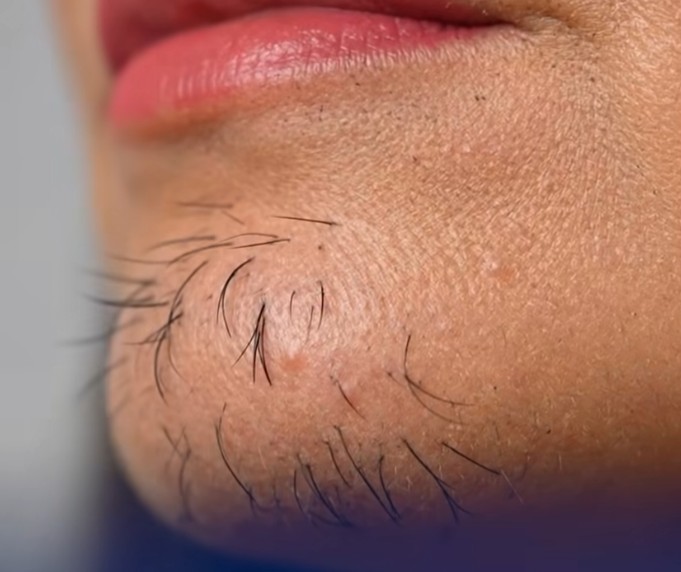
Why Do Women Grow Chin Hair? 10 Important Things to Know About Hormones, Aging, and Facial Hair
Noticed Thick, Dark Hairs on Your Chin? Here’s What They Could Mean for Your Health
Finding an unexpected hair on your chin can raise questions, especially if it is darker or thicker than the fine facial hair you are accustomed to seeing. Some women notice only one or two coarse hairs, while others experience a gradual increase in facial hair over several years.
Although these changes can be surprising, they are not automatically a sign of a medical problem. Facial hair growth varies considerably between individuals, and several natural factors can influence when and where new hairs become noticeable.
Age, inherited characteristics, hormone activity, and the sensitivity of individual hair follicles all contribute to facial hair patterns. In certain circumstances, however, increased growth can also accompany an underlying hormonal condition.
Understanding these differences can help women recognize ordinary changes, identify symptoms that may deserve attention, and make informed decisions about managing unwanted facial hair.
1. Growing Chin Hair Can Be a Natural Part of Aging
One reason women begin noticing chin hair later in life is the gradual change in hormone balance that accompanies aging. These changes can become more noticeable during the transition toward menopause and in the years that follow.
Estrogen levels generally decrease during this period. As the relationship between estrogen and other hormones changes, some hair follicles may begin producing more visible facial hairs.
Women naturally produce androgens, including testosterone. These hormones influence hair growth in different areas of the body, although the response depends partly on the sensitivity of each follicle.
Consequently, a woman who had very little noticeable facial hair in her twenties may discover several coarse hairs around her chin or upper lip in her forties or fifties.
For some women, the change happens gradually enough that it is barely noticeable. Others may become aware of it when they see a particularly dark hair while looking closely in the mirror.
Developing a few chin hairs with age does not necessarily indicate that hormone levels are abnormal. Natural variation remains an important part of understanding these changes.
2. Hormones Help Determine How Facial Hair Grows
Hormones influence the activity of hair follicles throughout the body. They can affect whether hair remains fine and barely visible or develops into thicker, darker strands.
Androgens are particularly important in the development of coarse facial hair. Although commonly associated with men, these hormones are also present in women and serve normal biological functions.
Some follicles are more responsive to androgen activity than others. This helps explain why two women with similar hormone levels may have noticeably different facial hair patterns.
Changes in hormone production may sometimes increase visible hair growth. However, greater follicle sensitivity can also contribute even when circulating hormone levels remain within an expected range.
This distinction matters because the presence of chin hair alone cannot establish whether someone has a hormonal imbalance.
Medical assessment becomes more relevant when facial hair changes substantially or appears alongside other symptoms. Looking at the overall pattern is more useful than drawing conclusions from one isolated hair.
3. Genetics Can Explain Why Some Women Have More Facial Hair
Inherited characteristics play a substantial role in determining hair thickness, color, distribution, and growth patterns.
Women whose mothers, grandmothers, or other female relatives have noticeable facial hair may experience similar characteristics themselves.
Genetics can also influence how strongly hair follicles respond to hormones. As a result, one woman may develop several coarse chin hairs while another of the same age develops almost none.
Neither experience necessarily indicates a health concern.
These inherited differences are one reason comparisons between individuals can be misleading. Hair growth is highly personal, and there is no single facial hair pattern that applies to every woman.
For someone who has always had a few darker facial hairs, the pattern may simply reflect her natural characteristics.
When the number and thickness of hairs remain relatively stable over time, the situation is generally different from a sudden or substantial increase that develops alongside other physical changes.
4. PCOS Is One Possible Cause of Increased Facial Hair
Polycystic ovary syndrome, or PCOS, is a hormonal condition that can affect women during their reproductive years.
It may involve increased androgen activity and changes in normal ovulation patterns. For some women, one of its visible effects is the development of thicker facial or body hair.
This pattern of excessive coarse hair growth is called hirsutism.
Hirsutism can involve the chin and upper lip, but it may also affect areas such as the chest and abdomen.
Other possible symptoms associated with PCOS include irregular menstrual cycles, persistent acne, and difficulties related to ovulation.
However, the condition does not affect everyone in exactly the same way. Some women experience several symptoms, while others notice only certain changes.
It is important to understand that having a few chin hairs does not establish a PCOS diagnosis.
Identifying the condition requires a broader medical evaluation that considers symptoms, health history, and appropriate diagnostic criteria.
Women who experience increasing facial hair together with irregular periods or persistent acne may benefit from discussing these changes with a healthcare professional.
5. Stress Is Not Necessarily Responsible for Chin Hair
Stress can influence different aspects of physical well-being, including sleep, mood, and certain processes involved in hormonal regulation.
However, it is inaccurate to assume that ordinary daily stress directly causes new chin hairs to develop.
Hair growth is influenced by multiple factors, particularly genetics, age, androgen activity, and follicle sensitivity.
A woman may first notice facial hair during a particularly demanding period of her life, but the timing does not prove that emotional stress caused the change.
Other influences may have been developing gradually before the hair became noticeable.
For this reason, persistent changes should be considered in the context of overall health rather than attributed automatically to stress.
Menstrual patterns, medication use, accompanying symptoms, and the speed of hair growth can all provide useful context during a medical assessment.
6. Certain Medications and Health Conditions May Affect Hair Growth
Some medications and medical conditions can influence facial hair development by affecting hormone activity or the body’s response to hormones.
The effect varies depending on the medication involved, the individual’s health, and other biological factors.
In certain situations, changes in androgen production or sensitivity may contribute to thicker or more widespread facial hair.
Less commonly, a hormone-producing medical condition may cause a rapid increase in hair growth.
The speed of the change is particularly important. A few hairs that have remained similar for many years generally present a different pattern from substantial facial hair growth appearing over a short period.
If a medication seems to coincide with changes in hair growth, it is sensible to discuss the concern with the prescribing clinician.
Medication should not be stopped or changed without appropriate medical guidance.
A healthcare professional can review possible contributing factors and decide whether further assessment or an alternative treatment should be considered.
7. When Does Chin Hair Require Medical Attention?
Most women who notice an occasional coarse chin hair do not need to assume that something serious is happening.
Nevertheless, certain changes deserve closer attention, particularly when they occur suddenly or are accompanied by other symptoms.
A noticeable increase in dark, coarse facial hair over a relatively short period may justify a medical appointment.
Facial hair growth accompanied by irregular or absent menstrual periods can also be relevant because both changes may involve hormonal activity.
New or worsening acne, thinning hair on the scalp, or other unexplained physical changes may provide additional reasons to seek advice.
More rapid changes, especially those accompanied by a noticeably deeper voice or increased muscularity, warrant prompt medical evaluation.
Such symptoms do not establish a particular diagnosis. They do, however, indicate that a clinician should consider whether significant androgen activity or another hormonal issue is involved.
Depending on the circumstances, an evaluation may include a discussion of medical history, symptom timing, medications, physical examination, or selected laboratory tests.
The appropriate approach depends on the individual rather than the presence of chin hair alone.
8. Does Shaving Chin Hair Make It Grow Back Thicker?
A common belief about facial hair is that shaving causes it to grow back darker, thicker, or faster.
Shaving does not change the underlying rate of hair growth or the biological characteristics of the follicle.
Instead, it cuts the hair at the skin’s surface. When the hair begins to grow again, its blunt end may feel rougher or appear more noticeable.
This temporary difference in texture can create the impression that the hair has become thicker, even though shaving has not altered its actual growth pattern.
Tweezing works differently because it removes individual hairs from the follicle rather than cutting them at the surface.
Waxing removes multiple hairs at once and can provide a longer period before regrowth becomes visible.
However, both methods can irritate sensitive skin, particularly when performed frequently or improperly.
Understanding how each technique works can help women choose an approach that suits their skin and preferences.
9. There Are Several Ways to Manage Unwanted Chin Hair
Women who prefer to remove facial hair have several options, ranging from simple home techniques to professional treatments.
For one or two isolated hairs, careful tweezing may be convenient. A clean facial razor can also remove visible hair without affecting the follicle’s natural growth pattern.
Threading and waxing may be suitable for people who want to remove several hairs at once, although skin sensitivity should be considered.
Depilatory products formulated specifically for facial use provide another option. Because these products can irritate the skin, following their instructions carefully is important.
For women seeking longer-lasting reduction, professional laser treatments may help decrease hair growth over a series of sessions.
Electrolysis treats individual hair follicles and can provide permanent hair removal when performed effectively.
The suitability of these methods depends on factors including hair color, skin tone, skin sensitivity, and the treatment technique.
A dermatologist or another qualified professional can help evaluate the available options, particularly for women with sensitive skin or an existing skin condition.
If excessive facial hair is associated with an underlying hormonal disorder, addressing that condition may help reduce future growth.
However, hairs that have already become coarse may still require a separate removal method.
10. Not Every Woman Needs to Remove Chin Hair
Facial hair removal is a personal preference rather than a medical requirement.
Some women prefer removing every noticeable chin hair, while others are comfortable leaving naturally occurring facial hair unchanged.
Both choices are valid.
A few coarse hairs do not necessarily indicate poor hygiene, abnormal health, or an underlying disease.
Appearance-related concerns can sometimes create unnecessary pressure to remove hair that is simply part of normal individual variation.
For women who choose removal, the most suitable method is one that balances convenience, comfort, skin health, cost, and desired results.
For those who do not find the hair bothersome, no treatment may be needed.
The important distinction is whether the growth represents a stable personal characteristic or a significant new change that deserves medical consideration.
Understanding the Difference Between Normal Facial Hair and Hirsutism
Although the terms are sometimes used interchangeably, ordinary facial hair and hirsutism are not necessarily the same.
Many women naturally have fine facial hair, and some develop a small number of darker hairs without having a medical condition.
Hirsutism describes a more pronounced pattern of coarse hair growth in areas that are sensitive to androgen activity.
Its significance depends on the distribution, extent, and progression of the hair, along with any accompanying symptoms.
This is why an isolated chin hair cannot be used as a reliable measure of hormone levels.
A meaningful assessment considers how the pattern has changed over time and whether other signs suggest an underlying condition.
Recognizing that difference can prevent unnecessary alarm while still encouraging appropriate attention to unusual changes.
Why Paying Attention to Changes Over Time Matters
When evaluating facial hair, the pattern of development may be more informative than the number of hairs seen on a particular day.
Gradual changes over many years may reflect aging, genetics, or natural variation in follicle sensitivity.
A rapid increase in coarse facial hair, particularly when accompanied by menstrual changes, acne, or scalp hair thinning, deserves a different level of attention.
Women who are uncertain about a change can consider when they first noticed it, whether it has progressed, and whether other symptoms appeared around the same time.
This information may help a healthcare professional decide whether further investigation is appropriate.
It is also important to avoid assuming that every visible change is connected to a serious hormonal problem.
Many women experience ordinary facial hair growth without any significant underlying disorder.
Final Thoughts: What Chin Hair Can Really Tell You About Your Health
Chin hair in women is common and can develop for several different reasons.
Natural aging, inherited characteristics, androgen activity, and the sensitivity of individual hair follicles all influence how facial hair appears.
In some circumstances, increased growth may be associated with PCOS, medication effects, or another hormonal condition.
However, a single coarse hair or a few gradually appearing chin hairs cannot reliably identify a hormone disorder.
The most useful approach is to consider the overall pattern rather than focusing on one isolated observation.
If the hair develops slowly and no other symptoms are present, it may simply reflect normal variation.
If growth becomes sudden, substantial, or occurs alongside other unexplained physical changes, medical advice can help determine whether further evaluation is needed.
Women who wish to remove facial hair can choose from several methods, while those who prefer not to remove it have no obligation to do so.
Ultimately, understanding the many reasons behind facial hair growth can reduce unnecessary worry and support informed decisions about personal care.
Every woman’s body is different, and noticing a few hairs on the chin is not, by itself, a reason to assume something is wrong.