
Trump’s Red “VETO” Hat Draws Attention After Republican Midterm Losses
A Four-Letter Message Points Toward His Approach to a Democratic-Controlled Congress
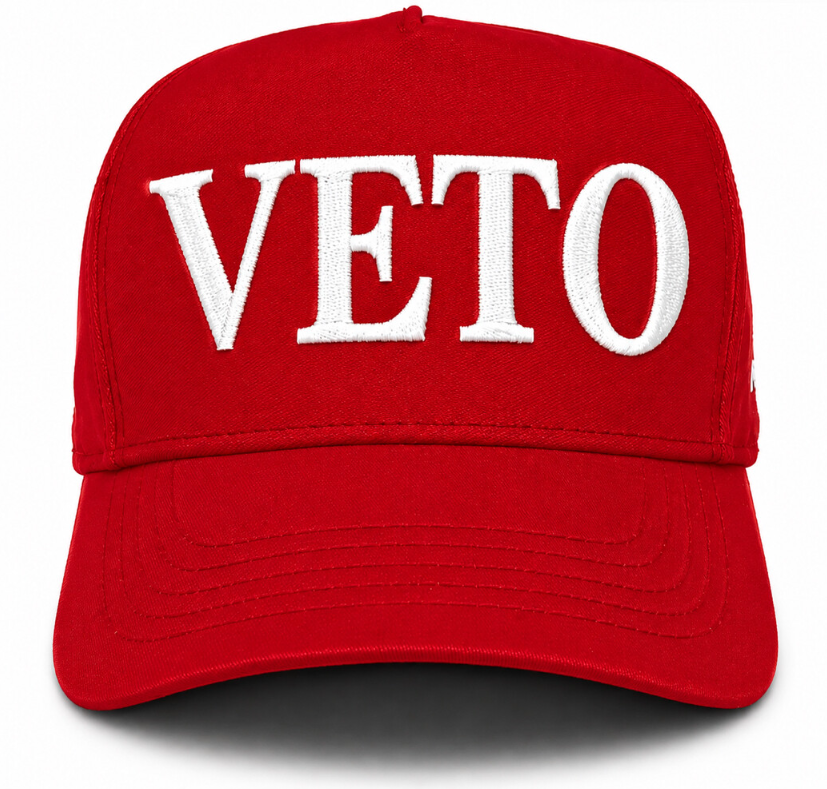
President Donald Trump prompted a new wave of political discussion after sharing a photograph of a red baseball cap with a single word embroidered across the front: “VETO”.
The image appeared on Truth Social on November 3 as Democrats celebrated major midterm election victories. With control of Congress shifting away from Republicans, the photograph offered a striking symbol of the power Trump would retain over legislation reaching his desk.
Trump did not include an explanation with the image. However, his public remarks about facing a Democratic majority provided context for the message and suggested that the presidential veto could become a central feature of the next phase of his administration.
A Familiar Red Hat With a Different Message
The cap resembled the red campaign hats closely associated with Trump’s political identity. Against a plain white background, its white lettering stood out clearly.
This time, however, the familiar campaign slogan had been replaced by a word describing a presidential power. The change gave the photograph an immediate political significance as election results came in.
The Associated Press subsequently called control of both the House of Representatives and the Senate for Democrats. Those victories established a different congressional landscape for Trump when the new Congress takes office in January 2027.
The photograph did not announce a specific policy or identify a particular bill. Its meaning rested largely on its timing and on what Trump had already said about how he might respond to opposition-party control of Congress.
Trump Had Already Raised the Possibility of Becoming “Mr. Veto”
Before the election, Trump discussed the possibility of Democratic congressional victories during an interview with Miranda Devine on the New York Post’s Pod Force One podcast.
Asked how he would respond to that outcome, he said, “Well, if that happens, I guess um I’ll become Mr. Veto”.
The remark made the later photograph easier to interpret. Rather than introducing an entirely new message, the hat reflected a response he had already raised publicly.
Nevertheless, the image itself contained no detailed explanation. It did not specify which proposals he would oppose, what conditions might lead him to sign legislation, or how frequently he expected to use the power.
A Warning About Bills From the New Majority
Following Republican losses, Trump made further comments about rejecting legislation passed by a Democratic-led Congress. In an interview with Fox News, he said, “They’ll send over things that are insane and I’ll veto them”.
That statement presented the veto as a way to resist proposals he considered unacceptable. It also emphasized that winning congressional majorities would not give Democrats unrestricted control over the legislative process.
Trump also suggested that disagreements could eventually lead to negotiations. He described a scenario in which Democrats would seek a way to pass legislation and said “we’ll work together.”
His comments therefore left room for both confrontation and compromise. The hat emphasized his ability to reject legislation, while his other remarks acknowledged that agreements could still be possible.
What Changes When the Opposing Party Controls Congress
Democratic control of Congress changes the political circumstances surrounding Trump’s remaining time in office. Legislation favored by his administration would need to move through chambers led by the opposing party.
At the same time, Democrats would face the challenge of advancing proposals that could survive a presidential veto. Passing a bill through Congress and securing its enactment are separate stages of the process.
That division creates incentives to negotiate, but it can also produce prolonged disagreements. A congressional majority may pass legislation to establish its position even when the president has indicated that he will reject it.
The red cap captured this coming tension in a compact form. It highlighted one of the president’s most visible responses to legislation he opposes without resolving the question of whether the two sides would reach agreements.
How an Ordinary Presidential Veto Works
A presidential veto allows the president to reject legislation passed by Congress. Under Article I, Section 7 of the Constitution, the president can return a bill with objections instead of signing it into law.
The decision does not necessarily end the legislative process. Congress can reconsider the measure and attempt to override the president’s objections.
A successful override requires a two-thirds vote in both the House and the Senate. That threshold is significantly higher than a simple majority, making the level of support for a particular bill important.
Consequently, control of both chambers does not automatically give a party the votes needed to overcome a veto. Lawmakers may need support from members of the president’s party to reach the required threshold.
A Veto Threat Can Affect Negotiations Before a Vote
The prospect of a veto can influence a bill before it ever reaches the White House. Congressional leaders deciding what to advance must consider whether the president is likely to sign it.
If the votes for an override are unavailable, negotiations may focus on changes that could make the legislation acceptable. Alternatively, lawmakers may decide to proceed despite the expected rejection.
This helps explain why a photograph of a hat attracted attention beyond its appearance. The word referred to a power that can shape bargaining as well as determine the fate of a completed bill.
Trump’s suggestion that repeated disagreements might eventually produce cooperation fits within that broader dynamic. Whether such cooperation develops depends on the proposals involved and the willingness of both sides to negotiate.
Congress Retains Powers Beyond Passing Bills
The focus on vetoes does not encompass every aspect of the relationship between Congress and the president. A congressional majority also has oversight responsibilities and influence over federal spending.
Committees can hold hearings, seek records, and pursue investigations. Those activities are distinct from sending legislation to the president for a signature.
That distinction matters when evaluating claims about what a veto can accomplish. It is a substantial legislative power, but it does not allow the president to cancel every action taken by Congress.
Some social media responses joked about impeachment. Presidential veto power applies to legislation; it does not provide a way for a president to veto impeachment proceedings.
Social Media Responses Mixed Humor With Political Debate
The photograph drew reactions from supporters, critics, and people interested in the cap itself. Some treated it as a humorous example of Trump’s political messaging.
“This man is hilarious!,” one commenter wrote. Another offered a shorter endorsement: “Love it!”
Other responses focused on whether the image hinted at a broader plan. “He got something up his sleeve,” one person suggested, although the photograph did not establish any undisclosed strategy.
Some commenters expressed interest in obtaining the hat. “I’m ordering one now,” another wrote, reflecting how quickly a political image can become a potential merchandise attraction.
Critics Pointed to the Possibility of an Override
Not everyone viewed the message as a demonstration of decisive presidential control. Several responses emphasized the constitutional limits on veto power.
“The word of the day is Override!” one commenter wrote.
The response identified a real congressional option, though exercising it requires the necessary two-thirds support in both chambers. The existence of that option does not mean every veto can be overturned.
Together, the reactions showed how the same image could support different political readings. Supporters saw confidence and humor, while critics highlighted the powers Congress would retain.
A Simple Image Ahead of a More Complicated Political Period
The red “VETO” cap reduced a complex institutional relationship to a single memorable word. Its timing connected it to Republican election losses, while Trump’s earlier comments supplied a plausible explanation for the message.
The photograph alone did not establish how he would approach every disagreement with the incoming Congress. His willingness to reject some legislation could coexist with efforts to negotiate other measures.
The practical consequences will depend on the bills lawmakers advance, the support those proposals attract, and the agreements congressional leaders and the White House can reach.
For now, the hat has become a visible symbol of the next political contest: a Democratic congressional majority seeking to advance its agenda and a Republican president making clear that his signature cannot be assumed.