
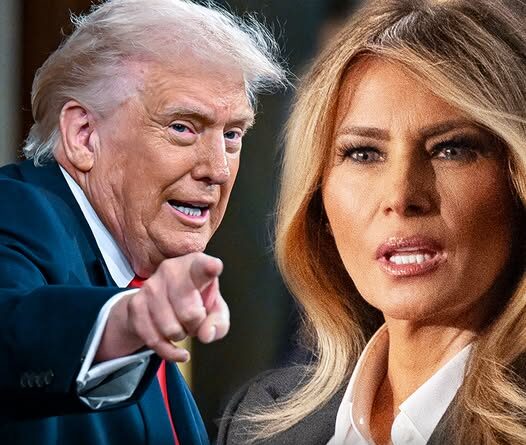
Trump’s First State of the Union of Second Term Draws Applause, Criticism, and a Lighthearted Remark About Melania
A Lengthy Address Marks the Start of a New Term
President Donald Trump delivered the first State of the Union address of his second term on Monday, offering a speech that immediately sparked debate across the political spectrum.
Supporters described the address as a strong and confident presentation of his agenda, while critics characterized it as divisive and confrontational.
The speech stood out not only for its tone but also for its duration. At approximately one hour and 48 minutes, it became the longest State of the Union address in modern history.
Throughout the evening, the president moved between policy achievements, campaign-style rhetoric, and moments of personal reflection.
Sharp Criticism and Economic Claims
During the address, Trump directed pointed criticism toward Democrats, at one point referring to them as “crazy.”
He framed his administration’s economic policies as transformative, stating that he had overseen a “turnaround for the ages” in the nation’s economy.
The president emphasized what he described as progress and renewal, outlining his vision for continued growth and stability in the years ahead.
Veterans and American families were highlighted as central to his plans, as he painted a picture of what he called a bright future for the country.
The tone alternated between combative and celebratory, reinforcing the sharp political divide that continues to shape national conversations.
A Moment Focused on the First Lady
In addition to policy discussions, Trump turned his attention to First Lady Melania Trump during the speech.
He acknowledged her work over the past year, referencing her involvement in foster care initiatives and issues related to artificial intelligence.
The president also mentioned her new Amazon documentary, noting her expanding public profile.
While praising her accomplishments, he introduced a moment of humor that quickly drew attention.
The Comment That Sparked Conversation
Trump began by commending her commitment to young Americans, saying, “Nobody cares more about protecting America’s youth than our first lady — she’s now a movie star, can you believe it? Who would’ve believed that?”
He continued by detailing her recent initiatives, adding, “Over the past year she’s had an incredible impact, implementing AI legislation, advancing a landmark executive order on foster care and securing 30 million dollars to launch the Melania Trump foster youth to independence initiative. It’s tremendous.”
Then came the line that generated the most reaction from viewers and commentators alike.
“It’s a really tremendous thing that happened and she got a lot of bipartisan support. She gets much better bipartisan support than I do. I get none, she gets a lot. Some day you’re going to have to tell me how you did that!”
The remark was delivered with a tone that many interpreted as playful rather than critical.
Public Interpretation of the Joke
Observers differed in how they viewed the president’s comment. Some described it as a light tease directed at his wife, highlighting her ability to attract support from both Republicans and Democrats.
Others saw it as a reflection of the broader political challenges Trump faces in securing bipartisan cooperation.
Within moments of the speech, discussion of the line spread widely, with viewers debating whether it revealed deeper political frustrations or was simply a moment of humor.
Regardless of interpretation, the comment added a personal dimension to an otherwise policy-heavy address.
Melania Trump’s Public Approval
While the president suggested that Melania enjoys stronger bipartisan backing than he does, recent polling presents a more complicated picture.
A YouGov survey indicates that the First Lady currently holds a negative approval rating.
According to the survey data, Melania Trump’s approval rating stands at -16.
That figure is lower than the rating of former First Lady Jill Biden, who registered at -9.
However, Melania’s rating remains slightly higher than that of Hillary Clinton, who polled at -17.
Comparisons to Other First Ladies
When compared to several earlier first ladies, the contrast becomes more pronounced.
Nancy Reagan recorded an approval rating of +25, while Lady Bird Johnson stood at +23.
Rosalynn Carter reached +32, and Barbara Bush measured at +21.
Michelle Obama and Laura Bush both achieved positive ratings as well, at +21 and +19 respectively.
These figures highlight the range of public opinion that has surrounded first ladies across different eras.
A Broader Political Context
The president’s speech took place in a deeply polarized political environment, where approval ratings and bipartisan cooperation are closely scrutinized.
Trump’s acknowledgment of limited bipartisan support for himself contrasted with his praise of Melania’s ability to secure backing across party lines.
The juxtaposition added nuance to the address, blending humor with subtle commentary on political realities.
For some viewers, the moment underscored the First Lady’s independent public image.
For others, it served as a reminder of the ongoing challenges facing the administration.
Reactions Across the Political Spectrum
As with much of the evening, reactions to the speech varied widely.
Supporters praised the president’s confident tone, his emphasis on economic progress, and his willingness to directly confront political opponents.
Critics, meanwhile, focused on the sharp rhetoric aimed at Democrats and questioned some of the claims made about economic performance.
The extended length of the address itself became a talking point, with some viewing it as a demonstration of thoroughness and others describing it as excessive.
Amid these debates, the comment about Melania remained one of the most frequently replayed moments.
Balancing Policy and Personality
State of the Union addresses traditionally combine policy outlines with personal storytelling and symbolic gestures.
Trump’s speech followed that pattern, blending discussions of legislation and economic performance with references to veterans and family initiatives.
The mention of the First Lady’s work added a human element, briefly shifting attention from partisan conflict to individual accomplishment.
By incorporating humor into the address, the president introduced a lighter tone that contrasted with earlier sharp criticism.
Such moments often resonate differently depending on audience perspective, reflecting the broader divisions that define contemporary politics.
Looking Ahead
As the second term moves forward, both the president’s agenda and the First Lady’s initiatives are likely to remain subjects of close attention.
Approval ratings and bipartisan cooperation will continue to shape public perception.
The State of the Union address marked the beginning of a new chapter, setting the stage for ongoing debates about policy direction and leadership style.
Whether remembered primarily for its length, its rhetoric, or its brief moment of humor about bipartisan support, the speech has already secured a place in the broader political conversation.
The blend of pointed criticism, economic claims, and personal remarks ensured that it would be analyzed from multiple angles in the days that followed.
In the end, the address reflected both the ambitions and the divisions that characterize the current political landscape.