
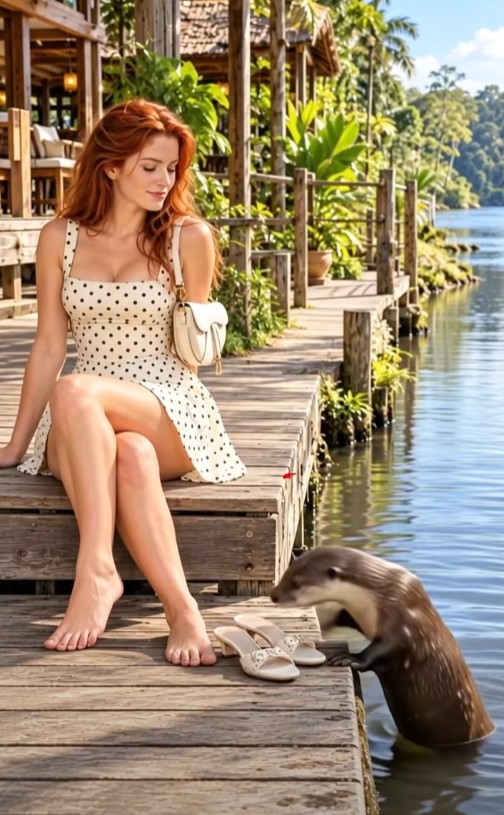
A Woman Notices an Otter Near a Dock—Then Spots a Youngster Tangled in Fishing Line
An Unexpected Encounter Along the Willowbrook River
Morning sunlight was beginning to reach the Willowbrook River when Laura Mitchell noticed movement beside a wooden dock. A dark brown head surfaced near a support post before an otter climbed onto the wet boards.
The thirty-six-year-old stopped near the entrance to the walkway. She had visited the riverside park many times, but an otter remaining in view was unusual enough to hold her attention.
After shaking water from its fur, the animal paused and examined its surroundings. Then it slipped back into the river and swam toward an inlet shaded by a large willow tree.
Laura watched it surface repeatedly near the exposed roots. A faint squeaking sound soon drew her attention toward the muddy shoreline, where a smaller otter appeared unable to move freely.
In this fictional story, a familiar morning walk becomes an encounter that requires trained assistance. Laura’s most important decision comes when she recognizes that observing the animal and calling for help are safer than attempting a rescue herself.
A Familiar Place for a Quiet Morning Walk
Laura had lived near the river for almost a decade. Before starting work, she often spent a little time in the park, enjoying its walking trails, docks and designated observation areas.
The willow trees were among her favorite features of the shoreline. Their branches shaded the water, while exposed roots created sheltered spaces for fish and other wildlife.
She regularly watched ducks and herons and occasionally caught sight of otters. Usually, those encounters lasted only a moment before the animals disappeared beneath the surface.
That morning, Laura had brought a small camera and a reusable water bottle. She intended to spend approximately thirty minutes photographing the river before returning to her usual responsibilities.
Only a handful of walkers were visible farther along the trail. With little activity around the dock, she could hear the water moving against its supports and notice small disturbances near the bank.
When the otter climbed onto the boards, Laura stayed still. She did not approach or try to attract its attention, allowing it to return to the water without interference.
Repeated Movements Draw Her Toward an Observation Area
Once back in the river, the otter swam toward the willow rather than continuing downstream. It disappeared briefly, then resurfaced close to the same section of roots.
Laura followed the curve of the public footpath while maintaining her distance. At first, she considered the possibility that the animal was searching for food in the shallows.
Then she heard a thin, high-pitched sound. She stopped walking, listened and heard it again from the direction of the tree.
A designated observation area provided a clearer view of the bank. From there, she could make out a smaller otter partly concealed beneath a fallen branch.
The youngster shifted, but its movements appeared restricted. The larger animal surfaced nearby, briefly approached it and returned to the water.
Laura could not establish whether the two were related or explain why the larger otter remained in the area. What she could see was that the smaller animal seemed to be in difficulty.
A Camera Lens Reveals the Entanglement
Instead of stepping down the bank, Laura used her camera’s zoom lens to examine the scene. The youngster lay beside a thick root close to the waterline.
A thin strand that appeared to be discarded fishing line was wrapped around one hind leg. It extended toward a submerged branch, tightening as the animal tried to move.
The view made Laura concerned about injury, but it also revealed the hazards of approaching. The bank was steep and muddy, and the exposed roots offered uncertain footing.
She also understood that a frightened wild animal could bite during an attempted intervention. Reaching the otter would not necessarily mean she could free it without causing further distress.
Laura lowered the camera and called the regional wildlife rescue organization. She described the trapped animal, the fishing line and the larger otter remaining nearby.
The dispatcher asked for a precise location and information about the youngster’s condition. Laura supplied the number of the nearest dock and agreed to wait where she could direct the responders.
Two Responders Assess the Riverbank
Approximately twenty-five minutes later, a wildlife rescue vehicle arrived at the park. Daniel Harris, a trained wildlife rehabilitation responder wearing protective clothing, approached Laura along the trail.
She explained how the encounter had begun at the dock and pointed out the smaller otter among the roots. Daniel examined the location from the observation area before deciding how to proceed.
Using binoculars, he assessed the animal’s position, the entanglement and the surrounding terrain. The larger otter was still moving through the nearby water.
Daniel contacted a colleague to coordinate assistance and confirm the availability of handling equipment. A second responder, Rebecca Lewis, arrived shortly afterward.
Together, they established a temporary working boundary away from the public trail. Laura remained behind it while Daniel asked approaching walkers to give the animals and the rescue team space.
The responders waited until the larger otter moved farther downstream. They then prepared to reach the youngster along a stable access route, limiting unnecessary disturbance around the roots.
The Fishing Line Is Carefully Removed
Daniel approached the trapped otter while Rebecca remained close with protective equipment and a suitable carrier. When the youngster reacted to his presence, he paused before continuing.
At closer range, he confirmed that fishing line was wound around a hind leg and caught beneath a submerged branch. The connection prevented the animal from moving away freely.
Using appropriate handling equipment, Daniel controlled sudden movement while examining the line. Rebecca assisted as he worked through the entanglement.
He first cut the section attached to the branch. With that connection released, he removed the remaining accessible loops from the youngster’s leg.
The otter attempted to move away, but it appeared tired. Daniel also noticed mild swelling around the affected area, making immediate release inappropriate.
The team placed it in a secure, ventilated carrier. Rebecca covered part of the carrier to reduce visual stimulation before they carried the animal back to level ground.
Laura watched from the observation area as the responders completed their work. Daniel explained that freeing the leg was only part of the process: a veterinary examination was needed before deciding whether the otter could return to the river.
Veterinary Care Comes Before a Release Decision
The youngster was transported to a licensed wildlife rehabilitation facility. There, a veterinarian examined the affected leg and checked for other injuries.
No obvious fractures were identified, but irritation and swelling remained where the line had restricted the limb. The otter received appropriate care and stayed under observation.
Several days later, Laura contacted the rescue organization for an update. A staff member told her that the animal was recovering and moving more comfortably.
The rehabilitation team continued assessing its appetite, mobility and behavior. Those observations helped determine whether it was ready to leave care.
After further assessment, staff approved its release and selected a suitable location within its original river habitat. The return would be handled quietly by trained personnel.
Laura respected the decision to keep visitors away. Although she cared about the outcome, she understood that the release was being arranged around the animal’s needs.
The otter eventually returned to the river under the team’s supervision. Whether it encountered the larger animal again, or whether the two had any family connection, remained unknown.
A Rescue Leads to Continued Care for the Shoreline
The encounter stayed with Laura after the youngster’s recovery. What began as a brief photography walk had shown her how discarded fishing equipment could restrict an animal’s movement in an otherwise familiar habitat.
She later joined a community cleanup focused on removing abandoned fishing materials from accessible shoreline areas. Volunteers followed park guidelines and avoided sensitive wildlife spaces.
The activity gave her a practical way to contribute without approaching or handling animals. Her role was to help address debris where volunteers were permitted to work.
Laura continued visiting the wooden dock and walking beneath the willows. She occasionally saw otters, though she never knew whether any were the animals involved that morning.
She remembered the sequence clearly: a brief appearance on the boards, repeated movement near a tree and a faint sound from the bank. None of those observations explained the larger otter’s intentions, but together they had drawn her attention to the trapped youngster.
By remaining on the public path, providing a clear location and allowing trained responders to take over, Laura helped the rescue proceed. The memory she carried was of a small animal given treatment and the opportunity to return to its river habitat.