
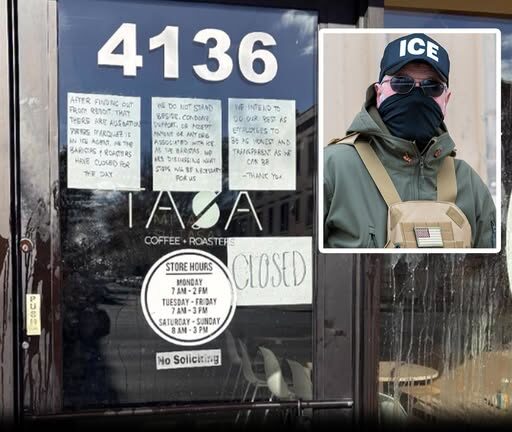
Chicago Coffee Shop Posts Closure Sign After Staff Walkout Over Unverified ICE Allegations
Tasa Coffee Roasters Faces Backlash Following Online Claims
Tasa Coffee Roasters in Chicago’s West Humboldt Park neighborhood closed after employees walked out over allegations connecting someone associated with the business to U.S. Immigration and Customs Enforcement. The claims circulated online before the employment connection had been independently confirmed.
Workers initially posted a notice explaining that they had closed for the day while considering their next steps. By Tuesday, November 24, a separate sign at the business said it was permanently closed.
The controversy has drawn attention to the distinction between a viral allegation and a verified employment history. The claimed connection to ICE remains unconfirmed, despite public records and leaked material involving a person with the same name.
Jackie Marquez has identified herself as the business’s sole owner. In a public response, she described her career in food and coffee, expressed disagreement with current immigration policy and asked that employees not be targeted.
A Neighborhood Business With a Stated Community Mission
Tasa operated as both a coffee shop and a roastery. Its public identity emphasized Latina ownership, support for women and locally roasted coffee.
The business described its mission as “to provide great locally roasted coffee mainly sourced from women-owned farms. We are an independent, Latina-owned, and woman-forward business.”
That positioning formed part of its connection with customers. The shop’s emphasis on the people behind its coffee gave its identity a significance beyond the drinks it served.
The allegations therefore raised questions among employees and customers about whether the claimed association conflicted with the business’s stated values. Their reactions, however, did not independently establish whether the underlying employment claim was accurate.
The public controversy involves several separate questions: who owns the business, whether another person associated with it worked for a federal agency, and how staff and customers chose to respond. Those questions require different evidence.
How the Allegation Spread Online
The dispute began with a Reddit post alleging that a man connected to the shop appeared in a leaked database of Department of Homeland Security employees. The material had circulated in late October.
The poster presented the alleged identification as established and claimed that the shop was owned by an ICE agent. That assertion went further than what independent verification had established.
The post also accused the business of removing a man’s face from its social media pages to conceal the supposed connection. That allegation attributed a motive that had not been independently demonstrated.
Forum moderators subsequently deleted the post. Its removal did not prevent the claims from spreading or halt the responses already developing around the business.
A matching name in a database can provide a reason to investigate, but it does not by itself establish that two references identify the same individual. The controversy continued while that central question remained unresolved.
Employees Explain Their Decision to Close
Baristas and roasters posted a statement at the shop after learning about the allegations. Their notice made clear that the immediate closure was their response to information encountered on Reddit.
“After finding out from Reddit that there are allegations. We, the baristas and roasters, have closed for the day. We do not stand beside, condone, support, or accept anyone or any org associated with ICE. As the baristas, we are discussing what steps will be necessary for us. We intend to do our best as employees to be as honest and transparent as we can be. Thank you,” the statement read.
The wording acknowledged that the information involved allegations. It also expressed the workers’ opposition to association with ICE and their intention to discuss what to do next.
The notice did not establish that staff had independently verified the employment claim. It explained their position and the action they had taken in response.
At that stage, the statement referred to closing for the day. The later appearance of a permanent-closure sign represented a further development beyond the workers’ original announcement.
UPDATE:
the workers at Tasa Coffee Roasters have closed the store after seeing the reddit post https://t.co/6OtVLlxLlS
— ann says fuckpledis (@honeykyeomie) November 23, 2026
What the Records Establish—and What Remains Unclear
Leaked documents listed an individual with the same name as a former supervisory detention and deportation officer. Public records also indicated that someone with that name had worked for the Department of Homeland Security.
However, the available information did not conclusively establish that the person in the leaked material was the same man identified in the viral post. The agency had not directly confirmed the relevant individual’s exact position or employment status.
That uncertainty is important when describing the allegation. Employment with the Department of Homeland Security and a specific role with ICE are not interchangeable claims.
Likewise, being associated with a business does not automatically establish ownership. Marquez’s statement about sole ownership addresses the business’s ownership structure, while the employment allegation concerns a separate issue.
The existence of records helps explain why the claims attracted attention. It does not eliminate the need to verify identity, role and employment status before presenting the allegation as fact.
Jackie Marquez Responds Publicly
Marquez addressed the controversy through an Instagram statement. She identified herself as Tasa’s sole owner and described food and coffee as her professional background.
“I’m Jackie, the sole owner of Tasa Coffee Roasters. I am a chef. Food and coffee have been my only career. I personally disagree with current immigration policy, and I believe in civil dialogue and mutual respect, even when we disagree. I ask that my employees not be targeted or held responsible for matters outside their control. My commitment remains firmly with my employees, my customers, and my community,” she wrote.
Her response combined an ownership statement with a position on immigration policy. It also asked people responding to the controversy to distinguish employees from matters beyond their control.
The statement did not directly resolve whether another person connected to the shop had worked for ICE. That question remained separate from her description of her own career and ownership.
Her appeal for civil dialogue came as the dispute extended beyond online discussion and began affecting the physical storefront.
Eggs Thrown at the Storefront and a Reported Confrontation
Eggs were thrown at the coffee shop as the controversy escalated. The incident added a physical act of vandalism to the staff walkout and public criticism.
A separate confrontation also drew police attention. A woman visiting the closed business alleged that a man inside revealed a handgun beneath his shirt during the encounter.
Police temporarily detained the man before releasing him. The supplied account does not establish that he was charged, and his detention should not be described as a criminal conviction or proof of the employment allegation.
The confrontation and the online claims are distinct parts of the story. Neither the reported presence of a firearm nor police involvement establishes whether someone associated with Tasa worked for ICE.
A Closure With Central Questions Still Unanswered
The permanent-closure sign appeared after the initial employee walkout, marking a significant development for the neighborhood business. It followed a rapid sequence of online allegations, staff action, an ownership statement and incidents outside the shop.
Some consequences are clear: workers stopped serving customers, statements were posted and the storefront became a focus of public reaction. The central employment claim, however, remains unverified.
The distinction matters when assessing what happened. Tasa experienced concrete disruption following an allegation that had not been conclusively established, while employees publicly explained their concerns and Marquez defended her own role in the business.
The closure sign communicates the shop’s announced operating status. It does not, by itself, resolve the questions about identity, ownership allegations or federal employment that prompted the controversy.