
The House on Juniper Lane
The Reading of the Will
Three days after Grandma Rose was laid to rest, the house on Juniper Lane already felt different.
The casseroles had stopped arriving. The sympathy bouquets were beginning to wilt, their petals curling inward as if even they understood something had shifted.
The yellow siding of the old house, once warm and welcoming, seemed pale under the afternoon sun.
It was the only home I had ever truly known.
Inside a lawyer’s office scented faintly with paper and lemon polish, the will was read aloud.
Margaret arrived early, dressed in navy, holding a leather folder tightly against her chest.
She looked composed, almost rehearsed.
“You holding up, okay, Taylor?” she asked softly.
“As well as anyone can,” I replied.
She nodded with controlled sympathy. “Rose was very particular. No loose ends. This will be quick. Clean.”
Clean.
The Unexpected Decision
The lawyer adjusted his glasses and began reading in a steady tone.
“The property located on Juniper Lane is to be transferred to Margaret under the terms of a previously executed care agreement.”
For a moment, the words floated without meaning.
“Transferred to who?” I asked.
“To Margaret.”
Margaret pressed her hand to her chest, as if receiving a blessing.
“Rose wanted me secure,” she said gently. “Everything was handled properly.”
Secure.
“But that was my home,” I whispered. “She raised me there.”
Margaret’s expression shifted, sympathy edged with something firmer.
“Sometimes the one who shows up daily matters more than the one who visits on weekends.”
The air in the room tightened.
“I came every weekend,” I said steadily. “I brought groceries. I paid her bills.”
The lawyer continued reading.
“To her granddaughter, Taylor, Rose leaves her sewing machine.”
A murmur rippled across the room.
“That machine?” someone muttered.
“That’s all?” I asked.
“That is what was written.”
Margaret leaned closer. “Maybe she knew who deserved the house.”
I left before anger could outrun restraint.
The Sewing Machine
The house greeted me with silence when I returned alone.
Dust floated in streaks of golden light near the windows.
My hand brushed over pencil marks etched into the doorway frame, each one marking my height at a different birthday.
“You could have told me,” I whispered into the stillness.
The sewing machine sat by the window, polished and waiting.
It had been part of every memory — the steady hum of fabric feeding through, the scent of thread and starch filling the air.
When I lifted it slightly, something grazed my fingertips.
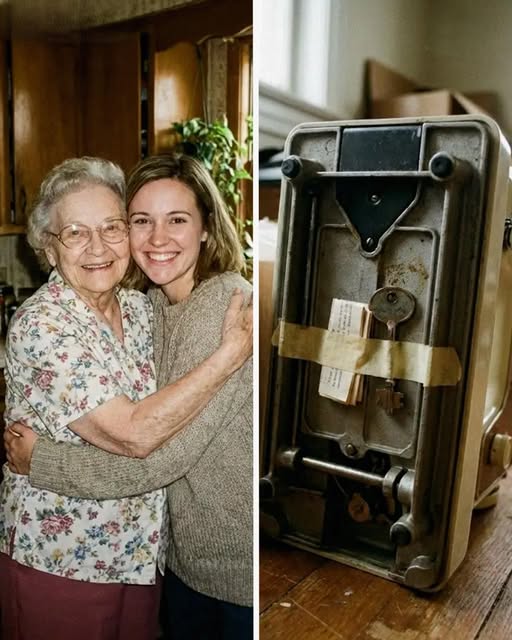
Taped beneath the base was a small brass key and a folded note.
My heart thudded as I opened it.
My darling girl,
If you’re reading this, the time has come. I know you have questions.
Don’t challenge Margaret until you’ve gone to the address below.
Bring a clear heart, not anger.
You deserve the whole truth.
Grandma Rose.
An address followed in careful handwriting.
“You really couldn’t just tell me?” I murmured. “You had to turn it into a mystery?”
The White House at the Edge of Town
The key led me to a modest white house in the neighboring town.
The porch sagged slightly under its own weight. A wind chime tapped softly in the breeze.
A woman with silver hair opened the door before I knocked.
“I’m Helen,” she said. “I helped Rose during her last months.”
“Why did she leave the house to Margaret?” I asked.
Helen’s expression remained calm.
“She didn’t leave it,” she said. “She negotiated it.”
She handed me a thick folder bound with a paper clip.
The Conditional Agreement
Inside were documents bearing Grandma Rose’s signature.
The agreement was detailed and formal.
Margaret would receive the house only if she fulfilled specific obligations.
Those requirements included documented daily care, payment of certain expenses, medication management, and transportation to medical appointments.
If she failed to meet those conditions, ownership of the property would revert to me.
“She didn’t trust assumptions,” Helen said quietly.
I read every line carefully.
The house had not been a gift.
It was a contract.
“If she honored her part, she would keep it,” Helen explained. “If not, it returns to you.”
Tucked inside the folder was another letter.
My dear Taylor,
Margaret needed stability. I needed help. We made a conditional agreement.
I knew if you understood how hard things had become, you would give up your own life to move back. I didn’t want that for you.
If she fulfills her promises, she keeps the house. If she does not, it comes back to you.
I didn’t want you fighting for what was already protected.
I loved you fiercely.
Grandma Rose.
I pressed the letter against my chest.
It had never been about choosing between us.
It had been about protecting me.
The Confrontation
I found Margaret the next afternoon standing in her yard, chatting brightly with neighbors.
“We need to talk,” I said.
Her smile tightened. “This isn’t appropriate.”
“It is,” I replied evenly. “You told people the house was a gift. It wasn’t.”
I opened the folder and held it between us.
“It was conditional. Did you document the expenses? Did you meet the agreement?”
Silence stretched.
Her posture faltered.
“I didn’t complete all of it,” she admitted quietly.
“I’ll have the lawyer review everything,” I said. “That’s all.”
The Final Outcome
Two days later, the call came.
Margaret had failed to meet the contractual requirements.
The ownership of the house reverted to me.
That evening, I sat in the familiar chair beside the sewing machine.
The wood beneath my fingers was worn smooth from decades of use.
That machine had mended school uniforms, stitched holiday dresses, and paid bills when money was scarce.
“It was never about choosing,” I whispered into the quiet room.
I remembered the first time I tried to sew.
The needle had slipped, pricking my finger, and I had burst into tears.
Grandma’s voice echoed gently in memory.
“Nothing is ruined, my girl. We just stitch it again.”
Stitching It Again
I threaded the needle slowly, guiding the thread through the tiny eye.
I lowered the presser foot and pressed down.
The machine came alive with a steady hum, the same comforting sound that had filled the house for years.
The walls no longer felt hollow.
The pencil marks on the doorway seemed less like relics and more like promises.
The house on Juniper Lane had not been taken.
It had been safeguarded.
Grandma Rose had seen further than I could in my grief.
She had ensured that what mattered most would return, intact and protected.
As the fabric moved beneath my hands, the stitches formed a straight, certain line.
Nothing was ruined.
We were simply stitching it again.