
Two Women Found a Turtle Upside Down on a Lakeside Path—Then a Passing Walker Stopped
An Unexpected Sight Beside the Shore
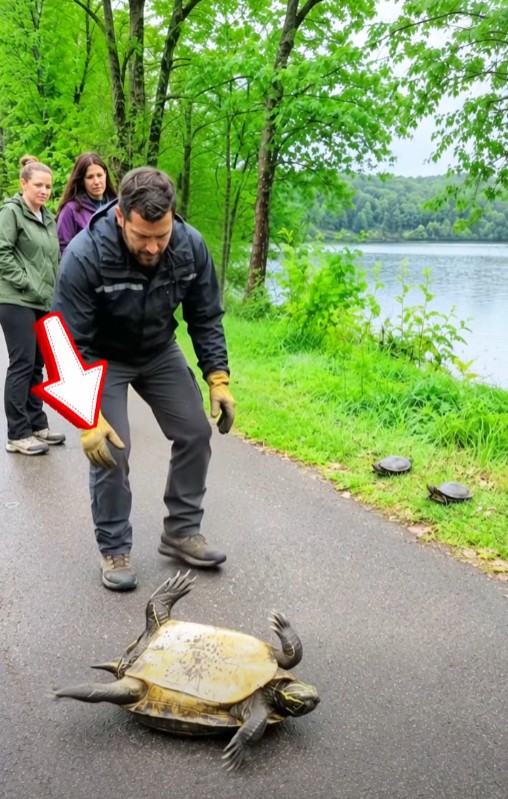
Abigail and Rebecca were enjoying an afternoon walk when they noticed an unusual shape beside the lakeside path. From a distance, it looked like a large stone resting near the grass.
Then it moved. A turtle lay upside down on its shell, extending its legs into the air as it tried to turn itself over.
The women stopped and watched. Each attempt ended with the animal still on its back, unable to find enough support against the ground.
Neither knew how it had become overturned. Uneven stones and exposed soil surrounded the spot, but nothing revealed exactly what had happened.
They wanted to help without making the situation worse. While Rebecca searched her phone for local wildlife information, Abigail stayed nearby to keep approaching pedestrians from accidentally disturbing the animal.
In this fictional story, their pause beside the path caught the attention of another visitor. His decision to stop would turn a worried conversation into a brief, careful rescue.
A Familiar Walk Interrupted
Forty-three-year-old Graham Walker regularly visited the lake outside his hometown. He enjoyed its walking paths, shaded benches and stretches of natural shoreline.
On pleasant weekends, the area drew families with picnic baskets, walkers following the water and visitors hoping to see wildlife. Graham had chosen a familiar route that afternoon and was making his way along the path when he saw the two women.
They were standing still, looking toward the ground rather than out across the lake. As he approached, he noticed the turtle between them.
Graham stopped and asked whether everything was all right. Rebecca explained that they had found the animal overturned and had been watching it struggle.
He looked carefully before moving closer. Through previous volunteering with a conservation organization, he had gained some experience observing freshwater turtles around the area.
That experience made him cautious about treating every unusual wildlife encounter as a rescue. First, he wanted to understand whether the turtle could recover its position without assistance.
Watching Before Intervening
The three stood back and gave the animal room. It continued moving its legs, but the surface beneath it offered little traction.
Graham examined the immediate surroundings. The turtle was close to a pedestrian route, and its repeated efforts had not brought it any nearer to turning upright.
Abigail and Rebecca watched as he knelt beside it. He explained that handling should be limited to what was necessary and that they should avoid crowding the animal.
He then carefully turned the turtle over and set it on a stable patch of ground. Once it was upright, he withdrew his hands and waited.
For several moments, the turtle remained still. Then its head gradually emerged, followed by more purposeful movements of its legs.
Rebecca had been watching those movements closely since the discovery. Seeing the animal able to place its feet against the ground was an immediate relief.
There were no obvious signs of a serious injury, although a brief observation could not establish everything about its condition. Graham continued watching rather than assuming that the first movement answered every concern.
A Short Move Away From the Path
The turtle was now upright, but it remained close to the busy walkway. Graham recognized it as a freshwater turtle associated with the lake and considered the nearby shoreline.
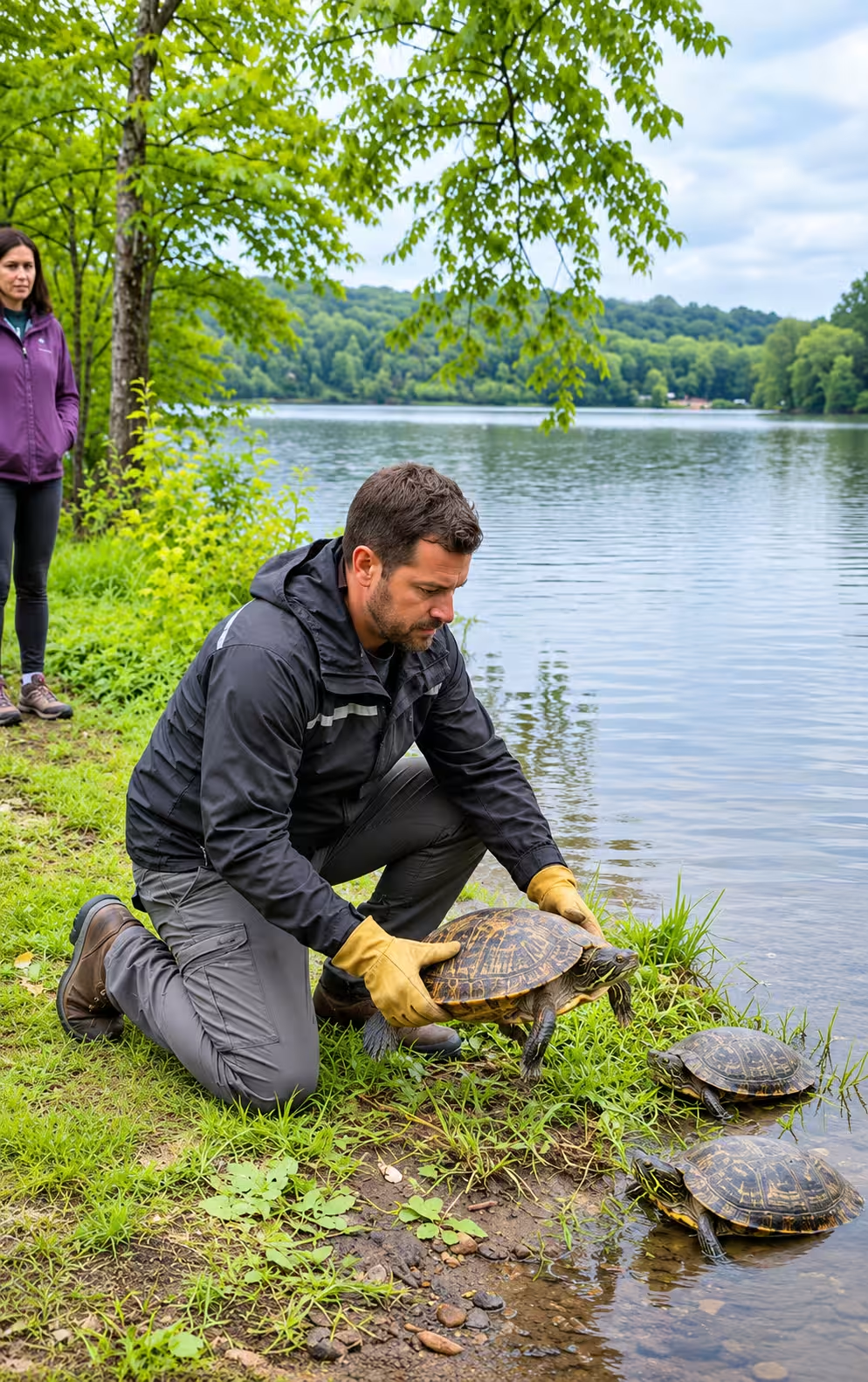
He decided to move it only a short distance from the pedestrian traffic. Abigail and Rebecca stepped aside while he carefully carried it toward a quiet section of the bank.
At the water’s edge, he chose gently sloping ground. He placed the turtle on the bank instead of putting it directly into the lake, leaving it to move on its own.
The three visitors stepped back. After another pause, the turtle began making its way toward the shallows.
Its progress was slow enough that the women could follow each movement from where they stood. Eventually, it reached the water and entered independently.
They watched it swim through the shallow area before it disappeared beneath the surface. The encounter that had begun with an animal struggling on its back ended with it moving freely out of sight.
A Conversation Beside the Water
Abigail thanked Graham for stopping. Rebecca said she was glad they had waited for help rather than immediately trying to carry the turtle into the lake.
Graham pointed out that the circumstances of this encounter mattered. Finding a turtle on land did not automatically mean it belonged in the water or needed someone to move it.
He also acknowledged what they had not learned. None of them knew how long the animal had been overturned or what had caused it to lose its footing.
For the women, the most useful part of the experience had been watching someone assess the situation before acting. Graham had first observed the turtle, restored its position and then watched how it moved.
The conversation continued while waterbirds crossed the lake nearby. With the turtle gone from view, the three could look around again and notice the ordinary activity along the shoreline.
Before leaving, Graham picked up a discarded plastic wrapper and placed it in a nearby waste container. Abigail and Rebecca said goodbye, and each resumed the walk that the encounter had interrupted.
Returning to the Same Stretch of Path
Several weeks later, Abigail and Rebecca visited the lake again. As they approached the place where they had stopped that afternoon, they remembered the turtle lying beside the grass.
This time, they noticed several turtles resting on partially submerged logs. They paused at a distance and watched them without approaching.
There was no way to tell whether the animal they had helped was among them. They did not need to identify it to enjoy the sight.
The encounter had prompted them to learn more about the wildlife around a place they already knew well. A route they had walked many times now held details they were more inclined to notice.
Graham continued visiting too, alongside his occasional involvement in community conservation activities. For him, the afternoon remained a small interruption to an ordinary walk, remembered because the turtle had been able to continue on its way.
For Abigail and Rebecca, the clearest memory was the moment after he set it upright: the quiet pause, the gradual extension of its head and the first steady movements of its feet against the ground.
Beside the lake, they had taken a few minutes to notice something that needed attention. Then they had stepped back and watched a small animal leave under its own power.