
Discussion Arises Over Classroom Feedback on Cursive Writing
A Classroom Moment That Sparked Conversation
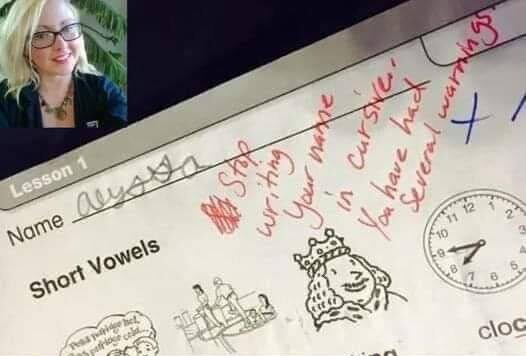
A parent recently shared her 7-year-old daughter’s school assignment online, bringing attention to a note written by the teacher. The feedback asked the student, Alyssa, not to use cursive when writing her name.
According to the parent, the teacher had made this request more than once, encouraging the student to follow a different writing style for classroom work.
The situation quickly became a topic of discussion, with many people sharing their perspectives on handwriting expectations in schools.
Different Views on Cursive Writing in Schools
Cursive writing is not always emphasized in modern classrooms, as many schools prioritize print writing and digital skills. However, it remains a traditional form of handwriting that some still consider important.
Learning cursive requires time, practice, and attention to detail. For many students, developing this skill can be both challenging and rewarding.
Because of this, some believe that students who show interest in cursive should be encouraged as they build their abilities.

The Importance of Classroom Guidelines
Teachers often establish specific expectations to ensure consistency across assignments. These guidelines help maintain clarity and make it easier to assess student work.
In some cases, requests to use a particular writing style are part of broader classroom standards rather than a reflection of a student’s effort.
Following these guidelines can support organization and fairness within the learning environment.
Encouragement and Skill Development
At the same time, encouragement plays an important role in a child’s learning experience. Positive reinforcement can help students stay motivated and confident as they develop new skills.
When children take initiative to practice something challenging, supportive feedback can help guide them while maintaining their enthusiasm.
Balancing structure with encouragement allows students to grow while still meeting classroom expectations.
The Ongoing Value of Cursive
Although cursive writing is not as widely required as it once was, it continues to hold value for many learners. It can support fine motor skills, handwriting fluency, and personal expression.
Some families and educators view cursive as an additional skill that complements standard writing methods.
Providing opportunities to explore different forms of writing can contribute to a more well-rounded learning experience.
A Balanced Perspective on Learning
This situation highlights the importance of understanding both the structure of classroom rules and the value of individual effort. Each plays a role in shaping a child’s educational journey.
By combining clear expectations with supportive guidance, students can develop skills while feeling encouraged to learn and improve.
Ultimately, fostering a positive learning environment benefits both students and educators.

Reflecting on Educational Approaches
Moments like this can lead to broader conversations about how different skills are taught and supported in schools. They also highlight how approaches to learning continue to evolve over time.
Understanding multiple perspectives allows for more thoughtful discussions about education and student development.
Through these conversations, parents, teachers, and communities can work toward creating supportive and effective learning environments.