
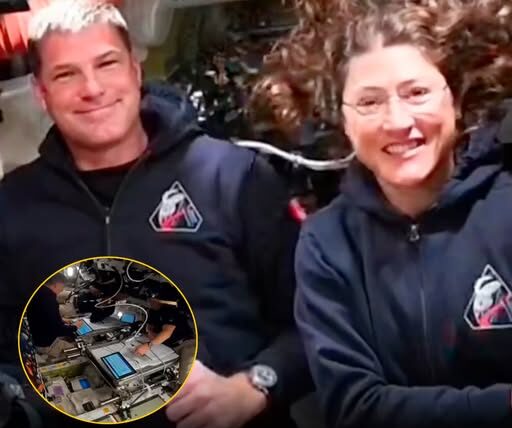
Artemis II Mission Sparks Online Debate as Viewers Question Live Space Broadcast
The Rise of Online Theories in the Digital Age
It has become increasingly easy to encounter conspiracy theories across the internet. While such ideas have existed for decades, the modern digital landscape has amplified their reach significantly.
With global connectivity, individuals can now share their perspectives instantly, allowing theories—regardless of their accuracy—to spread rapidly across platforms and audiences.
A Historic Moment for Space Exploration
Amid this environment, NASA’s Artemis II mission has drawn both admiration and scrutiny. The mission marked a significant milestone by surpassing the record for the farthest human spaceflight distance from Earth, previously set during the Apollo 13 mission in 1970.
The crew, consisting of NASA astronauts Christina Koch, Reid Wiseman, Victor Glover, and Canadian Space Agency astronaut Jeremy Hansen, launched aboard a 322-foot rocket on April 1.
Following launch, the team spent approximately 25 hours orbiting Earth, during which they described the view as “phenomenal” while communicating with mission control.
A Journey Beyond Earth’s Orbit
After completing their initial orbit, the astronauts began their journey toward the Moon. The Artemis II mission is designed as a flyby rather than a landing, serving as a critical step toward future lunar missions.
Although the spacecraft does not touch the Moon’s surface, the mission plays an essential role in testing systems and preparing for more advanced explorations.
Live Broadcast Draws Unexpected Attention
During the mission, the crew participated in a live interview with CNN, offering viewers a glimpse into life aboard the spacecraft. The astronauts shared insights into their experience traveling in microgravity and navigating deep space.
One visual element during the broadcast was a plush toy named “Rise,” which floated freely inside the capsule, demonstrating the effects of weightlessness.
Online Reactions and Speculation
Shortly after the broadcast aired, some viewers began to question what they saw. A particular moment during the interview drew attention, as certain letters appeared intermittently in the background behind the floating toy.
This detail led some individuals on social media to speculate about the authenticity of the footage, suggesting that the scene might have been digitally produced.
Several comments reflected skepticism, with users expressing doubt about the broadcast and sharing their interpretations of the visual anomaly.
A Technical Explanation Emerges
Despite the speculation, there is a straightforward technical explanation for what viewers observed. The broadcast made use of a technique known as Chroma Key, a common method used in video production.
This technique allows specific colors—typically green or blue—to be replaced with other visual elements, enabling overlays such as text or graphics to appear on screen.
During live broadcasts, text elements are often layered onto the video feed to provide context or additional information. In some cases, these overlays may refresh at slightly different times than the main video.
When this occurs, brief visual inconsistencies can appear, creating the impression of flickering or unintended shapes in the background.
Understanding Live Broadcast Limitations
Live transmissions, especially those involving complex environments like space missions, can occasionally produce minor visual irregularities. These are typically the result of timing differences in rendering or signal processing.
Such effects are not uncommon in live television and do not indicate manipulation or fabrication of the footage.
As the Artemis II astronauts prepare for today's lunar flyby, they each take a moment to reflect on the legacy of the Apollo 8 mission. Onboard with them is an Apollo 8 patch that flew aboard the lunar-orbiting mission over fifty years ago. pic.twitter.com/uNEkuvoWOp
— NASA Artemis (@NASAArtemis) April 6, 2026
The Broader Conversation Around Space Missions
The reaction to the Artemis II broadcast highlights how quickly online discussions can shift from observation to speculation. In an era where content is constantly analyzed and shared, even small details can become focal points for debate.
At the same time, the mission itself represents a major achievement in human space exploration, advancing efforts to return to the Moon and expand scientific understanding.
Balancing Curiosity with Context
Public interest in space missions often brings both excitement and scrutiny. While curiosity is natural, understanding the technical aspects behind what is being observed can provide valuable clarity.
Visual anomalies in broadcasts are often rooted in production techniques rather than hidden meanings, especially in high-pressure, real-time environments.
Looking Ahead
The Artemis II mission continues to be an important step toward future lunar exploration. Its success contributes to long-term plans that aim to establish a sustainable human presence beyond Earth.
As technology evolves and missions become more ambitious, public engagement is likely to grow alongside it.
Conclusion
The discussion surrounding the Artemis II broadcast serves as a reminder of how quickly interpretations can spread in the digital age. While some viewers questioned what they saw, the explanation lies in well-understood video production techniques.
Ultimately, the mission stands as a milestone in space exploration, reflecting progress, innovation, and the continued human drive to explore beyond our planet.