
Pentagon Responds After Pete Hegseth’s Prayer Remarks Draw Attention
Moment During Pentagon Service Sparks Discussion
Pete Hegseth returned to the spotlight after remarks made during a recent prayer service at the Pentagon drew widespread public attention. The event was part of an ongoing series of gatherings focused on spiritual reflection and support for those involved in military service.
During the session, Hegseth addressed attendees from a podium, speaking about the role of faith in leadership and how religious teachings can influence decision-making in challenging situations. His comments were framed around unity, responsibility, and the importance of shared values.
The speech also referenced a recent combat search and rescue mission involving Air Force personnel who had been shot down over Iran and later recovered. Hegseth described the mission as a reminder of the dedication and coordination required in high-risk operations.
However, a specific portion of his remarks quickly became the focus of public conversation.
Passage Raises Questions About Its Origin
While delivering a prayer, Hegseth recited a passage that appeared to combine religious language with themes of duty and teamwork. The wording included references to guiding others through darkness and standing against adversity.
From the podium, he read, “The path of the downed aviator is beset on all sides by the iniquities of the selfish and the tyranny of evil men. Blessed is he who, in the name of camaraderie and duty, shepherds the lost through the valley of darkness, for he is truly his brother’s keeper and the finder of lost children.”
He continued, “And I will strike down upon thee with great vengeance and furious anger those who attempt to capture and destroy my brother. And you will know my call sign is Sandy 1 when I lay my vengeance upon thee, and amen.”
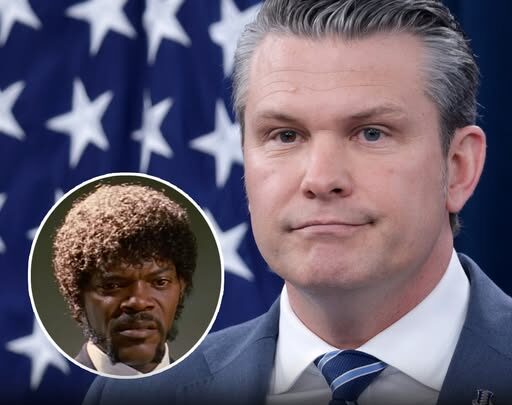
The passage was intended to emphasize protection, loyalty, and perseverance. Soon after the event, however, many observers noted similarities between the wording and a well-known monologue from popular culture.
Connection to a Familiar Film Scene
The phrasing used during the prayer closely mirrors a speech from the 1994 film Pulp Fiction. In that film, a character recites a stylized version of a biblical verse, attributing it to Ezekiel 25:17.
While the film’s version draws inspiration from scripture, it includes creative additions and changes that are not found in the original biblical text. This distinction became central to the reaction following Hegseth’s remarks.
The actual passage from Ezekiel 25:17 reads: “And I will execute great vengeance upon them with furious rebukes; and they shall know that I am the Lord, when I shall lay my vengeance upon them.”
The contrast between the authentic verse and the widely recognized film adaptation led many to question whether the two had been unintentionally blended.
Public Reaction and Online Discussion
Shortly after the speech, social media platforms saw a surge of commentary about the moment. Users shared clips and excerpts, with many pointing out the similarities between the prayer and the film dialogue.
Some reactions were critical, while others approached the situation with humor. The discussion quickly expanded beyond the initial moment, reflecting broader public interest in how cultural references intersect with formal settings.
Several individuals expressed surprise at the resemblance, while others focused on the broader message delivered during the speech. The varied responses highlighted how widely recognized the film’s dialogue has become over time.
Pentagon Issues Clarification
In response to the growing discussion, the Pentagon provided clarification through an official statement shared online. The explanation addressed the origin of the wording used during the prayer.
The statement described the passage as a custom prayer associated with a combat search and rescue unit known as Sandy-1. It noted that the wording had been used among personnel involved in missions and was intended to reflect their experiences and values.
According to the clarification, both the custom prayer and the well-known film dialogue draw inspiration from the same biblical verse, Ezekiel 25:17. The response emphasized that the reference to the verse had been mentioned during the remarks.
The statement also rejected claims that the passage had been incorrectly presented, stating that the context and intent were clear within the setting of the service.
Blending Tradition, Culture, and Language
The incident highlights how language can evolve across different contexts, from religious texts to cultural adaptations and professional traditions. In this case, a passage inspired by scripture has appeared in both entertainment and real-world settings, each with its own interpretation.
Moments like this often draw attention because they sit at the intersection of formal institutions and widely recognized cultural references. When familiar phrases appear in unexpected places, they can prompt both curiosity and debate.
For those present at the service, the focus remained on the broader themes of unity, service, and resilience. The subsequent public discussion, however, centered on how those themes were expressed and interpreted.
Ongoing Attention Around Public Statements
As the situation continues to be discussed, the moment serves as a reminder of how quickly public remarks can circulate and be analyzed. Speeches delivered in official settings often reach wide audiences, where every detail can be closely examined.
The combination of religious language, military context, and familiar phrasing contributed to the visibility of this particular moment. It also reflects the broader environment in which public figures operate, where statements can spark immediate and widespread reactions.
Despite the differing interpretations, the Pentagon’s response aimed to clarify the intent behind the remarks and the origin of the language used during the service.
Conclusion
The discussion surrounding Pete Hegseth’s prayer remarks illustrates how wording, context, and recognition can shape public perception. While the message delivered focused on themes of duty and support, the phrasing itself became the center of attention.
With the Pentagon offering its explanation, the situation underscores the complexity of communication in high-profile settings. It also shows how familiar language, whether drawn from scripture or cultural references, can take on new meaning depending on where and how it is used.
As conversations continue, the incident remains an example of how quickly a single moment can evolve into a broader public discussion.