
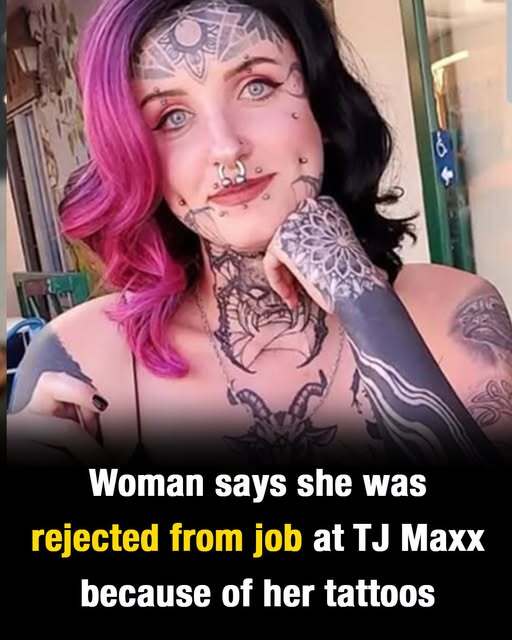
Tattooed Job Applicant Sparks Debate After Retail Rejection
Viral Video Raises Questions About Hiring Decisions
A young woman’s viral social media video has ignited a wider conversation about appearance, hiring standards, and workplace expectations after she shared her frustration over being turned down for a retail job.
Ash Putnam, 24, who posts online under the name ashxobrien, said she recently applied for a position at TJ Maxx but was not selected. Instead of receiving a phone call, she said she was notified through an automated email.
Her comments quickly attracted attention online, with millions of viewers watching the clip and sharing their own reactions.
Applicant Wanted Answers
In the video, Putnam explained that she wanted more information about why she had not been hired. She said she later visited the store and asked a hiring manager about the decision.
According to Putnam, the manager told her that the position went to applicants who had more experience.
Putnam also said she directly asked whether her tattoos played a role in the decision. She claimed the manager denied that appearance was the reason.
Even so, Putnam said she remained unconvinced and believed her visible body art may have influenced the outcome.
Concerns About Experience Requirements
Another part of her message focused on the challenge many young people face when applying for entry-level jobs.
She questioned how teenagers and young adults are expected to gain experience if employers prefer candidates who have already worked before.
Her comments reflected a common frustration among first-time job seekers who often feel trapped between needing experience and being unable to get hired without it.
Putnam said she wanted to hear from others who may be dealing with similar obstacles while searching for employment.
Appearance and Employment
Putnam also expressed disappointment that tattoos continue to be judged in professional settings.
She said that having tattoos should not automatically lead employers to assume someone would be a poor worker.
Her appearance includes visible tattoos on her face and body, along with several facial piercings. While tattoos have become more common in many industries, visible facial art can still be viewed differently depending on the role.
Customer-facing jobs, especially in traditional retail settings, often involve company image standards that vary from one employer to another.
Online Reactions Were Divided
The video generated a large number of comments, with viewers offering sharply different opinions.
Some users were supportive and argued that employers should focus more on reliability, attitude, and work ethic rather than appearance.
Others were more critical, saying visible facial tattoos and piercings could make it harder to secure certain jobs.
Several commenters suggested the issue was not tattoos in general, but the location and visibility of the tattoos.
Many people noted that body art on arms, legs, or areas covered by clothing is often more accepted than tattoos on the face.
Retail Expectations and Public Roles
Some commenters claiming hiring experience said companies may apply stricter appearance standards for employees who regularly interact with shoppers.
Retail businesses often place importance on customer comfort, branding, and maintaining a consistent public image.
Because of that, some viewers argued that employers may consider how an applicant’s presentation fits the specific role, especially at the front of the store.
Others responded that professional ability should matter more than personal style choices.
Changing Attitudes Toward Tattoos
Over the last decade, tattoos have become more accepted in many workplaces. Employees in creative fields, hospitality, technology, entertainment, and trades often face fewer restrictions than in the past.
Many businesses have also updated appearance policies to reflect changing social attitudes.
However, acceptance is not universal. Standards can still differ based on industry, company culture, region, and the type of position being filled.
Jobs involving direct customer interaction may sometimes maintain more traditional expectations than behind-the-scenes roles.
Putnam Calls for a New Perspective
Putnam later said employers should rethink how they evaluate applicants if tattoos are being used as a negative factor.
She argued that tattoos, piercings, and colored hair do not determine whether someone is qualified or professional.
In her view, body art can represent creativity, individuality, and self-expression rather than poor work habits.
Her remarks resonated with viewers who believe hiring decisions should be based primarily on skill, dependability, and attitude.
A Larger Employment Conversation
The discussion also highlighted the broader challenge of balancing company standards with changing cultural norms.
Employers often seek candidates who fit the brand image they want to present, while applicants increasingly expect personal expression to be accepted in the workplace.
That tension has become more visible as younger generations enter the workforce with different views about tattoos and personal style.
For some businesses, adapting policies may help attract a wider talent pool. For others, maintaining existing expectations remains a priority.
@ashxobrien I want to know who is also having a hard time finding a job right now! #jobs #jobmarket
No Simple Answer
There is no single rule that applies to every workplace. Some companies welcome visible tattoos, while others limit them in certain roles.
Likewise, some hiring decisions may come down to experience, scheduling availability, interview performance, or competition from stronger applicants rather than appearance alone.
In Putnam’s case, the explanation she received was that other candidates had more experience.
Whether viewers accepted that reason depended largely on their own beliefs about modern hiring practices.
Debate Continues Online
The viral response shows that appearance in the workplace remains a topic that draws strong opinions.
For some people, tattoos are simply a personal choice with no connection to job performance. For others, visible facial tattoos still create hesitation in professional environments.
As more industries reconsider dress codes and grooming policies, debates like this are likely to continue.
Putnam’s story has become part of that ongoing conversation about fairness, first impressions, and what truly matters when selecting the right employee.