
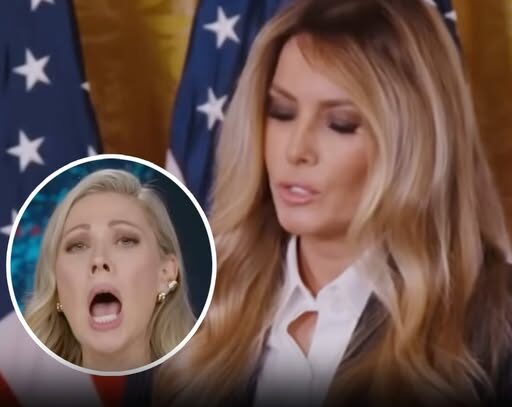
Melania Trump’s AI Speech Becomes Late-Night Comedy Flashpoint
A Speech About Innovation Turns Into A Viral Debate
Melania Trump walked onstage to recognize America’s brightest young minds and speak about a future increasingly shaped by artificial intelligence. The appearance was framed around innovation, students, and the rapid changes already transforming public life.
Within minutes, however, the focus shifted away from the students and the ideas at the center of the event. Late-night television turned the moment into comedy, and a speech intended to highlight achievement became part of a wider argument about satire, public image, and personal mockery.
The controversy grew after The Daily Show host Desi Lydic used the segment to imitate Melania’s delivery. The impression presented her speech as robotic, artificial, and oddly detached, turning her comments about technology into a punchline.
Desi Lydic’s Impression Draws Attention
Desi Lydic’s segment did not simply make fun of the language used in the speech. It also leaned into Melania Trump’s voice, accent, and manner of speaking, which made the reaction more divided.
Some viewers saw the bit as normal political satire. In that view, a public figure delivering a dramatic speech about artificial intelligence is fair material for comedy, especially when the language sounds lofty or unusual.
Others felt the joke went beyond the message and became personal. For those critics, the impression appeared to mock not only Melania’s words, but also her accent and public persona.
The Line Between Satire And Personal Attack
The moment raised a familiar question in political entertainment: where does sharp satire end, and where does personal ridicule begin? Public figures are often mocked for their speeches, style, and image, but the response can change when humor appears to target how someone speaks rather than what they said.
Melania Trump’s speech gave late-night comedy plenty of material because of its futuristic framing. Her remarks connected artificial intelligence to major areas of modern life, including medicine, conflict, and culture.
That subject matter could have opened a broader conversation about the role of AI in society. Instead, the most viral reaction focused on whether her delivery sounded human, artificial, rehearsed, or detached.
AI Becomes The Backdrop For A Personality Debate
The irony of the backlash was that Melania had spoken about artificial intelligence itself. Her comments were already centered on a world where technology is changing how people live, work, learn, and make decisions.
Yet the public response quickly became less about the subject and more about her as a figure. The discussion moved from students and innovation to tone, accent, sincerity, and performance.
That shift reflects a larger pattern in public debate. Complex topics are often pulled into personality-driven arguments, especially when the speaker is already a polarizing political figure.
Why The Segment Spread So Quickly
The Daily Show segment gained attention because it combined politics, celebrity, and artificial intelligence into one easily shareable moment. Melania Trump’s public appearances already draw strong reactions, and the addition of AI language made the speech especially easy to parody.
Lydic’s framing presented Melania almost like a human avatar reading generated text. That image was memorable, but it also became the reason some viewers felt the comedy crossed a line.
The phrase “sounds like ChatGPT.” captured the heart of the reaction. It turned the speech into a cultural shorthand for artificial, polished, or overly programmed communication.
A Celebration Overshadowed By Mockery
The original purpose of the appearance was to praise young people and spotlight the importance of emerging technology. The students being recognized represented achievement, ambition, and a generation preparing to inherit a world shaped by fast-moving tools.
That purpose was quickly overshadowed by the late-night response. Instead of discussing the young minds being celebrated, much of the attention centered on whether Melania’s words sounded sincere or machine-like.
The result was a familiar media cycle. A public speech became a comedy clip, the comedy clip became a viral argument, and the deeper subject was pushed into the background.
Supporters And Critics React Differently
For supporters of the segment, Desi Lydic was doing what late-night hosts often do: exaggerating a political figure’s style to make a point. They viewed the imitation as a critique of the speech’s tone and dramatic language.
For critics, the comedy seemed more personal than political. They argued that mocking Melania’s accent and delivery distracted from the actual topic and reduced the moment to a joke about how she sounds.
That divide shows why the clip created such a strong response. People were not only reacting to one joke, but also to different ideas about fairness, identity, and what kind of humor is acceptable in political commentary.
The Speech’s Larger Theme Was AI’s Growing Power
Melania’s speech touched on a future where artificial intelligence is no longer a distant concept. The technology already shapes conversations about health care, national security, education, creativity, and everyday communication.
Her references to robots in surgery and drones in combat pointed toward serious questions. These are not abstract concerns, because AI is increasingly tied to decisions that affect life, safety, and culture.
Those themes could have led to a deeper discussion about responsibility and leadership in an AI-driven future. Instead, the public conversation became centered on whether the person speaking about AI sounded artificial herself.
Public Figures Face A Different Standard
Melania Trump occupies a highly visible position in American public life. That visibility means her words, tone, and appearances are often examined closely, especially when they involve national themes.
At the same time, public visibility does not erase the question of taste. Satire has long been used to challenge powerful people, but reactions become more complicated when the humor appears to target accent, speech patterns, or personal mannerisms.
This is why the segment became more than a simple late-night joke. It became part of a broader argument over whether political comedy should focus on ideas, public actions, and statements, or whether personal presentation is also fair game.
AI Anxiety Meets Political Entertainment
The reaction also shows how artificial intelligence has become a cultural trigger. People now use AI comparisons to describe writing, speech, images, behavior, and even emotion.
Calling someone artificial is no longer just a comment about style. In the current moment, it can suggest a lack of sincerity, humanity, or ownership over one’s own words.
That is why the comedy landed strongly for some viewers and felt unfair to others. The joke was not only that Melania spoke about AI, but that she herself was framed as if she were part of the technology she was describing.
The Real Debate Goes Beyond One Segment
The controversy surrounding the speech and the late-night response points to a larger issue in modern media. Public discussions often move away from substance and toward performance.
Artificial intelligence affects medicine, war, culture, and communication. These are serious subjects with major consequences, but they are difficult to debate in short viral clips.
Comedy, by design, simplifies. It sharpens one angle, exaggerates it, and makes it memorable. That can be effective, but it can also flatten a complex issue into a personal attack.
A Moment That Reveals A Wider Cultural Tension
Melania Trump’s AI speech became controversial not because of one line alone, but because of what happened after it. A formal appearance about innovation was quickly transformed into a debate over voice, identity, and political ridicule.
For one audience, the late-night segment was a clever response to an awkward speech about futuristic technology. For another, it was an unnecessary attack on a woman’s accent and sincerity.
Both reactions reveal how sensitive the public conversation around AI and politics has become. Even a speech about students and technology can quickly become a battle over personality, media fairness, and who controls the meaning of a public moment.
The Focus Returns To The Future She Described
Beyond the jokes, the subject Melania raised remains important. Artificial intelligence is changing how people think about education, medicine, security, creativity, and human connection.
The viral response may have centered on how she sounded, but the larger issue is what kind of future she was trying to describe. That future is already arriving, whether it is discussed through serious speeches, late-night comedy, or online arguments.
The most important question may not be whether Melania’s speech sounded polished, strange, sincere, or artificial. The deeper question is whether public debate can move past personality drama long enough to confront the technology reshaping the world in real time.