
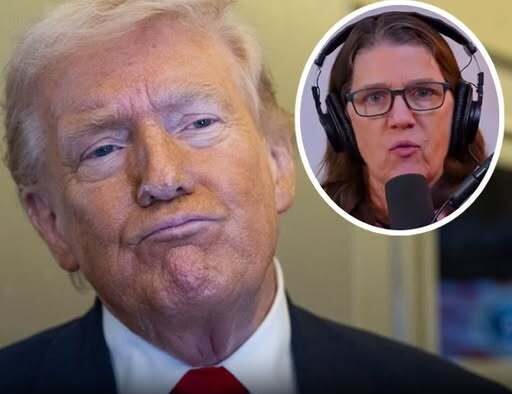
Mary Trump Escalates Criticism of the President’s Mental State and Public Image
A Family Dispute Becomes a Public Warning
Mary Trump has once again placed her uncle at the center of a sharp public confrontation, describing the president as a man under severe personal and political pressure.
In a new interview, she portrayed him as emotionally unstable, deeply insecure, and increasingly shaped by fears he cannot easily conceal. Her comments focused not only on his conduct in office, but also on what she sees as the deeper personal wounds driving his behavior.
Her remarks were unusually direct. She described him as an “empty, unloved man” who is clinging to authority while struggling against the one force no president, family member, or political operation can fully manage: public perception.
The comments quickly drew attention because they blended family history, political criticism, and questions about his fitness into a single pointed assessment. For Mary Trump, the issue is not simply disagreement over policy or personality. Her argument is that the president’s actions reflect a more serious pattern of emotional fragility and fear of humiliation.
Fear of Humiliation at the Center of Her Claim
Mary Trump’s central claim is that her uncle is not driven only by ambition or ideology. She argues that his deepest fear is being exposed as weak, diminished, or small in front of the public.
In her view, every awkward public appearance, every moment of confusion, every stumble on the international stage, and every strange online statement lands as a personal blow. She framed these incidents as more than passing embarrassments. She suggested they strike at the core of how he understands himself.
She described him as a man facing “constant narcissistic injuries,” a phrase that points to repeated emotional wounds caused by criticism, mockery, or signs that others do not see him as powerful and untouchable.
That idea sits at the heart of her warning. She argues that the president’s public strength is built around image, dominance, and control. When that image cracks, even briefly, she believes it creates a reaction that is larger than the moment itself.
Questions About Mind, Body, and Public Conduct
The interview also raised questions about the president’s mental sharpness, physical condition, and behavior during moments that his aides have often tried to explain or dismiss.
Mary Trump pointed to unusual public episodes as signs that something deeper may be happening. She did not present the issue as a normal political attack. Instead, she framed these moments as part of a broader pattern of decline, pressure, and emotional exposure.
Her criticism reached beyond the familiar language of family conflict. She questioned whether the president is able to withstand the personal strain of being constantly watched, judged, and challenged.
The concern she described is not only about isolated mistakes. It is about what those mistakes reveal. In her view, the president’s reactions to public embarrassment show a person who cannot separate personal injury from national leadership.
The White House Pushes Back Forcefully
The White House responded angrily to Mary Trump’s remarks, rejecting her claims and attacking her credibility.
Officials described her as dishonest and accused her of seeking attention. They also pointed to positive medical reports and strong cognitive evaluations as evidence that concerns about the president’s health and mental capacity are unfounded.
The response was swift and harsh, reflecting how seriously the administration viewed the interview. Rather than treating it as a private family grievance, the White House moved quickly to challenge both the substance of her comments and her motives.
That reaction also showed the political sensitivity of the subject. Questions about a president’s physical and mental condition are never minor. When those questions come from a relative with a history of public criticism, they become even more explosive.
More Than a Private Family Feud
Mary Trump’s criticism carries a particular charge because it comes from inside the family. Her words are not presented as observations from a distant political opponent, but as a judgment rooted in long-standing personal knowledge.
That does not make the dispute less political. Her comments are clearly part of a broader public battle over the president’s character, conduct, and capacity to lead. But the family connection gives her assessment a different kind of weight in the public conversation.
She is not merely saying that she disagrees with his decisions. She is arguing that the person behind those decisions is driven by fear, insecurity, and a need to avoid humiliation at all costs.
That distinction matters because it shifts the focus from political strategy to personal psychology. In Mary Trump’s telling, the president’s actions cannot be understood only through party loyalty, campaign messaging, or public performance. They must also be understood through his relationship with shame and weakness.
Public Image as a Source of Pressure
The portrait Mary Trump offered is of a man trapped by the image he has spent years building.
She suggests that strength, certainty, and dominance are not simply parts of his political brand. They are defenses. When those defenses are challenged, she argues, he reacts as someone who feels personally threatened.
That is why public humiliation plays such a central role in her assessment. A difficult interview, an awkward summit moment, a confused post, or a visible stumble can become more than a headline. It can become, in her view, a direct attack on the identity he has constructed.
For a president, that dynamic can carry serious consequences. The office requires judgment under pressure, the ability to absorb criticism, and the discipline to respond to setbacks without turning every slight into a crisis.
Why Her Words Continue to Resonate
The White House has tried to dismiss Mary Trump’s comments as personal, bitter, and politically motivated. Yet her words continue to draw attention because they speak to questions many observers already debate.
Her argument touches on the president’s public behavior, his communication style, his handling of criticism, and his need to project confidence even in moments of uncertainty.
She presents those traits not as isolated quirks, but as signs of a deeper struggle. In her view, the president is fighting against the possibility that the public may see through the image of control.
That is why her comments linger. They do not rely only on a single moment or one controversial appearance. They build toward a broader claim that the president’s greatest vulnerability is not a political opponent, a media controversy, or a difficult policy battle. It is the fear of being seen as less powerful than he claims to be.
A Stark Assessment of Power and Weakness
At the center of Mary Trump’s interview is a sharp contrast between public authority and private insecurity.
She describes a president who holds enormous power, commands national attention, and remains surrounded by aides prepared to defend him. Yet she also depicts him as deeply vulnerable to ridicule, rejection, and visible signs of decline.
That contrast makes her criticism especially severe. She is not simply accusing him of arrogance. She is suggesting that the arrogance itself may be a shield against fear.
In that framing, the louder the display of strength becomes, the more it may reveal the weakness underneath. The more aggressively his team rejects concern, the more attention falls on the moments they are trying to explain away.
The Broader Political Implication
Mary Trump’s comments arrive in a climate where the president’s words, posture, health, and public appearances are intensely scrutinized.
Every public moment becomes part of a larger debate over leadership and stability. Supporters see confidence and resilience. Critics see insecurity and decline. Mary Trump’s interview adds a personal dimension to that divide by arguing that the issue begins inside the man himself.
Her warning is that a leader consumed by fear of humiliation may treat criticism as a personal emergency rather than a normal part of democratic life.
That claim is serious because it links private emotional reactions to public decision-making. It suggests that personal insecurity can shape how power is used, how criticism is answered, and how national strength is performed on the world stage.
The Image Mary Trump Leaves Behind
By the end of her remarks, Mary Trump leaves behind a harsh and memorable image of the president.
She portrays him as a man surrounded by power but haunted by exposure. She describes someone who wants admiration, control, and loyalty, yet remains vulnerable to the possibility that others may see him as weak.
The White House has rejected that portrayal and responded with anger. It has pointed to medical evaluations and cognitive scores as proof that the president is fit and capable.
But Mary Trump’s argument is not limited to test results or official statements. Her claim is about character, fear, and the emotional demands of leadership.
Her final message is stark. The man entrusted with projecting American strength may, in her view, be most afraid of the public seeing him as small.