
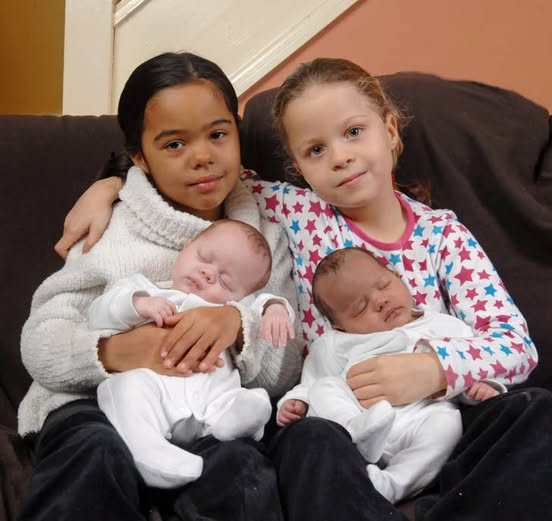
Twice the Surprise: How One Family Experienced an Exceptionally Rare Genetic Phenomenon
An Extraordinary Beginning for a British Family
Science can sometimes create outcomes that seem almost unbelievable, especially when genetics produces combinations that few people ever encounter. One British family experienced such a rare occurrence not once, but twice.
When Dean Durrant and Alison Spooner welcomed their first set of twin daughters in 2001, they had no idea their family story would draw widespread attention. The couple, who come from different racial backgrounds, were astonished when their newborn twins displayed strikingly different physical traits.
Although born on the same day and sharing the same parents, the sisters appeared remarkably different in complexion and features. Their arrival challenged common assumptions about what twins are “supposed” to look like.
A First Set of Twins With Distinct Appearances
The couple’s first daughters, Hayleigh and Lauren, immediately stood out because of their contrasting looks. Hayleigh inherited her father’s darker skin tone, while Lauren more closely resembled her mother, with fair skin and blue eyes.
The visual difference between the sisters was so noticeable that many people found it difficult to believe they were twins. Strangers often reacted with surprise when they learned the girls were born together.
Despite sharing the same birthday and household, the sisters’ outward appearances seemed to reflect two very different genetic paths. The contrast created curiosity wherever they went.
For their parents, however, the most important reality was simple: both girls were healthy and deeply loved. Their appearance did not change the fact that they were twins who entered the world together.

A Second Rare Event in 2008
Years later, the family experienced an even more astonishing development. In 2008, Alison gave birth to another set of twin girls, Miya and Leah.
Just like their older sisters, the younger twins also displayed clear physical differences from each other. Once again, one child inherited traits that contrasted sharply with those of her twin sibling.
The repetition of such a rare occurrence left the family stunned. Dean admitted he was shocked, saying there was “no easy way to explain it,” and few expected such an unusual genetic combination to happen twice within the same household.
What had already been considered an exceptional situation became even more extraordinary with the birth of the second pair.
Living With Public Doubt and Curiosity
Because of how different they look, the older twins often encounter disbelief from people they meet. Some assume they are simply close friends rather than sisters.
Others react with confusion or skepticism when they learn the girls are twins. Their appearance challenges many people’s preconceived ideas about sibling resemblance.
The phrase “No One Believes We’re Twins” reflects a reality they have faced repeatedly throughout their lives. Over time, the sisters have grown accustomed to these reactions.
Rather than becoming discouraged, they sometimes choose to embrace the surprise. In certain situations, they have even shown official documents, such as passports, to confirm that they truly are twins.
Despite public doubt, their relationship remains strong. They have shared the same bedroom since birth and describe twinhood as having a built-in best friend.
Their bond is rooted in shared experiences, childhood memories, and a lifetime of companionship. In nearly every way except physical appearance, they are inseparable.

Recognition for an Uncommon Family Record
Following the birth of the second set of twins, attention surrounding the family intensified. The situation was no longer a single rare event but a repeated genetic phenomenon.
The family was eventually included in the Guinness World Records. They were described as the only family known to have two sets of biracial twins with distinct differences in appearance.
The estimated odds presented in the article underline just how unusual their experience is. Different-looking biracial twins are said to occur in roughly 1 in 500,000 cases.
For the same family to have two sets is estimated at about 1 in 1,000,000. These figures highlight the statistical rarity of what happened in their home.
While numbers can illustrate how uncommon the situation is, they cannot fully capture what it feels like to live it. For this family, the phenomenon is simply part of everyday life.

Family Life Beyond the Headlines
Inside their household, the sisters’ connections extend far beyond public fascination. The younger twins, Miya and Leah, look up to their older sisters.
Their mother has described the family dynamic as raising “two mini-mes,” with the younger pair often imitating the older girls. The admiration is evident in daily interactions.
The older twins serve not only as siblings but also as role models. The younger sisters observe their behavior, copy their habits, and follow their lead.
In this way, the family operates like many others with multiple children. Shared routines, sibling influence, and close relationships shape their daily lives.
The unusual genetic outcome does not define the entirety of their identity. Instead, it exists alongside the ordinary experiences of growing up together.

Understanding the Genetics Behind the Differences
The key explanation for the twins’ different appearances lies in the nature of fraternal, or non-identical, twins. Unlike identical twins, fraternal twins develop from two separate eggs.
Each egg is fertilized by a different sperm cell. As a result, each child inherits a distinct combination of genes from the same parents.
In mixed-race couples, this variation can be especially noticeable. Skin color is influenced by multiple genes rather than a single determining factor.
Each parent carries genetic information that can express itself in various ways. When passed down to children, these genes combine in unique patterns.
One child may inherit more genes associated with darker pigmentation. Another may receive a combination linked to lighter skin tone and features.
Because fraternal twins share only about half of their genetic material, just like any other siblings, their physical traits can differ significantly.
When these genetic differences are visible in skin tone, eye color, or hair texture, the contrast can appear dramatic. Yet scientifically, it remains entirely possible.
In this family’s case, the outcome occurred twice, making it statistically rare but biologically understandable.
Challenging Assumptions About Family Resemblance
The story of this British family highlights how appearance does not always align with expectations. Many people assume that twins must look nearly identical.
In reality, only identical twins share the same genetic blueprint. Fraternal twins can resemble each other closely, or they can look as different as any two siblings.
When racial background is part of the genetic mix, the range of possible combinations increases. This can lead to outcomes that surprise observers unfamiliar with how genetics works.
The sisters’ lives demonstrate that outward differences do not diminish familial bonds. Shared upbringing and emotional connection remain far more significant than physical similarity.
Their experience also serves as a reminder that science can produce remarkable variation within a single family tree.

A Rare Story Rooted in Everyday Love
For Dean and Alison, the most astonishing aspect is not public attention or record recognition. It is the fact that an already rare occurrence happened twice within their family.
What may appear impossible at first glance is fully consistent with genetic principles. Still, the statistical odds make their story extraordinary.
At its heart, this is a story about four sisters growing up together. It is about shared bedrooms, sibling influence, and the bond that comes from entering the world as twins.
The differences in their appearances have sparked conversation and curiosity, but those differences are only one part of a much larger family narrative.
Their story underscores a simple truth: genetics can create unexpected outcomes, and families can reflect a wide spectrum of inherited traits.
In a world where assumptions are often made based on appearance, this family stands as a living example of how complex and fascinating human inheritance truly is.
Twice over, they experienced a rare genetic outcome that few others ever will. And twice over, they welcomed daughters whose shared bond outweighs any visible difference.
Preview photo credit Solent News / Shutterstock.com