
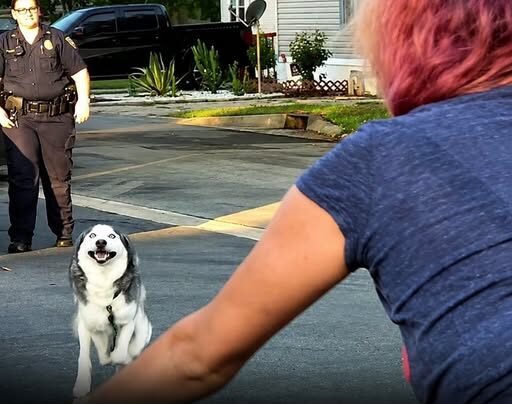
Cancer Survivor Reunites With Husky Semper After Nearly Three Years Apart
A Puppy Arrived During One of the Hardest Periods of Her Life
When Kameroun Mares was diagnosed with acute lymphoblastic leukemia, her life changed dramatically.
The illness brought exhausting treatment, major uncertainty, and emotional pressure that affected nearly every part of her daily routine.
Her cancer treatment also left her with Type 1 diabetes, adding another serious responsibility to an already difficult situation.
During that period, Mares decided that caring for a dog might help her cope with depression and give her another reason to remain active.
She brought home a husky puppy and gave him a name that reflected exactly what she hoped their bond would become.
She called him Semper Fidelis, Latin for “always faithful and loyal.”
At the time, neither Mares nor the young dog could have known how strongly that name would eventually come to define their relationship.
Semper Became Part of Her Recovery
Raising a puppy gave Mares something positive to focus on while she continued dealing with treatment.
Semper required walks, attention, training, veterinary care, and the daily routines that come with responsible pet ownership.
Those responsibilities helped provide structure at a time when Mares was facing significant health challenges.
She also took steps to make sure Semper could be identified if he was ever lost.
The husky received veterinary examinations and vaccinations.
Mares registered his microchip nationally and also completed local registration with the humane society in San Diego, California.
From her perspective, she had taken the proper precautions to establish ownership and make sure Semper could be returned to her if anything happened.
A Move to Florida Created an Unexpected Problem
Two years after bringing Semper into her life, Mares relocated to Florida.
The move created a serious complication when she discovered that her health insurance would not cover the treatment she needed there.
That meant she had to return to California for medical care.
Because the situation required her to get settled and continue treatment, she temporarily left Semper in the care of her roommate.
She expected that arrangement to keep her dog safe until her circumstances became more stable.
Instead, it became the beginning of a disappearance that would last for years.
The Phone Call She Never Expected
While Mares was back in California receiving treatment, her roommate contacted her with alarming news.
Semper was gone.
“I was told by my ex-roommate that he was missing,” she said in 2018.
The news added another emotional crisis to an already difficult period.
Mares was still fighting cancer and managing the consequences of treatment.
Now the dog who had been helping her cope was missing hundreds of miles away.
She did not know where Semper was, whether he was safe, or how he had disappeared.
Mares Refused to Stop Searching
Rather than accept that Semper was simply gone, Mares began an extensive search from California.
For approximately a year, she tried multiple ways of locating him.
She distributed flyers through pet websites.
She contacted roughly 15 veterinary offices in the neighborhood where she had previously lived.
She also contacted humane societies and animal shelters directly.
Mares believed the microchip registration should have helped.
Semper had been registered to her since he was a very young puppy.
Still, no call came informing her that someone had located him.
The Microchip Created More Questions
The lack of contact was especially confusing because Mares had taken the precaution of registering Semper’s microchip.
“His microchip is registered to me since he was 3 months old… yet I received nothing,” she said.
For Mares, the silence was extremely difficult.
“I was worried sick about him, and missed him dearly.”
She had expected the identification system to provide a clear link between Semper and his owner.
Instead, months passed without an answer.
The longer the search continued, the more complicated the disappearance became.
A Private Investigator Joins the Search
Eventually, Mares decided she needed additional help.
She hired private investigator Ana Campos to investigate Semper’s disappearance and determine whether there was still a way to locate him.
The decision finally produced the breakthrough Mares had been waiting for.
Campos found Semper.
But discovering the husky’s location also revealed that the story Mares had originally been given was not accurate.
Semper had not simply wandered away or become accidentally lost.
The Truth Behind Semper’s Disappearance
The investigation concluded that Mares’ roommate had taken the dog and sold him.
Semper had been advertised online and sold for $200.
The discovery completely changed the nature of the case.
Mares had spent months searching under the assumption that her husky had disappeared.
In reality, Semper had been deliberately transferred to another family without her permission.
The people who purchased the husky did not know the history behind the sale.
They had bought Semper believing the transaction was legitimate.
The New Family Had No Idea Semper Had Been Taken
The new owners were not aware that Mares was still searching for the dog.
They believed they had purchased Semper in good faith.
After bringing him home, they registered the husky through a microchip company.
That created another major complication.
The company allowed the new registration without first identifying that Semper was already associated with another owner.
Mares still maintained a lifetime microchip membership under her own name.
However, that existing registration did not prevent another name from being connected to the same microchip.
A Microchip Alone Did Not Resolve Ownership
Mares had believed that the microchip would provide permanent protection if Semper ever went missing.
The situation showed that the system could become complicated when separate registrations were created without proper verification.
The new owners had Semper physically in their home and had registered information connected to his chip.
Mares had her original records and long-standing ownership information.
The new family had no idea the dog had been taken from someone else, and they had become attached to him.
Understandably, they did not want to give him up simply because another person suddenly appeared claiming ownership.
That meant finding Semper was only the first step.
Mares Had to Fight to Bring Him Home
Mares was unwilling to walk away after finally learning where her dog was.
She continued working with private investigator Ana Campos and also obtained legal assistance.
Together, they gathered the information needed to establish Mares as Semper’s rightful owner.
The process was no longer simply about finding a missing pet.
It had become a legal effort to recover a dog who had been sold without the owner’s permission.
Mares had to demonstrate the history of her ownership, including the records created long before Semper disappeared.
Nearly Three Years Passed Before the Reunion
By the time the dispute was resolved, Mares and Semper had been separated for nearly three years.
For Mares, the reunion ended an extraordinary period of uncertainty.
She had gone from believing her dog was missing to learning he had been sold and was living with another family.
After years of searching and a legal recovery process, Semper was finally returned to her.
The moment carried enormous emotional weight.
“The huge wound in my heart can finally start healing,” Mares said afterward.
Semper Still Remembered Her
One of the most remarkable parts of the reunion was the husky’s response to Mares.
Despite the years they had spent apart, Semper had not forgotten the training he received as a puppy.
He still responded to commands and tricks Mares had taught him before the disappearance.
One particular command remained especially meaningful.
Mares could say, “Semper, go home. Where’s home? Go home” and the husky would head directly toward her front door.
For someone who had spent years trying to bring the dog home, the familiar response carried an entirely new meaning.
The Reunion Completed a Long Search
Semper’s return did not erase the stress Mares had experienced during the years he was missing.
She had searched while undergoing cancer treatment and dealing with the lasting health consequences associated with that treatment.
She contacted veterinary offices, shelters, humane societies, and pet websites while trying to solve the mystery from another state.
Eventually, she needed both a private investigator and legal assistance to recover the dog she had originally adopted to help her through one of the hardest periods of her life.
The reunion finally gave her the answer she had refused to stop pursuing.
The Case Exposed a Weakness in Microchip Registration
Semper’s story also highlighted an important limitation surrounding pet microchips.
A microchip contains identification information that can help connect a lost animal with an owner.
However, that protection depends on accurate registration and on the organizations involved checking existing records carefully.
In Semper’s situation, another registration was added even though Mares already had ownership information associated with the dog.
That meant the existence of the microchip did not automatically prevent a second person from being identified through another system.
The problem became particularly important because the family who acquired Semper did not know he had been taken from Mares.
Keeping Registration Information Current Matters
Semper’s experience demonstrates why pet owners should pay close attention to the information connected to a microchip.
Registration details should remain current so that shelters, veterinary offices, or other organizations can contact the correct person if the animal is found.
Where possible, owners may choose to maintain registration with more than one national database.
Keeping records of veterinary care, vaccinations, local registrations, and other ownership documentation can also become important if ownership is ever disputed.
Mares had maintained records that ultimately helped support her effort to recover Semper.
Buying or Adopting a Pet Requires Careful Verification
The story also contains a lesson for people obtaining animals through private sellers or online advertisements.
A buyer may have no reason to suspect that a dog being offered for sale belongs to someone else.
Checking for a microchip before completing a transaction can help reveal whether an animal already has identification information connected to another person.
Veterinary records or other documentation can also help establish whether the seller has a legitimate connection to the animal.
In Semper’s case, the family who purchased him believed they were making an ordinary transaction.
They only later became part of an ownership dispute because the dog’s true history had not been disclosed to them.
A Missing Pet and a Stolen Pet Can Create Different Problems
Mares initially searched for Semper as though he had become lost.
The later investigation showed that his disappearance involved an intentional sale.
That distinction can become significant when recovering an animal.
If circumstances suggest that a pet has been deliberately taken, creating an official report may provide documentation that could matter during a later dispute.
Mares eventually had to use legal channels to reclaim Semper.
Her case demonstrates how quickly a missing-pet situation can become more complicated when another person claims ownership.
Can Another Person Register an Already Microchipped Pet?
Semper’s experience showed that conflicting registrations can occur when a company does not properly identify an existing record before accepting new information.
For that reason, owners may want to verify how their microchip company handles changes to ownership details.
They can also ask whether documentation is required before an existing registration can be replaced or modified.
A microchip is most useful when the identifying information connected to it is accurate and carefully maintained.
What If a Pet Offered for Adoption May Be Stolen?
Someone considering buying or adopting an animal through a private transaction can ask for veterinary documentation or other proof showing the seller’s relationship to the pet.
The animal can also be scanned for a microchip before the transaction is completed.
A veterinary office or shelter may be able to perform the scan and determine whether identification information exists.
Unwillingness to provide basic records or permit a microchip check can be a warning sign that additional verification is needed.
Pet Theft Can Become a Legal Matter
The legal treatment of pet theft can vary depending on location.
In many places, intentionally taking another person’s pet can be treated as a criminal issue rather than simply a disagreement over ownership.
Documentation created when the animal first disappears can become important if recovery later requires investigators or lawyers.
For Mares, the search ultimately became a legal process because the dog had been sold to people who believed they had acquired him legitimately.
A Name That Became Remarkably Appropriate
Years before any of this happened, Mares chose the name Semper Fidelis because it meant “always faithful and loyal.”
At the time, it was simply a meaningful name for the husky puppy she hoped would help her through cancer treatment.
Years later, after separation, searching, investigation, and a legal struggle, the name seemed even more appropriate.
Semper returned to Mares after nearly three years and still remembered the commands she had taught him when he was young.
The dog she once brought home to help her through illness had remained connected to her despite years apart.
Finally Home Again
Mares’ experience began with a difficult diagnosis and a decision to bring a puppy into her life for companionship and motivation.
It later became a story involving a cross-country move, medical treatment, a missing dog, an online sale, conflicting microchip registrations, a private investigation, and a legal recovery effort.
Throughout it all, Mares refused to stop looking for Semper.
Nearly three years after they were separated, she finally brought him home.
For Mares, the reunion meant more than recovering a pet.
It restored the relationship that had begun when she was struggling through cancer treatment and needed a reason to keep moving forward.
And when Semper once again responded to “Semper, go home. Where’s home? Go home”, the long search finally reached the place Mares had been trying to bring him all along.