
Veterinarian Frees Chained Wild Horse in Romania—Then Another Horse Steps Forward in a Moment That Went Viral
A quiet encounter in Romania’s Danube Delta drew worldwide attention while highlighting a much larger effort to protect wild horses and the fragile landscape they inhabit
In parts of Romania’s Danube Delta, some wild horses have been found with their front or hind legs restrained by chains.
The practice is not part of an official wildlife-management program.
Instead, it has been used informally by some local people attempting to prevent horses from wandering too far.
For the animals, those restraints can leave visible marks and create serious welfare concerns.
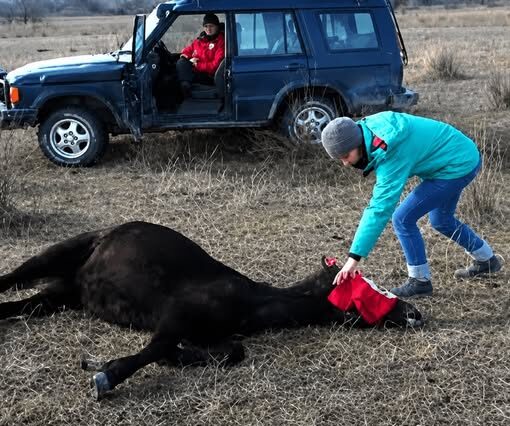
One such horse became the center of an unforgettable moment when veterinarian Dr. Ovidiu Rosu carefully removed the chains from a nervous mare.
The rescue was already emotional before another horse appeared
Footage released by Four Paws International showed Rosu working calmly beside the mare.
His priority was to keep the animal as relaxed as possible while removing the restraints from her legs.
The horse was understandably nervous.
She was a wild animal being approached and handled by humans in an unfamiliar situation.
Rosu continued carefully until the chains could be removed.
Then another member of the herd stepped closer
As the veterinarian worked, another horse approached.
Instead of fleeing or reacting aggressively, the animal moved near Rosu and gently touched him with its nose.
The brief interaction quickly became the most memorable part of the footage.
Many viewers interpreted the gesture as a kind of thank-you.
It is impossible to know exactly what the horse intended.
What is certain is that the calm contact between a wild animal and the person helping its companion created a striking image.
The video spread for reasons larger than the rescue itself
People were drawn to the apparent tenderness of the moment.
A veterinarian had just helped free one horse from a painful restraint.
Another horse appeared to acknowledge his presence in an unusually gentle way.
The scene carried an emotional simplicity that made it easy to understand even without explanation.
But behind that viral moment is a much more complicated story involving history, conservation and the future of one of Romania’s unusual wild horse populations.
The Danube Delta horses have a long history
According to the historical account provided by Four Paws, horses have been present in the region for roughly three centuries.
Their story has been connected to Tatar cavalry passing through the area and leaving horses behind after military campaigns.
Over generations, those animals became part of the landscape.
The population changed again dramatically following the collapse of Romania’s agricultural collectives after the fall of communism in 1989.
Former working horses were released into the delta
As the old agricultural system disappeared, many horses that had once been used for work were no longer kept in the same way.
Some were released and left to survive independently in the Danube Delta.
The environment provided enough space and resources for the population to grow.
Through the 1990s and 2000s, the number of free-roaming horses increased considerably.
Estimates over different years placed the wider population somewhere between approximately 1,000 and 4,000 animals.
The growing population created a conservation dilemma
The horses themselves became an important part of the region’s identity.
At the same time, large numbers of grazing animals began affecting sensitive habitats.
One of the most significant concerns involved Letea Forest.
The forest is a strictly protected area covering roughly 2,800 hectares.
It is part of the UNESCO Biosphere Reserve and is described as Romania’s oldest nature reserve.
Horses moved into the protected forest
As the population expanded, many animals entered the Letea Forest area.
Their grazing placed pressure on young vegetation.
That created problems for natural forest regeneration.
Young trees and plants could be damaged before they had time to mature.
Over time, concerns increased that an uncontrolled horse population could alter the ecosystem of the reserve.
By 2011, authorities were considering a much harsher solution
The ecological pressure eventually became serious enough that Romanian authorities considered reducing the horse population through culling.
For conservation managers, the concern was protecting the forest.
For animal-welfare organizations, killing large numbers of horses raised an entirely different set of ethical concerns.
The challenge was finding a method that could reduce population growth without destroying the animals that had become part of the Danube Delta landscape.
Four Paws proposed an alternative
Instead of allowing a large-scale cull, Four Paws International introduced a long-term population-management program based on immuno-contraception.
The idea was straightforward.
Rather than killing existing horses, veterinarians would gradually reduce the number of new foals being born.
Over time, natural population decline could bring horse numbers closer to a level that the protected habitat could sustain.
The program relied on a contraceptive vaccine
Female horses were treated with a vaccine designed to reduce reproduction.
The method made it possible to manage population growth without removing large numbers of animals through lethal measures.
The project required ongoing veterinary work because the mares had to be located, identified and treated individually.
Dr. Ovidiu Rosu became one of the central figures in that effort.
The veterinarian from the viral video had worked on the project for years
Rosu was not simply a veterinarian who happened to encounter one chained mare.
He had been deeply involved in the long-term management of the Danube Delta horses.
He wrote his doctoral thesis on the effectiveness of the contraceptive vaccine used in the project.
He also helped lead the program beginning in its early stages around 2012.
Each horse required careful veterinary handling
The contraception program involved far more than administering an injection.
Mares were first tranquilized so veterinary teams could examine them safely.
They received full health checks.
Blood samples were collected.
Their teeth were examined to help estimate age.
The horses were also tagged so that veterinarians could identify them during future monitoring.
The vaccine was only one part of the fieldwork
Once a mare had been examined and identified, the contraceptive treatment could be administered.
Some animals later required booster shots.
That meant teams had to return repeatedly to the difficult delta landscape and locate specific horses again.
The work required coordination between animal-welfare specialists, veterinary experts and Romanian authorities.
The program involved Romanian veterinary institutions
Four Paws worked alongside Bucharest’s Faculty of Veterinary Medicine and Romanian veterinary authorities.
The partnership helped make the project more than a temporary rescue operation.
The goal was to establish a sustainable management system capable of continuing over many years.
In its early seasons alone, the program reportedly delivered more than 100 vaccinations along with dozens of booster treatments.
The population began moving toward a more sustainable level
A 2017 aerial census reported fewer than 500 horses in the Letea Forest area.
That number represented a considerable reduction from the earlier population pressures that had caused concern.
The smaller population was viewed as more manageable for the protected environment.
The result suggested that reducing births gradually could provide an alternative to mass culling.
The program attempted to balance two competing responsibilities
Protecting the horses was important.
Protecting the forest was also important.
Those goals were not automatically compatible when the number of grazing animals became too large.
The contraception strategy represented an attempt to respect animal welfare while still acknowledging that the ecosystem had limits.
That balance became one of the defining features of the project.
The chained horses revealed another welfare problem
Population management was not the only challenge encountered by veterinary teams.
Some horses were found with their legs restrained.
These chains were not part of the official contraception or conservation program.
They were an informal method used by some people in the area to limit how far horses could travel.
Veterinary teams encountering such animals removed the restraints when possible.
The chains could leave visible marks
The mare seen in the widely shared footage showed signs that the restraints had affected her legs.
Removing them therefore involved both immediate welfare concerns and careful handling.
A frightened horse can easily injure itself or the people attempting to help.
That made Rosu’s calm approach especially important.
The other horse’s response became the emotional symbol of the work
The contraception statistics and population counts explain why the project mattered scientifically.
The viral video showed why people cared emotionally.
One horse stood free after the chains were removed.
Another stepped forward and touched the veterinarian gently.
Viewers did not need to understand population models or conservation policy to react to that moment.
Calling it a “thank-you” is an interpretation
It is natural for people to assign human meaning to animal behavior.
The horse’s gentle approach looked remarkably affectionate.
Many people saw gratitude.
But the safest description is simply what could be observed.
The horse voluntarily approached Rosu and made calm physical contact with him after he had helped the mare.
That alone was remarkable enough.
The Danube Delta presents unusual management challenges
Wild or free-roaming horses do not exist separately from the environment around them.
They eat vegetation.
They travel across large areas.
They reproduce.
When populations become too large for a sensitive habitat, conservation managers have to make difficult decisions.
The Danube Delta project demonstrated one possible approach.
Non-lethal management requires patience
Culling can reduce animal numbers quickly.
Contraception works more slowly.
The existing horses remain in the environment while fewer new animals are born.
That means managers must continue monitoring population size for years.
The method requires consistent funding and veterinary involvement.
It also requires identifying individual animals
Because mares may need follow-up treatment, tagging became an important part of the program.
Veterinary teams had to know which horses had already been treated.
They also needed information about age and health.
This turned the project into an ongoing monitoring effort rather than a one-time campaign.
Health examinations provided additional benefits
Whenever mares were tranquilized for contraception, veterinarians could also assess their general condition.
Blood testing and dental examinations helped provide information about the health and age of individual animals.
Field teams could also identify welfare problems such as chains or injuries.
That meant population control and veterinary care could occur at the same time.
The project continued for more than a decade
Four Paws remained directly involved in Romanian equine welfare for years.
The Danube Delta horse program became one of the organization’s long-running efforts in the country.
The intention, however, was never for the international organization to remain responsible forever.
A sustainable program needed local institutions capable of continuing the work.
By 2025, responsibility had shifted
As of 2025, Four Paws formally handed its Romanian equine welfare programs, including the Danube Delta project, to local Romanian authorities.
The transition represented an important milestone.
After more than a decade of direct international involvement, local institutions were expected to continue the management effort.
The handover was part of the original long-term idea
International animal-welfare programs can provide expertise, funding and momentum.
But permanent reliance on an outside organization can make a project vulnerable.
Transferring responsibility locally can help establish continuity.
The Danube Delta initiative was designed with that eventual transition in mind.
Population control remains relevant
The contraception program significantly reduced growth in the protected Letea Forest area.
That does not mean monitoring is no longer necessary.
Horse numbers can change over time.
Habitat conditions can also change.
The transfer to Romanian authorities therefore represents a continuation of management rather than the end of the issue.
Conservation is rarely as simple as choosing animals or habitat
The story of the Danube Delta horses illustrates how complicated wildlife management can become.
Allowing unlimited population growth could damage a protected ecosystem.
Removing the horses through lethal methods would create major animal-welfare concerns.
Doing nothing was not necessarily a neutral option.
The contraception program attempted to create a middle path.
The horses themselves are part of the region’s history
Their presence is not a recent phenomenon.
Generations of horses have lived in the Danube Delta.
Historical events, changing agricultural practices and the collapse of collective farming all contributed to the population that exists today.
That history helps explain why managing the animals is both an ecological and cultural issue.
Letea Forest also has its own claim to protection
The forest is not simply empty land available for unlimited grazing.
It is a protected ecosystem with its own plants and regeneration needs.
When large numbers of horses feed on young growth, the effects can accumulate.
Protecting the forest therefore requires keeping grazing pressure within manageable limits.
The viral rescue showed the individual animal behind the statistics
Wildlife management discussions often focus on population numbers.
Five hundred horses.
One thousand horses.
Thousands across the wider region.
But the video of Rosu and the chained mare brought attention back to one animal experiencing one difficult moment.
That individual perspective can be powerful.
One horse can represent a much larger issue
The mare’s chains highlighted the welfare challenges encountered during fieldwork.
Her release showed what direct veterinary intervention could accomplish.
The approaching herd member added an emotional moment that helped the footage spread widely.
As people shared the video, they also encountered the larger story of the Danube Delta horses.
Public attention can help conservation projects become visible
Much of the work involved in animal management happens far from public view.
Veterinarians conduct examinations.
Teams track populations.
Researchers evaluate results.
Authorities negotiate management plans.
Those efforts rarely produce dramatic images.
A short video can suddenly make years of work understandable to millions of people.
The moment did not require dramatic action to become memorable
There was no spectacular chase.
No theatrical rescue.
The power of the video came from its quietness.
A veterinarian helped one nervous horse.
Another horse approached.
There was a gentle touch.
Then the moment was over.
It became a reminder that animal behavior can surprise us
Wild animals do not necessarily react in ways people expect.
Sometimes they flee.
Sometimes they become defensive.
And sometimes they remain surprisingly calm around a person who has just helped another member of their group.
Interpreting the exact meaning may be impossible.
The behavior itself can still be remarkable.
Supporting horse welfare involves more than rescues
Programs like the one in Romania require veterinary expertise.
They need monitoring.
They require cooperation with authorities and scientific institutions.
They also depend on public awareness and financial support.
Rescuing one chained horse matters.
Preventing the larger conditions that create repeated welfare problems matters too.
The goal is long-term management rather than temporary intervention
A single field visit cannot solve an expanding population problem.
Likewise, removing one set of chains cannot guarantee every horse will remain safe.
Sustainable welfare requires systems that continue after individual rescue teams leave.
The transfer of responsibility to Romanian authorities reflects that longer-term objective.
Dr. Ovidiu Rosu became connected to both sides of the story
He appeared in the viral moment freeing the chained mare.
But his role extended far beyond that single rescue.
His academic and veterinary work contributed to the contraception program designed to protect both the horses and the Letea Forest ecosystem.
That combination of individual care and population-level management made him an important figure in the project.
The mare’s freedom was only one small part of years of work
Removing the chains took minutes.
Managing the Danube Delta horse population has taken years.
Both actions were connected by the same basic challenge.
How can people reduce suffering while also responsibly managing animals living within a sensitive environment?
The answer required something more thoughtful than simply removing horses
The contraception approach accepted that the horses belonged to the landscape while recognizing that their numbers could not increase indefinitely.
Instead of treating the animals as a problem to eliminate, the program attempted to reduce population pressure over time.
That slower strategy allowed existing horses to remain while future growth was moderated.
The viral gesture remains the image many people remember
Years of conservation planning can be difficult to summarize.
One horse touching its nose gently to a veterinarian is much easier to remember.
Perhaps that is why the footage traveled so widely.
It gave a human-scale image to a complex project.
Whether it was gratitude or curiosity, the moment mattered
No one can know exactly what the approaching horse was thinking.
Calling the gesture a deliberate thank-you goes beyond what can be proven.
But there is no need to exaggerate what happened.
A wild horse voluntarily approached a veterinarian helping another horse and made calm, gentle contact with him.
That was enough to move people around the world.
The Danube Delta horses continue to represent both beauty and responsibility
They are visually striking animals living in an extraordinary landscape.
They are also part of a population that must be managed carefully to protect the environment supporting them.
The challenge is not choosing whether the horses or forest deserve protection.
Both do.
The difficult work lies in finding a method that respects both needs.
A quiet rescue helped tell that much larger story
When Dr. Ovidiu Rosu removed the chains from the mare, he was helping one animal directly.
When another horse stepped forward and touched him gently, the cameras captured something that people immediately understood emotionally.
Behind those few seconds were centuries of history, decades of population growth and more than a decade of organized conservation work.
The horse could not explain what the gesture meant.
But the scene gave millions of viewers a reason to notice.
And sometimes, being noticed is where larger change begins.