
A Stray Dog Tore a Backpack From a Little Girl—Then Something Inside Began to Move
The Frightening Animal Was Trying to Protect an Entire Playground
For several agonizing seconds, the park became completely still.
The wind faded, the distant traffic seemed to disappear and a heavy clicking sound came from the brightly colored backpack lying on the playground.
The noise did not resemble a toy or a vibrating telephone.
It sounded mechanical and deliberate.
After eight years as a park ranger, I had responded to lost children, medical emergencies and encounters with wildlife. I had never faced a suspicious package that might contain an explosive device.
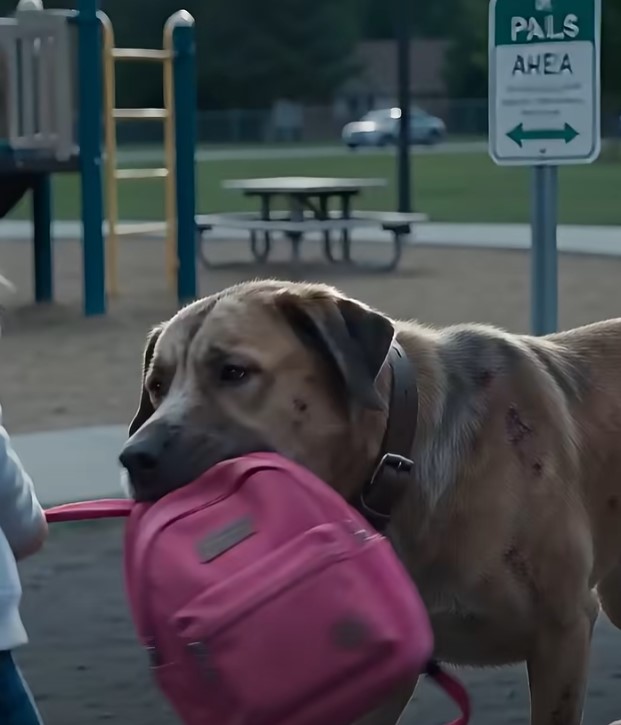
Only moments earlier, a large stray dog had torn the pink backpack away from a seven-year-old girl named Mia.
The animal had initially appeared to be attacking her. Now he stood directly over the bag and refused to allow anyone near it.
I ordered everyone away from the playground
My training finally overcame my confusion.
“Everyone, back away!” I shouted. “Move! Get back right now!”
The crowd scattered.
Parents lifted their children and hurried away, leaving strollers and picnic food behind. A man who had approached the dog with a tree branch dropped it and ran.
Mia remained on the ground, trembling as she wiped tears and dirt from her face.
I extended one hand and encouraged her to move toward me. She rushed forward and clung to my uniform.
I lifted her into my arms and moved away from the backpack before calling for her mother.
A terrified woman appeared through the trees and ran toward us.
She took Mia into her arms and immediately began looking for bite marks.
The mother believed the stray had attacked her daughter, but Mia was unharmed.
I told them to run toward the main parking area and remain behind the concrete restroom building.
At first, the mother could not understand why. Then the clicking sound came from the backpack again.
She stopped asking questions and carried Mia away.
The scarred dog guarded the bag
I contacted emergency dispatch and requested police officers, hazardous-materials responders and the bomb squad.
The playground emptied until only the dog, the backpack and I remained.
The stray was an enormous brindle mix that appeared to be part pit bull and part mastiff. Old scars covered his muscular body, and his ears had been cut short.
Despite his intimidating appearance, his posture did not suggest that he wanted to attack me.
His front paws were planted on opposite sides of the backpack. His ears repeatedly turned toward the clicking sound.
When I attempted to coax him away, he looked at me and growled.
The sound established a clear boundary.
He did not want anyone approaching the bag.
A dark liquid began escaping
The backpack was an inexpensive pink bag decorated with cartoon princesses.
Its material was stretched tightly around a large, rigid object inside the main compartment.
A dark stain appeared near the lower zipper and slowly moved across the fabric.
Thick drops fell onto the woodchips.
The liquid seemed too heavy to be water. In the afternoon light, it resembled dark oil or blood.
I moved to one side to see it more clearly. The dog followed every step with his eyes while releasing a nervous whine.
The mechanical rhythm suddenly accelerated before stopping completely.
For the first time, the dog backed away.
Then the entire backpack expanded and contracted as though something inside had taken a breath.
The backpack started moving
A low mechanical sound began building within the bag.
The fabric vibrated as though a powerful motor were struggling to activate. The dark fluid began escaping more quickly and soaking into the ground.
Police sirens sounded in the distance, but I feared help would arrive too late.
The dog started pawing at the dirt beside the bag. He remained frightened but refused to abandon the object.
As the sirens grew louder, the bag began shaking with greater force.
The dog barked every time it moved and threw dirt toward the spreading liquid as though attempting to bury it.
Three police vehicles crossed the grass and stopped approximately 50 yards from the playground.
Sergeant Miller, a veteran officer I knew from previous park incidents, ordered me to retreat.
I moved behind one of the cruisers and described everything I had seen.
Police established a wide perimeter
More patrol cars blocked every entrance to the park.
Officers moved residents and curious spectators into the surrounding streets while waiting for specialists to arrive.
One young officer suggested shooting the dog before it disturbed the potential explosive device.
I immediately objected.
The stray had removed the backpack from Mia. If he had not acted, the little girl would still have been wearing it when the mechanical activity began.
Whatever the animal’s reasons, he had already protected her from an unknown threat.
Miller agreed that no one should harm the dog unless the danger escalated.
A heavily armored bomb-squad vehicle soon entered the park, followed by a hazardous-materials unit.
Captain Reynolds took control
The bomb-squad leader introduced himself as Captain Reynolds and requested a rapid explanation.
I described the clicking, leaking fluid, violent movement and the dog’s decision to target the backpack instead of Mia.
Reynolds found that detail significant.
He considered whether the animal had detected an explosive or unstable chemical compound, but its behavior did not match the usual trained response.
The stray was not sitting calmly after identifying something suspicious. He appeared determined to attack or contain whatever was hidden inside.
Reynolds ordered his team to prepare a remote-controlled inspection robot.
The tracked machine carried cameras and an articulated arm that could examine the backpack without placing a technician beside it.
The dog blocked the bomb-squad robot
The robot crossed the grass and entered the playground.
As soon as it approached the bag, the stray charged.
He barked and snapped at its metal tracks, forcing the operator to reverse before the cameras were damaged.
The dog pursued it until it was well away from the backpack.
The team could not inspect the suspicious package while the animal continued blocking the robot.
Animal-control officers were approximately 20 minutes away, but the bag’s movements were becoming more violent.
I volunteered to remove the dog with a catch pole.
Miller objected because entering the restricted area placed me dangerously close to the package.
I reminded him that my work as a park ranger included handling stray animals. Waiting another 20 minutes could allow the object inside to activate completely.
Reynolds reluctantly approved the attempt.
I entered the danger zone
An officer retrieved a long aluminum pole fitted with a wire loop.
Reynolds instructed me to remain at least five feet from the backpack. If the mechanical sound returned or changed pitch, I was to drop everything and run.
I walked slowly toward the stray.
The closer I moved, the stronger the smell became. The liquid carried odors resembling battery acid, metal and burning plastic.
The dog’s paws were already stained from standing in it.
By then, the backpack was no longer merely vibrating. It twisted across the woodchips as though a powerful creature were struggling beneath the material.
The animal looked from me to the bag and released a distressed whine.
I passed the loop over his head and tightened it around his thick neck.
He did not resist.
Once secured, he seemed to surrender responsibility for the package and allowed me to pull him behind the police vehicles.
The camera revealed something impossible
The bomb-squad robot returned to the playground.
Its high-definition camera showed that the backpack had been stretched to its limit.
The shape inside did not resemble an ordinary explosive device. It looked more like a rigid cage.
The camera moved toward the dark liquid.
Tiny metallic fragments swirled through the thick fluid and reflected the sunlight.
The robot then examined the zipper.
Pressure from inside the bag was separating its metal teeth one after another.
Through a small opening, the camera revealed a scratched metal surface.
At its center was a glowing red mechanical eye.
The eye moved and focused directly on the robot’s lens.
The clicking sound returned, louder than before.
This time, it did not feel like a countdown.
It felt like a warning.
The machine broke out of Mia’s backpack
The zipper burst apart before the inspection robot could retreat.
Torn fabric, school supplies and pieces of the princess decorations flew across the playground.
A thick cloud of dark metallic fluid surrounded the object emerging from the ruined backpack.
The machine was approximately the size of a large dog.
Scratched metal plates covered its body, while six jointed limbs ended in sharp points. A single red optical sensor moved rapidly as it scanned the area.
A damaged section along its side leaked the dark fluid that had stained the backpack.
The machine immediately attacked the bomb-squad robot.
One of its pointed limbs penetrated the camera housing, causing every monitor inside the command vehicle to dissolve into static.
Officers raised their weapons while Reynolds authorized them to stop the machine.
The stray dog escaped and charged
Before the officers could fire, the stray lunged toward the playground.
The sudden force pulled the catch pole from my hands.
The dog raced across the grass with the long pole dragging behind him.
Miller ordered everyone to hold their fire because the dog had entered the line of sight.
The machine turned and raised its front limbs toward the approaching animal.
The stray crashed into it with the full force of his muscular body.
Dog and machine tumbled into the playground sand.
The mechanical limbs cut the animal’s shoulders and sides, but he refused to retreat.
He locked his jaws onto the central metal casing directly above the glowing red sensor.
His powerful bite cracked the damaged outer shell.
Sparks escaped as the machine attempted to free itself.
The dog continued despite his injuries
One of the machine’s limbs injured the stray’s back leg and caused him to lose his grip.
The damaged device began dragging itself toward the trees.
The dog remained in the sand, bleeding from several wounds.
I could not allow the machine to escape into another part of the park after seeing what it had done.
I drew my steel ranger baton and ran toward it.
Miller ordered me to return, but I continued.
The dog’s bite had damaged the machine and reduced its speed.
I caught it before it reached the trees, raised the baton with both hands and struck the glowing red sensor.
The impact broke through the cracked casing and drove the baton into the internal components.
The red light flashed several times before going dark.
The machine’s limbs collapsed, and smoke began rising from its body.
The hero lay wounded in the sand
A quiet whimper brought my attention back to the dog.
He was lying on his side with blood covering parts of his brindle coat. His breathing had become shallow and irregular.
I ran to him and pressed my hands against the wounds on his shoulder and side.
The stray did not growl or attempt to bite.
He rested his head on my knee and gently licked my trembling hand.
I called urgently for medical assistance.
The dog had removed a dangerous machine from a child, prevented the bomb-squad robot from triggering it prematurely and then fought it when it escaped.
Now the animal who had protected everyone in the park was in danger of losing his life.
Federal authorities took over the investigation
Black vehicles soon arrived carrying federal teams.
They closed the park, collected recordings and placed the remains of the machine inside heavily protected containers.
Specialists also removed soil contaminated by the dark fluid.
I spent several hours inside a mobile command center answering questions.
The officials provided a limited explanation of what had happened.
The machine was an experimental autonomous drone created as corporate-espionage technology.
A foreign operative had allegedly stolen the prototype from a private defense contractor.
Federal agents confronted the suspect earlier that morning near an interstate highway a few miles from the park.
The operative escaped temporarily and ran through nearby neighborhoods while carrying the damaged drone.
Mia’s backpack became a hiding place
The operative entered the crowded park while searching for somewhere to conceal the stolen machine.
Mia’s backpack had been left on a bench for less than two minutes while her mother discarded a juice box.
The man placed the deactivated and leaking drone inside the bag before continuing his escape.
Authorities caught him three blocks away, but they did not know where he had hidden the prototype.
The drone’s automatic repair process eventually began restoring its damaged systems inside Mia’s backpack.
Had the stray not detected the unusual fluid and removed the bag from the child, the machine could have activated while she was still wearing it.
The dog’s extraordinary senses recognized the danger before any person did.
The dog was unlikely to survive
Animal-control officers transported the wounded stray to a state veterinary surgical center.
A federal agent warned me that he had suffered extensive injuries and lost a dangerous amount of blood.
The medical team was operating, but his chances of surviving the night appeared extremely low.
I was released from questioning at three in the morning.
I did not return home or change out of my stained ranger uniform.
I drove directly to the veterinary hospital and entered its quiet waiting area.
Mia and her mother were already there.
Her mother embraced me and explained that they had learned what the dog had done.
Together, we waited for four hours while surgeons fought to save an animal none of us had known before that day.
The surgeon finally returned
As sunlight began entering the lobby, the surgical doors opened.
An exhausted veterinarian stepped into the waiting area wearing stained green scrubs.
For a moment, I feared his expression meant the dog had died.
Then he offered a tired smile.
“He’s the toughest son of a gun I’ve ever seen in my twenty years of medicine,” the doctor said.
The surgical team had placed more than 100 stitches. The dog would have a permanent limp and require a long recovery, but his vital signs had stabilized.
He was going to live.
Mia’s mother began crying with relief. I dropped into a chair and covered my face as the tension of the previous 12 hours finally released.
His tail moved when he saw me
We were allowed into the recovery area an hour later.
The dog remained heavily sedated on a thick foam bed. Intravenous lines surrounded him, and white bandages covered much of his right side.
He looked small and vulnerable compared with the fearless animal that had fought the machine.
I placed one hand against his uninjured ear.
His eyes opened slowly.
When he recognized me, a faint sound came from the bed.
His tail was moving against the foam pad.
“Hey, buddy,” I whispered. “You did good. You did so good.”
Despite the pain and medication, he still responded with trust.
The official explanation concealed the truth
More than a year has passed since that terrifying afternoon.
The public explanation described the incident as a chemical spill caused by a discarded industrial battery.
The playground was cleaned, new woodchips were installed and families eventually returned.
Children once again filled the swings while most people remained unaware of what had actually emerged from Mia’s backpack.
I remembered every detail.
So did the scarred brindle dog who eventually came home with me.
The stray finally received a name
When the veterinary hospital released him, I adopted him immediately.
I named him Titan.
His injuries left him with a noticeable limp, and thick scars remained across his shoulders.
Those physical reminders did not prevent him from enjoying his new life.
Titan received an orthopedic bed, all the treats he wanted and permission to sleep on the furniture.
Mia and her mother began visiting every weekend. They brought toys and fresh steaks for the dog who had protected her.
The frightened child who once believed he was attacking her came to understand that he had saved her life.
People still judged him by his appearance
To strangers, Titan remained an intimidating animal.
His muscular build, cropped ears and extensive scars caused some people to cross the street when they saw us approaching.
They saw an old and damaged stray without knowing what existed beneath that appearance.
I saw the animal who recognized a threat that trained professionals initially mistook for an explosive device.
I saw the dog who removed a dangerous backpack from a little girl and then remained beside it to keep everyone away.
I saw the wounded fighter who charged a machine to protect a playground filled with people who had previously feared him.
The greatest hero I have ever known
Titan could have run at any point.
He could have left after pulling the bag away from Mia. He could have escaped when the clicking began or when police vehicles entered the park.
He could have hidden when the machine broke free.
Instead, he repeatedly placed himself between the danger and everyone else.
His actions were not motivated by training, recognition or the promise of a safe home.
At the time, he was a stray with no family waiting for him and no reason to believe any person would protect him in return.
Still, he chose to fight.
The scars that made people afraid of Titan were evidence that he had survived a difficult past. They did not define his character.
Beneath them was an extraordinary capacity for courage, loyalty and self-sacrifice.
The most important lesson I carried away from the park was simple.
Appearance does not reveal the true nature of a person or an animal.
Sometimes the creature everyone fears is the only one brave enough to recognize danger and stand against it.
Titan entered the park as a misunderstood stray.
He left it as the greatest hero I would ever know.