
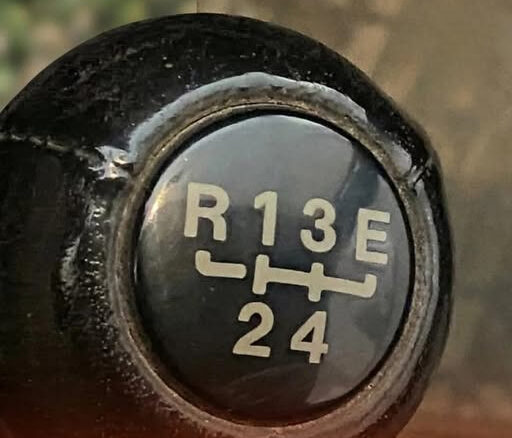
The Forgotten Meaning Behind the “E” on Older Gear Sticks
For generations, drivers have recognized the familiar arrangement of letters and numbers displayed on gear selectors. Whether behind the wheel of a manual or an automatic vehicle, the layout has remained largely consistent, guiding motorists through the mechanics of everyday driving.
Manual transmissions typically feature numbered gears for forward movement along with an “R” for reverse. Automatic transmissions, meanwhile, commonly display “P,” “N,” “D,” and “R,” representing Park, Neutral, Drive, and Reverse. In some models, an additional “L” for Low gear also appears.
Recently, however, attention has turned to a lesser-known letter that once appeared on certain older gear sticks. Some drivers noticed the presence of an “E” and found themselves puzzled by its purpose.
For many modern motorists, the letter seemed unfamiliar, sparking curiosity and conversation about its meaning and function.
A Letter That Sparked Curiosity
The mystery surrounding the “E” resurfaced during a discussion shared by Supercar Blondie. Followers were asked if they knew what the additional letter stood for, prompting a wave of responses from experienced drivers.
Those familiar with older vehicles quickly provided the answer. The “E” stood for “Economy.”
While it may appear simple, the inclusion of this letter represented a specific driving feature designed with efficiency in mind.
At a time when fuel economy was becoming an increasingly important consideration for motorists, manufacturers explored ways to help drivers conserve fuel during everyday travel.
How the “Economy” Gear Worked
The “E” setting functioned similarly to a high gear. Its primary objective was to reduce fuel consumption during steady driving conditions.
By keeping the engine’s revolutions per minute (RPM) lower, the setting allowed the vehicle to operate more efficiently over longer stretches of road. Lower RPM generally means the engine is not working as hard, which can translate to reduced fuel use.
In some cases, the “Economy” mode also adjusted how the engine operated. The intention was not to increase performance but to maintain smooth, steady motion while minimizing unnecessary fuel burn.
This feature proved particularly useful during highway cruising or consistent-speed travel, where rapid acceleration was not required.
Drivers seeking a balance between performance and savings could select the “E” setting when efficiency was a priority.
Why the Feature Disappeared
As automotive technology progressed, the need for a dedicated “Economy” gear gradually diminished.
Modern engines are designed with significantly improved efficiency compared to earlier generations. Advances in fuel injection systems have allowed for more precise delivery of fuel into the engine.
Improved aerodynamics have also contributed to better overall fuel economy, reducing drag and allowing vehicles to move more smoothly through the air.
Additionally, computerized engine management systems now monitor and optimize performance automatically. These systems continuously adjust engine behavior based on driving conditions, eliminating the need for drivers to manually select an economy-focused gear.
With efficiency features built directly into vehicle design, a separate “E” option became unnecessary.
Over time, the letter quietly disappeared from most gear selectors, becoming a detail remembered primarily by those who drove older models.
A Shift in Automotive Design Philosophy
The removal of the “Economy” gear reflects a broader shift in how vehicles are engineered. Rather than requiring driver intervention to maximize fuel savings, modern cars handle these adjustments internally.
Computers manage engine output, transmission behavior, and fuel mixture in real time. The result is a smoother and more seamless driving experience.
This evolution has simplified vehicle controls. Many drivers today may never need to think about optimizing fuel efficiency manually because the system does it automatically.
As a result, gear selectors themselves have also undergone transformation.
Traditional gear sticks are increasingly being replaced with compact switches, rotary dials, or digital selectors.
The mechanical feel of shifting gears has given way to streamlined interfaces that reflect advances in technology.
The “E” in a New Era
Interestingly, while the “E” once signified “Economy,” it has taken on a different association in today’s automotive world.
In modern discussions about vehicles, the letter is now most commonly linked to electric transportation.
Electric vehicles operate differently from traditional internal combustion engine cars. They do not rely on multi-speed gearboxes in the same way manual or conventional automatic vehicles do.
Instead, electric cars typically function with simplified transmission systems that resemble automatics in operation.
Some newer models have eliminated traditional gear sticks entirely, opting for compact selectors or fully digital controls integrated into dashboards.
This transformation underscores how dramatically the driving experience has changed over time.
The Evolution of Driving Experience
Decades ago, driving required a more hands-on approach. Selecting gears, managing engine speed, and adjusting for efficiency were active components of the experience.
The presence of an “Economy” gear represented a practical solution for drivers who wanted greater control over fuel consumption.
Today, efficiency is embedded into vehicle systems themselves. The role once played by a labeled gear setting is now handled by sophisticated software and advanced engineering.
As electric vehicles become increasingly common and governments promote lower-emission transportation, the shift continues.
Vehicle controls are becoming simpler, cleaner, and more integrated.
What was once a physical lever with clearly marked letters and numbers is evolving into digital interfaces designed for convenience and sustainability.
A Nostalgic Reminder of Automotive History
For many drivers, the “E” gear remains a small but meaningful piece of automotive history.
It serves as a reminder of a time when fuel efficiency required deliberate action and mechanical understanding.
Older vehicles often demanded a closer connection between driver and machine. Selecting the right gear could directly influence performance, economy, and overall driving feel.
The disappearance of the “Economy” gear illustrates how innovation has reshaped that relationship.
While modern vehicles offer remarkable efficiency and convenience, they also reflect a shift away from manual control toward automated precision.
Classic gear sticks, with their distinctive layouts and specialized letters, now evoke a sense of nostalgia for those who remember them.
As automotive technology continues to advance, the symbols and features of the past gradually fade into memory.
Yet the story of the “E” gear highlights an important chapter in the ongoing evolution of motoring.
It demonstrates how manufacturers once addressed efficiency concerns with mechanical solutions, paving the way for the integrated technologies that define today’s vehicles.
In an era where electric mobility is reshaping transportation, even familiar letters take on new meanings.
What once stood for “Economy” now often signifies a broader transformation toward electrification and sustainability.
Though the “E” gear may no longer appear on modern gear sticks, its legacy remains part of the journey that has led to today’s advanced automotive landscape.
For drivers who recall using it, the feature represents a time when conserving fuel was a manual choice rather than an automatic process.
For newer generations, it stands as an intriguing reminder that even small design elements can carry significant historical value.
The evolution of the gear selector tells a larger story about how vehicles have changed — from mechanical systems guided by driver input to sophisticated machines optimized by technology.
And in that story, the once-mysterious “E” holds its own place as a quiet symbol of efficiency from a different era of driving.