
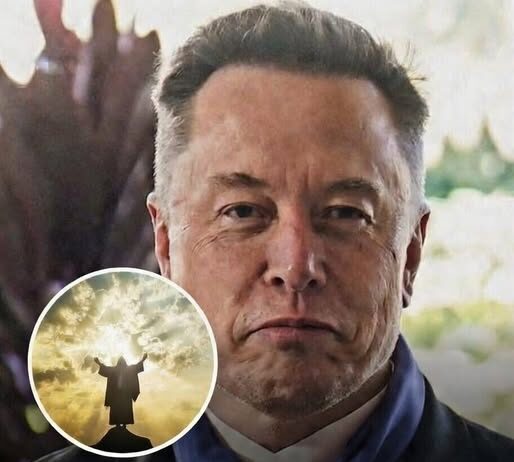
Elon Musk’s Brief Comment on Jesus Sparks Wide Debate About Faith and Ethics
A Simple Statement, A Global Reaction
Elon Musk has once again found himself at the center of public conversation. This time, however, the focus is not on technology, artificial intelligence, or space exploration.
Instead, attention has turned to a brief comment about faith. When asked who would “evangelize Elon Musk,” he responded, “I agree with the teachings of Jesus.”
The sentence was short, but its impact was immediate. Within hours, the remark circulated widely online, generating discussion across social media platforms and news outlets.
Some interpreted the comment as evidence of personal spiritual reflection. Others questioned whether there might be deeper motivations behind the statement.
The Power of a Few Words
In the digital age, even a single sentence can carry enormous weight. Public figures, especially those as influential as Musk, often see their remarks amplified and analyzed in detail.
This particular comment acted as a catalyst for varied interpretations. Admirers praised what they viewed as humility or openness.
Critics speculated about intent. Observers debated whether the statement marked a meaningful shift or simply reflected philosophical agreement.
The reaction itself underscored how sensitive discussions about belief and spirituality have become in modern public discourse.
Early Questions About Religion
Musk has previously spoken about questioning religion during his teenage years. Around age 14, he began examining large existential themes, including life, suffering, and the nature of the universe.
During different periods of his life, he has described himself as atheist or agnostic. At other times, he has expressed openness to belief, depending on what evidence might support it.
His approach to spirituality has not followed a rigid path. Instead, it appears shaped by inquiry, skepticism, and reflection.
That history adds context to his recent remark, suggesting that his relationship with faith has long been complex rather than static.
Renewed Respect for Ethical Teachings
In recent years, Musk has voiced appreciation for the moral framework found in the teachings of Jesus.
He has specifically referenced principles such as forgiveness, compassion, and the idea of “turning the other cheek.”
While he has clarified that he does not consider himself deeply religious in a traditional sense, he has acknowledged finding wisdom within those ethical foundations.
His reflections emphasize conduct rather than formal devotion.
Conduct Over Confession
Musk’s public comments suggest that his focus lies more in how people treat one another than in institutional religious identity.
He appears to separate the ethical message from formal doctrine, highlighting behavior as the central measure of belief.
This distinction forms the heart of the debate surrounding his statement. For some, faith is inseparable from worship and structured religious practice.
For others, moral principles stand independently of institutional affiliation.
Ethics Without Labels
Musk has indicated that appreciating Jesus’ teachings does not necessarily mean embracing organized religion.
Instead, he frames his agreement as alignment with ideas that promote kindness, mercy, responsibility, and restraint.
This perspective places emphasis on universal ethical values rather than denominational identity.
It reflects a philosophical lens through which spiritual ideas can be examined without adopting a formal religious label.
The Intersection of Science and Spirituality
As a prominent figure in scientific and technological innovation, Musk often approaches questions through logic and evidence.
His engagement with spiritual themes tends to mirror that analytical mindset.
Rather than expressing devotion in traditional language, he discusses belief in terms of reasoned alignment with moral teachings.
This blend of scientific inquiry and ethical appreciation creates a nuanced public image.
Public Reaction Reveals Broader Tensions
The strong online reactions reveal as much about society as they do about Musk himself.
Conversations about faith have become increasingly polarized. Expressions of belief are sometimes interpreted as political signals or strategic positioning.
Admiration can quickly meet suspicion. Reflection can be mistaken for calculation.
Yet spiritual questioning and ethical exploration are common human experiences, even among highly visible leaders.
Leadership and Existential Questions
Success and influence do not eliminate existential inquiry. In some cases, they may intensify it.
Public figures often face scrutiny not only for their decisions but also for their philosophical views.
Musk’s comment reopened discussion about how leaders navigate personal belief while operating within global platforms.
It also raised questions about how ethical frameworks shape decisions in positions of power.
Valuing Teachings Without Religious Identity
One of the broader conversations sparked by Musk’s remark centers on whether it is possible to value sacred teachings without adopting religious identity.
Many individuals, regardless of faith tradition, find wisdom in concepts such as love of neighbor, humility, and forgiveness.
Agreeing with those principles does not automatically imply adherence to doctrine.
This distinction resonates in a society where personal belief systems are increasingly individualized.
The Question of Authenticity
Public reaction often hinges on perceived authenticity. Observers want to know whether statements reflect genuine belief or strategic messaging.
However, determining sincerity from a single comment is rarely straightforward.
Faith conversations tend to unfold gradually, shaped by ongoing reflection rather than isolated remarks.
In that sense, Musk’s brief statement may represent one moment within a longer, evolving dialogue.
Actions as the Measure
Ultimately, many argue that the true significance of ethical alignment lies in behavior.
Stating agreement with moral teachings invites scrutiny about whether those principles appear in action.
Compassion, restraint, and responsibility are not abstract concepts. They manifest in decisions, leadership styles, and interpersonal conduct.
Public figures often find their values evaluated through the lens of their influence.
A Broader Cultural Reflection
The debate surrounding Musk’s comment reflects larger cultural questions about faith in modern society.
As traditional religious affiliation shifts, many people explore spirituality outside institutional frameworks.
Philosophical appreciation of sacred texts and teachings has become more common among those who do not identify with a specific denomination.
This evolving landscape shapes how statements about belief are interpreted and discussed.
The Enduring Appeal of Ethical Teachings
The teachings of Jesus have influenced ethical thought for centuries, extending beyond strictly religious contexts.
Principles such as forgiveness, compassion, and humility continue to resonate across cultures.
Musk’s acknowledgment of those ideas places him among many who recognize their enduring relevance.
The broader conversation lies not in the novelty of agreement, but in its practical implications.
A Conversation Still Unfolding
Faith, philosophy, and ethics rarely resolve themselves in a single exchange.
They develop over time, often privately and sometimes publicly.
Musk’s comment has reopened discussion rather than closed it.
Whether it signals deeper transformation or philosophical acknowledgment remains a matter of interpretation.
The Real Question
In the end, the central question may not be what someone claims to believe.
Instead, it may be how those beliefs, however defined, shape behavior and influence.
Curiosity about faith is not unusual, nor is it weakness.
Living according to ethical principles with consistency and integrity is the more enduring measure.