
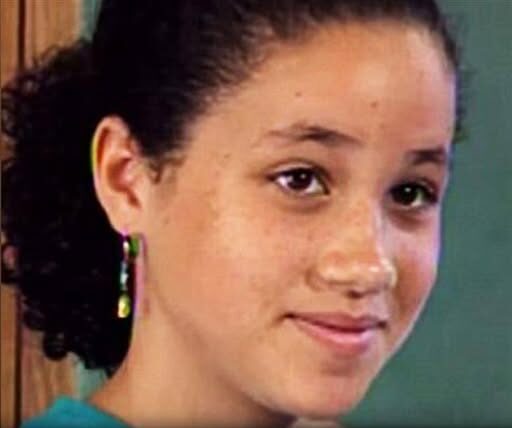
From Los Angeles Childhood to Global Spotlight: Meghan Markle’s Personal Journey
Early Life in Los Angeles
Long before royal titles and international recognition became part of her identity, Meghan Markle was a young girl growing up in Los Angeles, navigating questions about belonging and self-understanding.
Born to a Black mother and a white father, she often found herself reflecting on where she fit within the world around her. Her upbringing did not resemble a polished Hollywood storyline in progress. Instead, it was marked by ordinary routines and complex social dynamics.
“My dad is Caucasian and my mom is African American. I’m half Black and half white,” she once revealed.
That reality shaped much of her early perspective. From school environments to broader beauty standards, she frequently felt as though she existed between categories rather than firmly within one.
A Latchkey Childhood
As a child, Meghan described herself as a “latchkey kid,” returning home after school while her parents worked long hours to provide for the family.
Her mother, Doria Ragland, worked as a makeup artist. Her father, Thomas Markle Sr., built a career in television production.
“I grew up with a lot of fast food and also a lot of TV tray dinners,” she mentioned.
“Watching ‘Jeopardy!’ and enjoying many microwaveable kids’ meals… that was the norm.”
Her father later challenged aspects of her recollections, stating that his memories of her childhood differed, particularly regarding daily routines and meals.
He maintained that he either personally picked her up from school or arranged transportation when professional responsibilities prevented him from doing so himself.
View this post on Instagram
Public Assumptions and Early Identity Questions
One of the most formative influences on Meghan’s early years came from the reactions she and her mother encountered in public spaces.
Because many people assumed she was white, questions frequently arose about her relationship with her Black mother.
Doria once recalled being mistaken for a nanny while out with her daughter.
“I just recall my mom sharing stories about taking me to the grocery store and a woman asking, ‘Whose child is that?’ She would respond, ‘It’s my child.’ ‘No, you must be the nanny. Where’s her mom?’” Meghan recounted.
Such encounters left a lasting impression, reinforcing her awareness of how others perceived race and identity.

Family Changes and Support Networks
After her parents separated, Meghan spent time living with both of them until she was nine years old. Following that period, her father became her primary caregiver while her mother focused on advancing her career.
She lived full-time with her father until she left for college at eighteen.
Meanwhile, her mother relocated to a predominantly Black neighborhood outside the Valley. Although the move represented a significant transition, Doria found strength in a close-knit circle of supportive women.
“We had a wonderful network of women who truly assisted me in raising Meg. She was always so easy to connect with, friendly, and made friends effortlessly. She was a very empathetic child, quite mature,” Doria mentioned in one of the episodes of Meghan’s Netflix series.
Their bond, however, was not always conventional.
“I remember asking [her] if I felt like her mom,” her mother reminisced, “and she told me I felt more like her older, controlling sister.”
Meghan Markle is seen in unearthed family photos illustrating idyllic, happy childhood – far from modest upbringing she claimed, Duchess’s cousin Shawn Johnson reveals https://t.co/41b5VXt2L6 pic.twitter.com/HLFeDKNAiQ
— Daily Mail (@DailyMail) February 19, 2024
Teenage Insecurities and Academic Drive
Like many teenagers, Meghan experienced insecurity during adolescence. For her, those feelings were intensified by the sense of existing between racial categories.
“I was a big nerd growing up,” she admitted. “People don’t realize that about me. Like, I was not the attractive one. My identity was tied to being the smart one.”
Her academic focus became central to her self-image. Even at a young age, she demonstrated confidence in using her voice.
At just 11 years old, she challenged a sexist television commercial through a letter-writing effort, reflecting her early belief in advocacy.
Despite financial constraints, she remembers moments of gratitude rather than resentment.
“I grew up on the $4.99 salad bar at Sizzler,” she remembered. “I understood how hard my parents worked to make this possible… and I felt fortunate.
As a Girl Scout, whenever my troop celebrated with a dinner, we always ended up at the same salad bar or The Old Spaghetti Factory – it was simply what those families could afford.”
View this post on Instagram
A Turning Point in Opportunity
A major shift occurred when her father won $750,000 in the lottery. The financial change expanded her educational and professional opportunities.
Her half-brother later commented on how the win influenced her future direction.
“That money enabled [her] to attend the finest schools and receive top-notch training,” he shared. “[She] is relentless in pursuing her goals.”
From a young age, she articulated ambitious dreams. At 11, she wrote to her principal promising to make her school famous once she achieved success.
Her determination extended beyond academics. By 13, she worked multiple jobs, including babysitting and selling donuts at a stand called Little Orbit.
Her exposure to television production through her father’s work also sparked curiosity about acting.
Spending time on the set of Married… with Children, where Thomas Markle Sr. worked as a lighting director, introduced her to the entertainment industry.
“It was such a funny and twisted environment for a little girl in a Catholic school uniform to grow up in,” she chuckled.

Navigating Race and Career Challenges
As she pursued acting, questions about identity resurfaced.
“I didn’t feel black enough.”
Reflecting on her teenage years, she wrote, “My teenage years were even more challenging — struggling to find my place. As a biracial individual, I felt like I was caught in the middle.”
In early auditions, casting perceptions created additional obstacles.
“I wasn’t black enough for the roles meant for black actresses, and I wasn’t white enough for the white roles.”
By her twenties, she described internal pressure to match external expectations.
“It was a relentless struggle with myself… to be as cool/as trendy/as intelligent/as ‘whatever’ as everyone else.”
However, self-acceptance gradually emerged.
“Today, I turn 33. And I feel happy,” she shared. “Learning to be kind to yourself… to experience [happiness] — it requires time.”
From Television to Royal Life
Her breakthrough role as Rachel Zane on the television series Suits introduced her to a wider audience.
In 2016, she met Prince Harry. Their relationship progressed quickly, culminating in their 2018 wedding at Windsor Castle.
In 2021, they welcomed two children: Prince Archie and Princess Lilibet.
Royal life, however, brought new challenges alongside public attention.
A Postpartum Health Crisis
In April 2025, Meghan launched her podcast, Confessions of a Female Founder. During the first episode, she revealed a serious medical complication following childbirth.
Speaking with Whitney Wolfe Herd, she shared, “We both had very similar experiences — even though we were strangers at the time — with postpartum issues.”
“We both experienced preeclampsia. Postpartum preeclampsia. It’s incredibly rare and frightening.”
She continued, “In those quiet moments, you’re still trying to be there for others — primarily for your children — but those experiences are monumental.”
Whitney concurred: “I mean, it’s a matter of life or death, honestly.”
She later endured another deeply personal loss, revealing in an essay that she had experienced a miscarriage.
A Life Defined by Resilience
Meghan Markle’s path from a Los Angeles childhood to global prominence has unfolded in stages shaped by identity, ambition, and adversity.
Her early experiences with racial assumptions, financial limitations, and self-doubt influenced the resilience she later relied upon in the public eye.
From television sets and academic achievements to royal ceremonies and motherhood, her life has encompassed contrasting worlds.
Rather than fitting neatly into a traditional narrative, her story reflects complexity and persistence.
Now, as a public figure, media personality, and mother of two, she continues to share her experiences in her own voice.
The young girl who once questioned where she belonged has become a woman shaping her narrative on her own terms.