
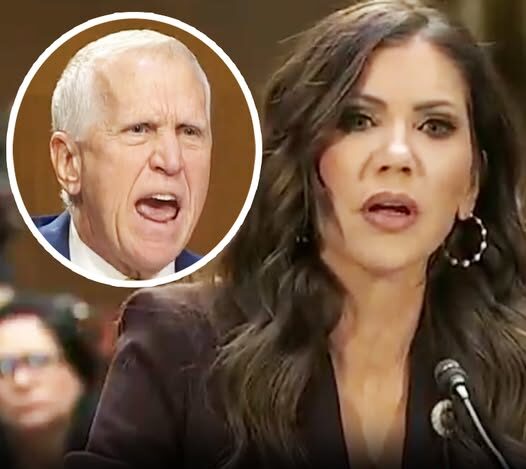
Senate Hearing Brings Renewed Scrutiny to Homeland Security Secretary Kristi Noem
Heated Exchange During Senate Session
Homeland Security Secretary Kristi Noem remained at the center of political debate following a tense Senate hearing on Tuesday. The session focused on immigration enforcement operations and the leadership of federal agencies responsible for overseeing those efforts.
During the hearing, Republican Senator Thom Tillis voiced strong criticism of Noem’s leadership and called for her resignation. His remarks referenced both recent immigration enforcement actions and controversy surrounding passages from her memoir.
The confrontation quickly became one of the most discussed moments of the hearing, highlighting ongoing disagreements among lawmakers over immigration policy and federal oversight.
Debate Over Immigration Enforcement Operations
A major focus of the hearing involved an immigration enforcement operation that took place earlier in the year in Minneapolis and Saint Paul, Minnesota.
The operation drew national attention and raised questions among lawmakers regarding planning, oversight, and the conduct of enforcement actions.
During the Senate session, several members sought clarification about how the operation was organized and how decisions were made during the event.
The discussion reflected broader concerns in Washington about the balance between immigration enforcement and accountability within federal agencies.
Attention Returns to Noem’s Memoir
In addition to questions about immigration policy, lawmakers also referenced a passage from Noem’s memoir titled “No Going Back.”
The book had already sparked significant public discussion before its release when excerpts circulated widely.
In the memoir, Noem described experiences from her time living and working on a family farm. The passage explained how certain situations involving animals required difficult decisions in a rural farming environment.
The account described challenges related to managing animals on the property and the responsibilities that sometimes accompany agricultural life.
These passages prompted strong reactions from both supporters and critics after they became widely known.
Public Reaction to the Memoir
Following the release of the excerpt, the memoir quickly became a topic of debate across social media and political discussions.
Some critics argued that the stories raised questions about leadership and judgment, while others said the experiences reflected the realities of rural life and farm management.
At the time, Noem addressed the controversy publicly and emphasized that farm life often involves complex decisions that may be difficult but necessary.
She explained that caring for animals and maintaining a working farm can sometimes involve challenging responsibilities.
The explanation did little to quiet the broader public conversation, and the memoir continued to generate discussion months after its release.
Senator Tillis Voices Strong Criticism
During the Senate hearing, Senator Thom Tillis brought up the memoir while evaluating Noem’s leadership as head of the Department of Homeland Security.
He argued that the situations described in the book reflected decisions that he believed demonstrated poor judgment.
“You should know that if you’re going out to a hunting lodge and you’re putting pheasants out and you’re putting dogs out, you don’t take a puppy out there — a 14-month-old dog is basically a teenager in dog years,” Tillis said.
He continued by questioning how the situation described in the memoir had been handled.
“You decided to kill that dog because you had not invested the appropriate time and training, and then you have the audacity to go into a book and say it’s a leadership lesson about tough choices.”
Linking the Memoir to Leadership Decisions
Tillis also referenced another situation mentioned in the memoir involving a farm animal that had become difficult to manage.
He used the example to argue that decisions described in the book reflected a pattern of judgment that concerned him.
“You are a farmer. You don’t castrate a goat; they behave badly. You should have probably done that before,” he said.
He then connected the discussion to the immigration enforcement operation in Minnesota, suggesting that leadership decisions in both situations raised similar concerns.
A Direct Call for Resignation
The senator concluded his remarks with a blunt assessment of Noem’s leadership.
“I’m giving you a performance evaluation here,” Tillis said during the hearing.
He stated that he had been repeatedly disappointed with decisions made during her time in office.
“Time after time after time, I’ve been disappointed. What we’ve seen is a disaster under your leadership.”
Based on his evaluation, Tillis called for Noem to step down from her position as Secretary of Homeland Security.
Political Reactions Continue
The exchange between the senator and the secretary quickly drew widespread attention across political circles.
Supporters of Noem argued that the criticism was politically motivated and emphasized her efforts in overseeing immigration enforcement operations.
Critics, meanwhile, pointed to the memoir controversy and the Minnesota operation as reasons to continue examining her leadership.
The differing reactions illustrated the sharp divisions that often arise when immigration policy and federal oversight are debated in Washington.
Immigration Policy Remains a Divisive Issue
The hearing took place during an ongoing national conversation about immigration enforcement and the role of federal agencies.
Lawmakers continue to debate how immigration operations should be conducted and what safeguards should exist to ensure accountability.
These discussions often involve questions about security, public safety, and the responsibilities of government institutions.
The Department of Homeland Security plays a central role in carrying out many of these policies, making its leadership a frequent subject of congressional oversight.
The Role of Congressional Oversight
Senate hearings such as the one held on Tuesday are part of the broader oversight process carried out by lawmakers.
Members of Congress regularly question officials from federal agencies in order to review policies, evaluate leadership decisions, and discuss future strategies.
These hearings can become highly contentious, particularly when the issues involved are politically sensitive.
The exchange between Senator Tillis and Secretary Noem reflected the intensity that often accompanies discussions about immigration enforcement.
A Continuing National Debate
The controversy surrounding Noem’s memoir and the immigration operation in Minnesota demonstrates how multiple issues can intersect in political debates.
Personal stories shared by public figures can become part of larger discussions about leadership and public responsibility.
At the same time, policy decisions involving federal agencies often generate scrutiny from both lawmakers and the public.
The Senate hearing brought these topics together in a single forum, leading to a heated exchange that captured national attention.
Ongoing Discussion in Washington
As immigration policy remains one of the most debated subjects in American politics, the leadership of the Department of Homeland Security continues to face close examination.
Lawmakers from both parties are expected to continue questioning officials about enforcement strategies, operational decisions, and the broader direction of federal immigration policy.
The events discussed during the hearing are likely to remain part of the political conversation as policymakers evaluate future approaches.
For now, the exchange between Senator Tillis and Secretary Noem highlights the ongoing challenges of navigating complex political and policy debates at the national level.
Holy shit, Senator Tillis just flash fried Kristi Noem over her failed leadership and FINALLY screamed at her for killing that puppy.
This was BRUTAL. 🔥🔥🔥 pic.twitter.com/UtILasodt0
— BrooklynDad_Defiant!☮️ (@mmpadellan) March 3, 2026