
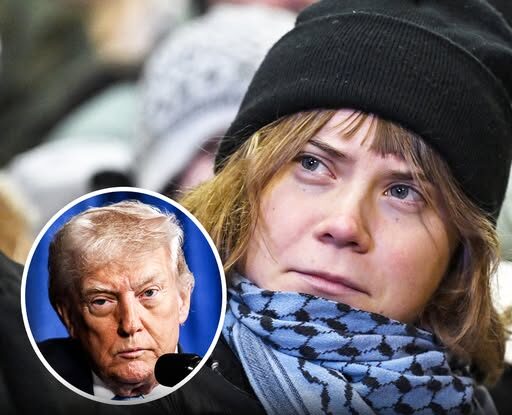
U.S.-Iran Ceasefire Sparks Debate After Greta Thunberg Criticizes Trump’s Wartime Rhetoric
Ceasefire announced after more than a month of conflict
The United States and Iran have moved into a two-week ceasefire after a conflict that had lasted for more than a month.
The agreement was presented as a major pause in hostilities and was described as a step that could help calm tensions well beyond the region.
On Tuesday, the ceasefire was publicly outlined with an emphasis on stability, diplomacy, and the reopening of an important shipping route.
Donald Trump said the arrangement would allow for a “complete, immediate, and safe opening of the Strait of Hormuz,” a development that could have wider economic importance because of the route’s role in global trade.
The Strait of Hormuz has long been viewed as a strategic passage with consequences far beyond the countries directly involved in any military dispute connected to it.
Because of that, any movement toward stability in the area is often watched closely not only for political reasons but also for its possible impact on international markets.
Trump outlines why the pause was accepted
Trump said the decision to suspend military action followed conversations involving Pakistan’s Prime Minister Shehbaz Sharif and Field Marshal Asim Munir.
He wrote on Truth Social, “Based on conversations with Prime Minister Shehbaz Sharif and Field Marshal Asim Munir, of Pakistan, and wherein they requested that I hold off the destructive force being sent tonight to Iran, and subject to the Islamic Republic of Iran agreeing to the COMPLETE, IMMEDIATE, and SAFE OPENING of the Strait of Hormuz, I agree to suspend the bombing and attack of Iran for a period of two weeks.”
The statement framed the ceasefire as conditional and linked the temporary halt in military action to both diplomatic contact and Iranian cooperation.
Trump later added that the United States had received a 10-point ceasefire proposal from Iran.
He described that proposal as a “workable basis on which to negotiate,” suggesting that significant progress had already been made on earlier disagreements.
In another Truth Social post, he wrote, “Almost all of the various points of past contention have been agreed to between the United States and Iran, but a two week period will allow the Agreement to be finalised and consummated.”
That message gave the impression that the next two weeks would be used not simply as a pause in fighting, but as a period for trying to turn a temporary truce into a more durable arrangement.
Details of Iran’s 10-point proposal
The ceasefire discussions drew additional attention after details of Iran’s proposal were revealed.
The list outlined a broad set of demands and conditions tied to military, economic, and regional issues.
One of the points stated that Iran would halt military action if the United States did the same.
Another called for the removal of all sanctions, making clear that Tehran wanted economic pressure brought to a complete end.
The proposal also said that U.S. forces should leave the region, signaling Iran’s continued opposition to an American military presence nearby.
Iran also insisted on keeping its nuclear program and maintaining its right to enrich uranium.
Control over the Strait of Hormuz was another major element, with Iran seeking authority over the route while also calling for shipping to reopen under agreed rules and guarantees.
The proposal included a demand for a legally binding promise that there would be no future attacks.
It also called for frozen Iranian funds overseas to be restored and for compensation tied to war damage.
The final point sought a United Nations-backed deal that would formalize the arrangement and make it enforceable on a global level.
Together, those ten points showed that the ceasefire was not merely about stopping immediate military operations, but about addressing wider disputes that have shaped U.S.-Iran relations for years.
Relief over the truce is mixed with criticism of earlier threats
Although the ceasefire brought relief to many observers, it did not erase the controversy surrounding Trump’s comments before the truce was announced.
In the lead-up to the agreement, he had set a Tuesday-night deadline for Iran to accept a deal.
He also warned of extreme consequences if that did not happen.
Those remarks triggered a fresh wave of criticism, including from people who had once supported him.
The reaction was not limited to political opponents.
Several public figures who had previously been associated with Trump or had defended him at different times openly challenged the tone of his statements.
Among those mentioned were influencer Alex Jones and former Fox News host Tucker Carlson, both of whom reportedly criticized the president over the severity of his rhetoric.
The backlash showed that even with a ceasefire in place, the language used before the deal remained a central part of the public conversation.
For many people following the conflict, the issue was no longer only about diplomacy and military decisions, but also about how leaders speak in moments of crisis.
Greta Thunberg joins the criticism
Greta Thunberg was among the figures who publicly condemned Trump’s remarks.
The 23-year-old activist posted an Instagram video on Tuesday shortly before news of the ceasefire became public.
In the video, she connected Trump’s comments to what she described as a wider failure to respond strongly enough to destruction and suffering linked to war.
Thunberg said, “The president of the United States just said that a whole civilisation will die tonight, never to be brought back again.”
She followed that with another statement: “And no one is reacting. This speaks for itself. What the f*** is anyone even doing at this point?”
Her remarks did not stop there.
She continued, “We have normalised genocide, total annihilation of entire people, the systematic destruction of the biosphere which we are all depending on to survive, and that corrupt, racist war criminals can act with complete impunity.”
Thunberg concluded her message with a call for action, saying, “But even though we have allowed far too much so far, it is not too late to say stop.”
The video quickly became part of the wider debate surrounding the ceasefire, not because it changed the agreement itself, but because it highlighted how sharply divided reactions had become over the language used during the crisis.
A long-running public clash between Trump and Thunberg
This was not the first time Thunberg and Trump had publicly opposed each other.
The article makes clear that the latest criticism came against the backdrop of an already established pattern of exchanges and disagreement between the two figures.
That history gave additional weight to her response, since it fit into a larger public conflict that has played out before.
At the same time, the timing of the video made it especially notable.
It was posted just before the ceasefire was announced, meaning her criticism came at one of the most tense points in the standoff.
The combination of a looming deadline, rising fears of a broader escalation, and then a sudden diplomatic pause gave her comments a particularly sharp context.
Whether Trump will respond directly remains unclear.
The article notes only that time will tell if he chooses to answer the activist publicly.
Even without an immediate reply, however, the exchange has already become part of the broader reaction to the ceasefire and to the rhetoric that surrounded it.
Why the response has drawn such attention
The reason Thunberg’s statement has received so much attention is not only because of who delivered it, but because it arrived at a moment when the world had been watching for signs of either escalation or restraint.
A ceasefire after more than a month of war would normally shift discussion toward de-escalation and the possibility of negotiation.
Instead, public attention has also remained fixed on the words used before the truce took hold.
That has created two parallel conversations.
One is about whether the ceasefire can hold and whether the two-week pause can be turned into something longer-lasting.
The other is about whether political leaders should face stronger criticism when they use severe language during wartime.
Thunberg’s intervention placed that second question at the center of the debate.
Her message suggested that the problem was not only one leader’s phrasing, but also what she sees as a broader public willingness to accept destructive rhetoric without strong resistance.
For supporters of her view, that made the video more than a reaction to a single statement.
For critics, it was another example of her using a global crisis to deliver a sweeping political message.
Either way, the reaction ensured that her remarks became part of the ongoing discussion around the ceasefire.
The next two weeks will be closely watched
With the ceasefire now in place, attention is turning toward what happens during the two-week period Trump described as necessary for a final agreement.
The success or failure of that process could determine whether the current pause remains temporary or becomes the foundation for a broader settlement.
The issues on the table are extensive, as shown by Iran’s 10-point proposal.
They touch on military activity, sanctions, regional presence, shipping access, nuclear policy, financial restrictions, compensation, and international enforcement.
That means the truce may have lowered immediate tensions, but it has not removed the deeper disputes that brought the two countries to this point.
Even so, the fact that both sides moved into a ceasefire after more than a month of conflict marks a significant change from the threats that came before it.
For now, the agreement has created an opening for diplomacy.
At the same time, the reaction from figures such as Greta Thunberg shows that public judgment of the conflict will not be based only on whether military action pauses, but also on how leaders conducted themselves during the most dangerous moments.
As the two-week window unfolds, both the diplomatic negotiations and the political fallout from earlier statements are likely to remain in focus.