
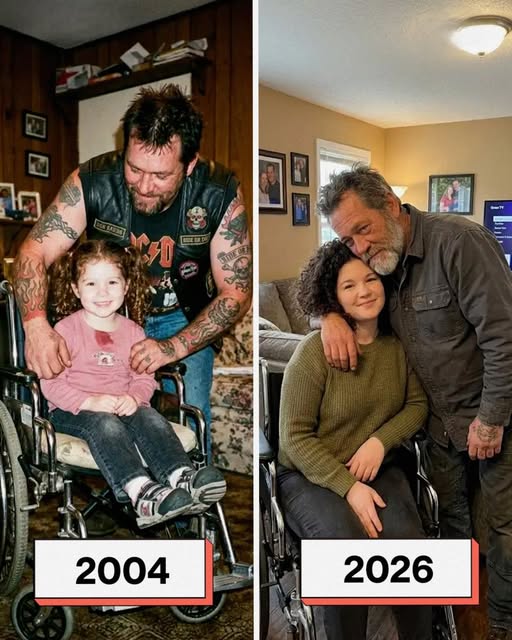
A Final Letter, a Hidden Truth, and the Long Road to Standing Again
The Silence After the Funeral
I was 26 when my uncle’s funeral ended and the house fell into a silence that felt permanent. The kind of quiet that doesn’t just fill a room — it settles into your bones.
Guests drifted away in soft clusters of sympathy. Casserole dishes sat untouched on the kitchen counter. The air still carried the faint scent of flowers and coffee.
That was when Mrs. Patel approached me.
Her eyes were swollen from crying. In her hands, she held a sealed envelope with my name written across the front in my uncle’s blunt, unmistakable handwriting.
“Your uncle asked me to give you this,” she said gently. “And to tell you he’s sorry.”
Sorry for what?
The Story I Thought I Knew
I hadn’t walked since I was four years old.
Most people hear that and assume my life began in a hospital room. But I had memories before that.
I remembered my mother, Lena, singing too loudly in the kitchen as she cooked. I remembered my father, Mark, coming home smelling like motor oil and peppermint gum. I remembered light-up sneakers, a purple sippy cup, and having strong opinions about everything.
Then there was the accident.
The version I grew up with was simple and clean: a car crash took my parents’ lives, and I survived. My spine did not.
After that, the state began discussing “appropriate placements.” A social worker named Karen stood beside my hospital bed with a clipboard and a carefully rehearsed smile.
“We’ll find a loving home,” she told me.
That was when my mother’s brother walked into the room.
Ray.
He had big hands, a permanent frown, and the kind of presence that made people pause mid-sentence.
“No,” he said firmly.
“Sir—” the social worker began.
“I’m taking her,” he said. “I’m not handing her to strangers. She’s mine.”
A Home Built From Determination
He didn’t have children. He didn’t have a partner. And he didn’t have experience raising a child with a spinal injury.
But he brought me home.
His small house smelled like coffee, motor oil, and something steady. It wasn’t fancy. It wasn’t designed for wheelchairs. But it became mine.
He learned everything the hard way.
He watched nurses carefully and copied what they did. He filled a beat-up notebook with instructions: how to reposition me without causing harm, how to check my skin, how to lift me like I was both heavy and fragile at once.
The first night I came home, his alarm went off every two hours.
He shuffled into my room, hair sticking up, eyes barely open.
“Pancake time,” he muttered, gently turning me to prevent pressure sores.
If I whimpered, he whispered, “I know. I got you, kiddo.”
He built a plywood ramp for the front door. It wasn’t beautiful, but it worked.
He argued with insurance companies on speakerphone while pacing the kitchen floor.
“No, she can’t ‘make do’ without a shower chair,” he snapped once. “You want to tell her that yourself?”
They didn’t.
The Everyday Acts That Changed Everything
When children stared at the park, he crouched beside me and said, “Her legs don’t listen to her brain. But she can beat you at cards.”
He braided my hair badly. He bought pads and mascara after watching online tutorials. He washed my hair in the kitchen sink, one hand steady beneath my neck.
When I cried about school dances or crowded spaces that weren’t built for me, he would look at me firmly and say, “You’re not less. You hear me? You’re not less.”
My world felt small at times. Mostly my room. Mostly what I could reach.
Ray made that room bigger.
He installed shelves at my height. Welded together a slightly crooked tablet stand in the garage. Built a planter box near the window because I once complained that cooking shows made me want fresh basil.
When I cried over the herbs growing for the first time, he panicked.
“Jesus, Hannah, you hate basil?”
“It’s perfect,” I sobbed.
The Diagnosis
Then he began to slow down.
He paused halfway up the stairs to catch his breath. He burned dinner twice in one week. His movements lost their usual certainty.
“I’m fine,” he insisted.
He was 53.
Mrs. Patel cornered him in the driveway one afternoon. “You see a doctor.”
He went.
He returned home with papers in his hand and a blank expression I had never seen before.
“Stage four,” he said quietly. “It’s everywhere.”
Hospice arrived soon after. Machines hummed softly in the background. Medication charts covered the refrigerator door.
The night before he died, he came into my room and lowered himself carefully into the chair beside my bed.
“You know you’re the best thing that ever happened to me, right?” he said.
“That’s kind of sad,” I tried to joke.
“Still true.”
“I don’t know what to do without you,” I whispered.
“You’re gonna live,” he said. “You hear me? You’re gonna live.”
He paused.
“I’m sorry,” he added quietly. “For things I should’ve told you.”
He kissed my forehead.
He died the next morning.
The Letter
After the funeral, I opened the envelope.
The first line read:
“Hannah, I’ve been lying to you your whole life. I can’t take this with me.”
He wrote about the night of the crash.
Not the version I had grown up believing.
My parents had brought my overnight bag to his house. They were planning to move to a new city.
“They said they weren’t taking you,” he wrote. “Said you’d be better off with me because they were a mess. I lost it.”
He described the argument. The words he had shouted. That my father was a coward. That my mother was selfish. That they were abandoning me.
“I knew your dad had been drinking,” he wrote. “I saw the bottle. I could’ve taken his keys. Called a cab. Told them to sleep it off. I didn’t. I let them drive away angry because I wanted to win.”
Twenty minutes later, police called.
“Car wrapped around a pole. They were gone. You weren’t.”
He admitted that when he first saw me in the hospital bed, he felt something he was ashamed of.
“At first, when I saw you in that hospital bed,” he wrote, “I looked at you and saw punishment. For my pride. For my temper. I’m ashamed to say that sometimes, in the beginning, I resented you. Not for anything you did. Because you were proof of what my anger cost.”
He said taking me home was the only right choice left.
Everything after that, he wrote, was an attempt to repay a debt he could never fully repay.
A Different Future
He revealed something else.
What I believed had been constant financial struggle had been careful protection. He had placed my parents’ life insurance in his name to prevent state interference. He worked overnight shifts as a lineman to keep us afloat.
The remainder, he wrote, had been placed into a trust for me.
“The lawyer’s card is in the envelope. I sold the house. Your life doesn’t have to stay the size of that room.”
The final lines were the hardest to read.
“If you can forgive me, do it for you. So you don’t spend your life carrying my ghost. If you can’t, I understand. I will love you either way. I always have. Even when I failed.”
Standing Again
A month later, after meetings with attorneys and paperwork I could barely process, I rolled into a rehabilitation center an hour away.
My physical therapist, Miguel, reviewed my chart carefully.
“This is going to be rough,” he said.
“I know,” I replied. “Someone worked really hard so I could be here. I’m not wasting it.”
They secured me into a harness suspended over a treadmill. My legs trembled under the unfamiliar demand.
“You okay?” Miguel asked.
I nodded, tears already forming.
“I’m just doing something my uncle wanted me to do.”
The machine started. My knees buckled. The harness caught me.
“Again,” I said.
We tried again.
Last week, for the first time since I was four years old, I stood with most of my weight supported by my own legs for several seconds.
I shook. I cried. It wasn’t graceful.
But I was upright.
I could feel the floor beneath me.
In my mind, I heard his voice: “You’re gonna live, kiddo.”
Forgiveness in Pieces
Do I forgive him?
Some days, the answer is no.
Some days, all I feel is anger at what his pride may have cost.
Other days, I remember rough hands steadying my shoulders. Badly braided hair. A planter box filled with basil. The words “You’re not less.”
And I realize forgiveness has been happening quietly, in pieces, for years.
He did not run from what happened that night.
He spent the rest of his life walking into it — one alarm clock, one insurance argument, one sink hair wash at a time.
He carried me as far as he could.
The rest is mine.