
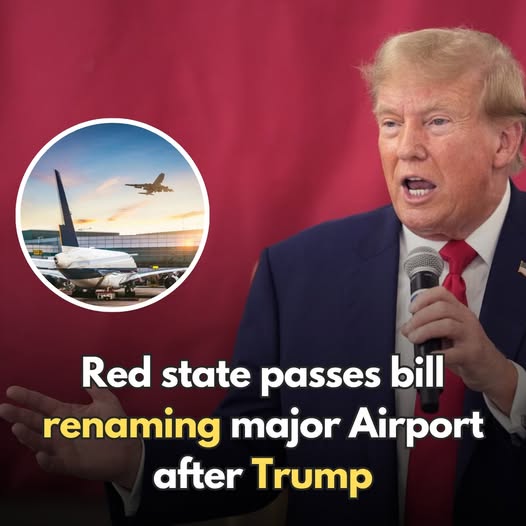
State Senate Approves Measure to Rename Palm Beach International Airport After President Trump
Senate Vote Sparks Extended Debate
The state Senate voted Thursday to approve legislation that would rename Palm Beach International Airport after President Donald Trump, igniting hours of debate over cost, timing, and precedent.
The measure passed on a 25-11 vote, reflecting a clear partisan divide as lawmakers weighed the broader implications of honoring a sitting president with a major commercial airport designation.
Supporters framed the proposal as a recognition of regional ties and historic achievement, while critics questioned the financial and symbolic impact of the decision.
Centralizing Airport Naming Authority
The legislation consolidates authority over naming major commercial service airports at the state level.
In addition to renaming one facility, the bill formalizes the official titles of several other airports across the state, most of which will retain their existing geographic names.
Palm Beach International Airport would be the only airport to receive a completely new designation under the measure.
The move marks a rare instance in modern U.S. history in which a sitting president would have a landmark of this scale named in his honor.
Supporters Emphasize Regional Ties
Republican lawmakers described the bill as a tribute to President Trump’s longstanding connection to the area.
“President Trump is a resident of this area,” said the bill’s sponsor, Republican Sen. Debbie Mayfield. “It’s an honor for me to present legislation to rename this airport after the first resident of our state to be elected president of the United States.”
Mayfield characterized the proposal as symbolic rather than partisan, emphasizing the president’s historical significance to the region.
Supporters also pointed to the president’s personal and business presence in Palm Beach County, including his ownership of Mar-a-Lago and multiple golf properties.
They argued that the renaming reflects both his local residency and his rise to national office.
Licensing Agreement and Cost Structure
Under the legislation, the renaming would take effect only after a licensing agreement is executed with the rights holder for the president’s name.
Mayfield explained that the agreement is structured to be royalty-free, allowing the county to use the name permanently without incurring ongoing fees.
The arrangement would cover signage, marketing materials, and merchandising tied to the airport’s new identity.
Supporters said the agreement ensures there would be no continuing financial burden related to the use of the name itself.
Financial Concerns Raised by Opponents
Democratic senators voiced strong opposition to the bill, citing an estimated $5.5 million in costs associated with updating signage, marketing materials, and other logistical changes.
“$5.5 million of our money, your taxpayer money, just to satisfy the fragile ego of our sitting president,” said Democratic Sen. Tina Polsky. “The county did not weigh in on this. Citizens did not weigh in on this decision.”
Opponents argued that the expenditure represents an unnecessary use of taxpayer funds for a largely symbolic gesture.
Some lawmakers also raised concerns about potential additional branding or administrative costs over time.
Dispute Over Initiative’s Origin
During debate, Polsky alleged that the president had personally requested the airport be renamed.
Mayfield firmly rejected that assertion.
“President Trump did not ask me—matter of fact, I haven’t even spoken to him about this bill. These discussions have been negotiated solely between the county and the relevant entities,” Mayfield said.
She maintained that the proposal originated locally and was not directed by federal officials.
Legislative Process and Amendments
The Senate initially reviewed SB 706 but later substituted the House version, HB 919, due to nearly identical language between the two measures.
The substitution ensures that both chambers pass the same text, streamlining the process before the bill reaches the governor.
Before the substitution, the Senate rejected several Democratic amendments.
Those proposed changes sought to delay the renaming until the president leaves office, require a local referendum in Palm Beach County, and mandate that the airport’s FAA code, PBI, remain unchanged.
Republican lawmakers opposed the amendments, stating that the state has a history of naming landmarks after influential figures and that the bill establishes a consistent framework for airport naming.
Debate Over Political Symbolism
The discussion extended beyond logistics into broader questions of political symbolism.
Critics argued that naming a major airport after a sitting president could be perceived as partisan or premature.
They noted that many public facilities are typically named after individuals posthumously or after they leave office.
Supporters countered that the measure reflects civic pride and recognizes a resident who achieved the nation’s highest office.
Both sides acknowledged that comparable examples involving airports of similar prominence are uncommon.
Implementation Timeline
If signed into law by Governor Ron DeSantis, the renaming would take effect July 1, 2026.
Government records created on or after that date would be required to reflect the new airport name.
Lawmakers emphasized that the change would not alter airport operations, staffing, or management structures.
The renaming is described as primarily ceremonial, focused on branding rather than structural changes.
Local Agreements and Naming Rights
The Palm Beach County Commission previously engaged in discussions with the Trump organization to secure perpetual naming rights.
According to supporters, the agreement ensures that the county retains authority to use the president’s name for official purposes without paying royalties.
Proponents argued that this structure protects taxpayers from recurring expenses tied to licensing.
They characterized the arrangement as fiscally responsible within the scope of the one-time rebranding cost.
Precedent and Historical Context
Supporters of the legislation cited examples of highways, public buildings, and landmarks named after prominent political figures.
They contended that the renaming aligns with established practices of honoring individuals who have shaped history.
Opponents maintained that the timing sets an unusual precedent by honoring a president while he remains in public life.
The debate underscored differing views about when and how public recognition should occur.
Majority Support Secures Passage
Despite vocal opposition, the Senate’s 25-11 vote reflects the Republican majority’s support for the measure.
Democratic senators continued to question the financial prudence and optics of the decision during closing arguments.
Mayfield reiterated that the proposal reflects regional heritage rather than political allegiance.
She highlighted the president’s decades-long presence in Palm Beach County and described the renaming as recognition of a historic milestone for the community.
Next Steps and Broader Impact
If the governor signs HB 919, Palm Beach International Airport will become one of a small number of American landmarks named after living figures.
Airport administrators and local officials would then begin implementing logistical updates, including signage replacement and marketing revisions.
Coordination with federal aviation authorities would ensure that official records align with the new designation.
Supporters expect the transition process to proceed smoothly once authorized.
Opponents have indicated that debate over the decision may continue at both local and national levels.
A Symbolic Shift for a Major Transportation Hub
The renaming proposal illustrates the intersection of politics, regional identity, and public finance.
For supporters, the change represents acknowledgment of a local resident who rose to national prominence.
For critics, it raises questions about fiscal responsibility and the appropriateness of honoring a sitting president.
The legislation also establishes a standardized process for naming major airports statewide, potentially shaping future decisions.
As the measure advances to Governor DeSantis for consideration, the fate of Palm Beach International Airport’s name now rests with the executive branch.
The outcome will determine whether one of the state’s busiest transportation hubs undergoes a symbolic transformation in 2026.
Regardless of the final decision, the Senate’s vote marks a significant chapter in the ongoing conversation about civic recognition and political symbolism in public spaces.