
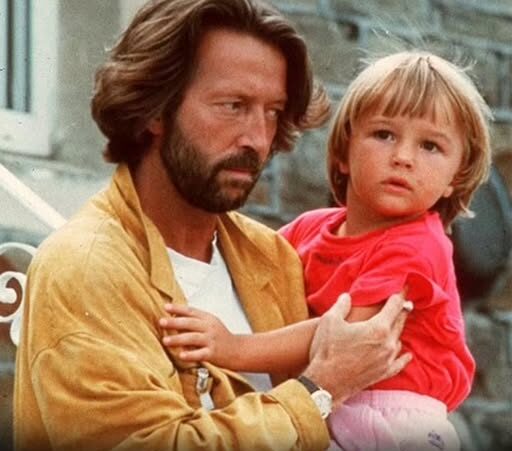
Eric Clapton’s Life Changed Forever After the Loss of His Young Son
A deeply personal chapter in Eric Clapton’s life
Eric Clapton has spent decades as one of the most recognizable figures in music, but behind his long career stands a personal story marked by profound loss.
Among the most painful moments in his life was the death of his young son, Conor, in 1991. The tragedy left a lasting impact on the artist and shaped the way he moved forward in the years that followed.
Conor was four years old when he died on March 20, 1991, in New York City. The loss became one of the defining events of Clapton’s life, not only because of the heartbreak itself, but because it came during a time when he was looking ahead to building a closer bond with his son.
At the time, Conor was in New York with his mother, Italian actress Lory Del Santo. He had traveled there during Easter so he could spend time with Clapton.
What should have been a meaningful family visit instead became a moment that changed everything.
A father looking toward the future
In the days before the tragedy, Clapton had begun to imagine a different future for his relationship with Conor.
He was no longer simply thinking about occasional visits. He was beginning to consider a larger role in his son’s everyday life.
According to the details shared in the account, Clapton had hopes of bringing both Conor and Lory Del Santo to London so they could live closer to him. That plan reflected a growing commitment and a sense that he wanted to be more present as a father.
The timing makes the story especially emotional. Just as he was preparing to become more involved, that possibility was suddenly taken away.
The shift in his thinking had become especially clear the day before Conor died.
View this post on Instagram
A special day together
On March 19, 1991, Clapton and Conor spent a full day together at the circus on Long Island.
It was described as their first full day alone together, which gave the outing extra meaning. It was not just a casual trip, but a chance for father and son to share time and create memories.
Clapton had bought the circus tickets himself and looked forward to making the day special. The visit appears to have left a strong impression on both of them.
Conor returned excited by what he had seen, talking about the clowns and elephants after the trip. For Clapton, the day seems to have highlighted what he had been missing and what he wanted to change moving forward.
Biographer Philip Norman later described the importance of that moment in Clapton’s life. He wrote that the afternoon helped Clapton recognize how much he wanted to be a more active father.
That realization gave the day unusual emotional weight. It was a joyful experience, but it also stood at the edge of a future that never had the chance to unfold.
Plans that were never fulfilled
Clapton had already made plans for the following day as well.
He had promised Conor a visit to the Bronx Zoo, followed by lunch at a nearby Italian restaurant. These were simple plans, but they reflected something important: he intended to keep building time around his son.
That promise became one of the most heartbreaking parts of the story. It represented the ordinary future of a father and child spending time together, something warm and hopeful that was interrupted too soon.
In stories of public figures, tragedy is often remembered through headlines. In this case, what also stands out are those ordinary details of family life: a circus trip, plans for the zoo, lunch together, and a father starting to make room in his life for more connection.
Those small plans made the loss feel even more devastating.
The day everything changed
On the morning of March 20, 1991, Conor died in a tragic accident in Manhattan.
The event happened while he was with his mother at an apartment in New York. The suddenness of the moment left everyone involved in shock.
Lory Del Santo later recalled how quickly events unfolded that morning. Her account reflected the deep pain and disbelief that followed.
For Clapton, the news was life-altering. He had been preparing to pick Conor up, but instead he was faced with an unimaginable reality.
He rushed to the scene after learning what had happened. The emotional impact was immediate and overwhelming.
Lory Del Santo later described his reaction as one of total shock. In her recollection, he appeared frozen by the news, struggling to process what had taken place.
The tragedy did not only mark the loss of a child. It also brought a decisive end to the relationship between Clapton and Del Santo, according to her own account.
The event permanently changed the course of both of their lives.
View this post on Instagram
A loss felt far beyond the public eye
Although Eric Clapton was known around the world as a musician, the pain he faced in the aftermath was not about fame or career.
It was about the death of his son and the sudden collapse of the future he had begun to imagine.
Conor was just weeks away from his fifth birthday. That detail added another layer of heartbreak to an already devastating loss.
The days that followed were marked by grief, silence, and mourning. Clapton stepped away from public life as he tried to absorb what had happened.
He brought his son’s body home from New York, accompanied by members of Conor’s maternal family from Italy, so funeral arrangements could be made.
The funeral took place in Ripley, the village in Surrey, England, where Clapton had grown up. Located about 25 miles southwest of London, Ripley had long been a deeply personal place for him.
By laying Conor to rest there, the funeral connected the child’s memory to Clapton’s own roots. It was a private and emotional farewell in a place filled with family meaning.
Withdrawal from public life
After the funeral, Clapton retreated from the public eye.
Overwhelmed by grief, he went to Antigua, where he rented a small cottage and remained for nearly a year. During that period, he had very little contact with the outside world.
Rather than returning quickly to ordinary public life, he chose isolation. It was a way of stepping back from everything while trying to find some path through the pain.
He later described how simple and quiet that period became. His daily life revolved around solitude, reflection, and music.
He spent much of his time with a small Spanish string guitar, playing for hours while living in near seclusion. That instrument became a companion during one of the darkest stretches of his life.
The image of a world-famous musician withdrawing almost completely from view and spending day after day with a guitar in a small cottage captures the depth of the grief he was carrying.
Music as a way to survive grief
For Clapton, music became more than a profession during that time. It became a way to endure sorrow and move through it little by little.
He explained that he played and rewrote songs repeatedly, returning to them again and again as though the process itself helped him remain afloat.
This repetition was not about perfection. It was about expression and emotional release.
He said he continued rewriting and reperforming the material until he felt he had made some movement back toward the surface of his own life.
That long period of immersion in music eventually gave rise to one of the most personal songs associated with his career.
Clapton co-wrote
Tears in Heaven
with Will Jennings. Originally created for a film soundtrack, the song became one of the clearest artistic expressions of his grief.
Its emotional power came from the personal loss behind it. For many listeners, the song became inseparable from the story of Conor.
It allowed Clapton to channel sorrow into something lasting, transforming private pain into a work that resonated with audiences around the world.
A letter that arrived too late
Another heartbreaking detail emerged in the days after Conor’s death.
Shortly before the accident, Conor had written his first-ever letter to his father with help from his mother. The message was simple and affectionate.
It had been mailed to Clapton’s home in London, but it did not arrive until after Conor had died.
That timing made the letter especially painful. What should have been a sweet childhood message instead became a lasting reminder of what had been lost.
Lory Del Santo later described the moment when Clapton received the letter after the funeral. It remained one of the most unforgettable memories connected to that period.
The significance of the letter lies not in its length, but in what it represented. It was a child’s direct expression of love, reaching its destination only after the chance to respond had vanished.
In many ways, the letter symbolized everything that made the tragedy so difficult to absorb: the innocence of the child, the closeness that had begun to grow, and the future that was no longer possible.

PA/PA Images via Getty Images
The lasting meaning of Conor’s story
Over time, the loss of Conor became one of the most widely remembered personal chapters in Eric Clapton’s life.
It remained part of the public understanding of him not because of celebrity curiosity alone, but because it touched on something universal: the fragility of family life and the pain of sudden loss.
The story continues to resonate because it is not only about tragedy. It is also about recognition, love, and unfinished plans.
Clapton had reached a point where he wanted to become more present. He had begun to picture a stronger relationship with his son. He had made simple plans and personal promises. He had started to look toward a more connected future.
All of that gave the loss a particularly painful dimension.
It was not simply the ending of a life. It was also the ending of a beginning.
A memory carried through life and music
More than three decades later, this chapter remains central to Clapton’s story.
It affected his personal life, his emotional world, and his creative path. His withdrawal from public life, his year in Antigua, and the music that followed all reflected the depth of that experience.
What remains especially moving is how many of the details are rooted in ordinary family moments. A day at the circus. Plans for the zoo. A letter from a child. A father trying to build something stronger.
Those details are what give the story its enduring emotional force.
For Eric Clapton, the loss of Conor was not a passing tragedy tied to one moment in time. It became part of his life’s history and part of the music that carried his feelings into the world.
The story remains heartbreaking because it speaks not only to grief, but also to love, intention, and the painful distance between what was hoped for and what became reality.
In the end, the memory of Conor remained with Clapton not only in sorrow, but also in the work, reflection, and emotional honesty that followed. That is why the story continues to be remembered with such sadness and such care.